
Full resolution (TIFF) - On this page / på denna sida - Introduction
<< prev. page << föreg. sida << >> nästa sida >> next page >>
Below is the raw OCR text
from the above scanned image.
Do you see an error? Proofread the page now!
Här nedan syns maskintolkade texten från faksimilbilden ovan.
Ser du något fel? Korrekturläs sidan nu!
This page has been proofread at least once.
(diff)
(history)
Denna sida har korrekturlästs minst en gång.
(skillnad)
(historik)
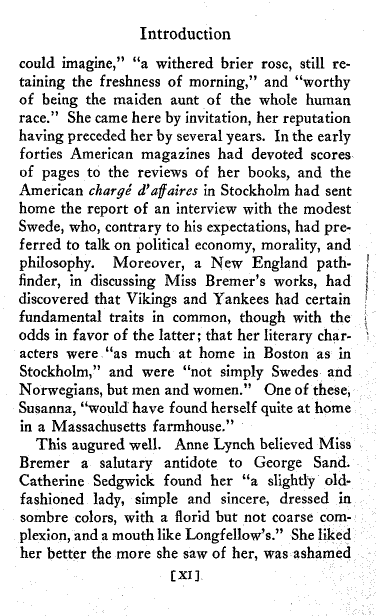
could imagine,” “a withered brier rose, still
retaining the freshness of morning,” and “worthy
of being the maiden aunt of the whole human
race.” She came here by invitation, her reputation
having preceded her by several years. In the early
forties American magazines had devoted scores
of pages to the reviews of her books, and the
American chargé d’affaires in Stockholm had sent
home the report of an interview with the modest
Swede, who, contrary to his expectations, had
preferred to talk on political economy, morality, and
philosophy. Moreover, a New England pathfinder,
in discussing Miss Bremer’s works, had
discovered that Vikings and Yankees had certain
fundamental traits in common, though with the
odds in favor of the latter; that her literary
characters were “as much at home in Boston as in
Stockholm,” and were “not simply Swedes and
Norwegians, but men and women.” One of these,
Susanna, “would have found herself quite at home
in a Massachusetts farmhouse.”
This augured well. Anne Lynch believed Miss
Bremer a salutary antidote to George Sand.
Catherine Sedgwick found her “a slightly
old-fashioned lady, simple and sincere, dressed in
sombre colors, with a florid but not coarse
complexion, and a mouth like Longfellow’s.” She liked
her better the more she saw of her, was ashamed
<< prev. page << föreg. sida << >> nästa sida >> next page >>

