
Full resolution (TIFF) - On this page / på denna sida - Introduction
<< prev. page << föreg. sida << >> nästa sida >> next page >>
Below is the raw OCR text
from the above scanned image.
Do you see an error? Proofread the page now!
Här nedan syns maskintolkade texten från faksimilbilden ovan.
Ser du något fel? Korrekturläs sidan nu!
This page has been proofread at least once.
(diff)
(history)
Denna sida har korrekturlästs minst en gång.
(skillnad)
(historik)
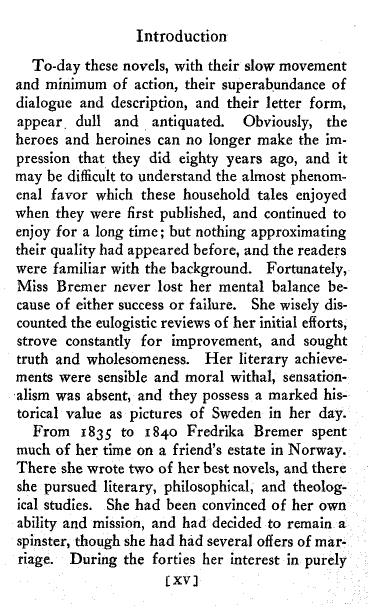
To-day these novels, with their slow movement
and minimum of action, their superabundance of
dialogue and description, and their letter form,
appear dull and antiquated. Obviously, the
heroes and heroines can no longer make the
impression that they did eighty years ago, and it
may be difficult to understand the almost phenomenal
favor which these household tales enjoyed
when they were first published, and continued to
enjoy for a long time; but nothing approximating
their quality had appeared before, and the readers
were familiar with the background. Fortunately,
Miss Bremer never lost her mental balance because
of either success or failure. She wisely discounted
the eulogistic reviews of her initial efforts,
strove constantly for improvement, and sought
truth and wholesomeness. Her literary achievements
were sensible and moral withal, sensationalism
was absent, and they possess a marked historical
value as pictures of Sweden in her day.
From 1835 to 1840 Fredrika Bremer spent
much of her time on a friend’s estate in Norway.
There she wrote two of her best novels, and there
she pursued literary, philosophical, and theological
studies. She had been convinced of her own
ability and mission, and had decided to remain a
spinster, though she had had several offers of
marriage. During the forties her interest in purely
<< prev. page << föreg. sida << >> nästa sida >> next page >>

