Full resolution (JPEG) - On this page / på denna sida - Sidor ...
<< prev. page << föreg. sida << >> nästa sida >> next page >>
Below is the raw OCR text
from the above scanned image.
Do you see an error? Proofread the page now!
Här nedan syns maskintolkade texten från faksimilbilden ovan.
Ser du något fel? Korrekturläs sidan nu!
This page has never been proofread. / Denna sida har aldrig korrekturlästs.
54
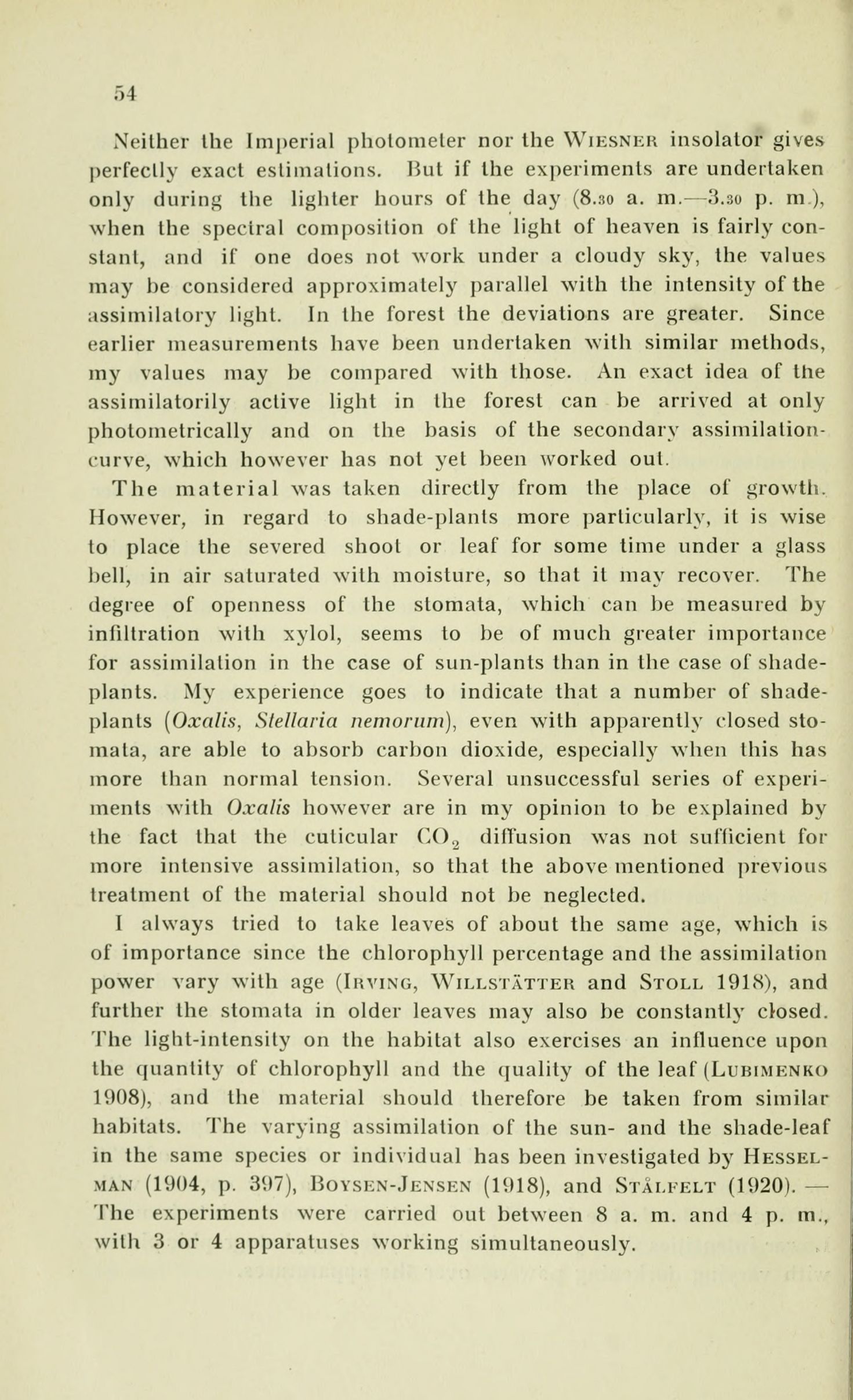
Neither the Imperial photometer nor the WIESNER insolator gives
perfectly exact estimations. But if the experiments are undertaken
only during the lighter hours of the day (8.50 a. m.—3.30 p. m.),
when the speciral composition of the light of heaven is fairly con-
stant, and if one does not work under a cloudy sky, the values
may be considered approximately parallel with the intensity of the
assimilatory light. In the forest the deviations are greater. Since
earlier measurements have been undertaken with similar methods,
my values may be compared with those. An exact idea of the
assimilatorily active light in the forest can be arrived at only
photometrically and on the basis of the secondary assimilation-
curve, which however has not yet been worked out.
The material was taken directly from the place of growth.
However, in regard to shade-plants more particularly, it is wise
to place the severed shoot or leaf for some time under a glass
bell, in air saturated with moisture, so that it may recover. The
degree of openness of the stomata, which can be measured by
infiltration with xylol, seems to be of much greater importance
for assimilation in the case of sun-plants than in the case of shade-
plants. My experience goes to indicate that a number of shade-
plants (Oxalis, Stellaria nemorum), even with apparently closed sto-
mata, are able to absorb carbon dioxide, especially when this has
more than normal tension. Several unsuccessful series of experi-
ments with Oxalis however are in my opinion to be explained by
the fact that the cuticular CO, diffusion was not sufficient for
more intensive assimilation, so that the above mentioned previous
treatment of the material should not be neglected.
I always tried to take leaves of about the same age, which is
of importance since the chlorophyll percentage and the assimilation
power vary with age (IRVING, WILLSTÄTTER and STOLL 1918), and
further the stomata in older leaves may also be constantly closed.
The light-intensity on the habitat also exercises an influence upon
the quantity of chlorophyll and the quality of the leaf (LUBIMENKO
1908) and the material should therefore be taken from similar
habitats. The varying assimilation of the sun- and the shade-leaf
in the same species or individual has been investigated by HESSEL-
MAN (1904, p. 397), BovsEN-JENSEN (1918), and STÄLFELT (1920). —
The experiments were carried out between 8 a. m. and 4 p. m,,
D
with 3 or 4 apparatuses working simultaneously.
<< prev. page << föreg. sida << >> nästa sida >> next page >>