
Full resolution (JPEG) - On this page / på denna sida - Sidor ...
<< prev. page << föreg. sida << >> nästa sida >> next page >>
Below is the raw OCR text
from the above scanned image.
Do you see an error? Proofread the page now!
Här nedan syns maskintolkade texten från faksimilbilden ovan.
Ser du något fel? Korrekturläs sidan nu!
This page has never been proofread. / Denna sida har aldrig korrekturlästs.
the female gametophyte in nolana
375
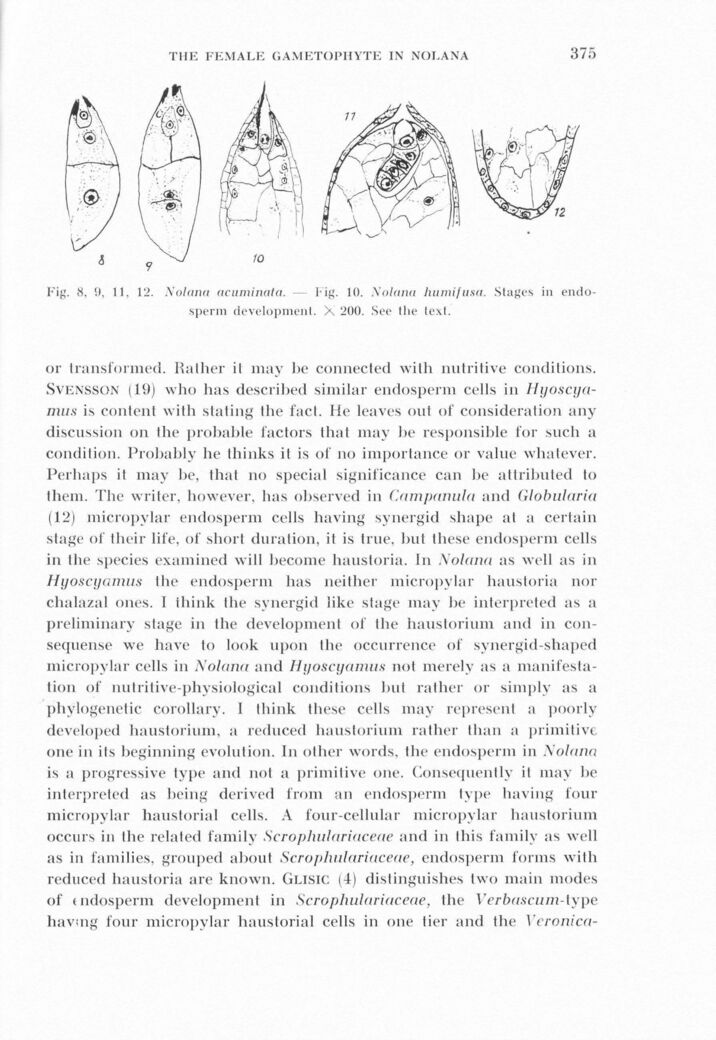
Fig. 8, 9, 11. 12. Solana acuminata. — Fig. 10. Xolana humifusa. Stages in
endosperm development. X 200. See the text.
or Iransformed. Rather il may he connected with nutritive conditions.
Svensson (19) who has described similar endosperm cells in
Hyoscya-mus is content with stating the fact. He leaves out of consideration any
discussion on the probable factors that may be responsible for such a
condition. Probably he thinks it is of no importance or value whatever.
Perhaps il may be, that no special significance can be attributed to
them. The writer, however, lias observed in Campanula and Globularia
(12) micropvlar endosperm cells having synergid shape at a certain
stage of their life, of short duration, il is true, but these endosperm cells
in the species examined will become haustoria. In Nol ana as well as in
Hyoscyamns Ihe endosperm has neither micropvlar hausloria nor
chalazal ones. 1 think the synergid like stage may be interpreted as a
preliminary stage in the development of the haustorium and in
con-sequense we have to look upon the occurrence of synergid-shaped
micropvlar cells in Nolana and Hyoscyamns not merely as a
manifestation of nutritive-physiological conditions but rather or simply as a
phylogenetic corollary. I think these cells may represent a poorly
developed haustorium, a reduced haustorium rather than a primitive
one in ils beginning evolution. In other words, the endosperm in Xolana
is a progressive type and not a primitive one. Consequently i I may be
interpreted as being derived from an endosperm type having four
micropvlar haustorial cells. A four-cellular micropvlar haustorium
occurs in Ihe related family Scrophulariaceae and in Ibis family as well
as in families, grouped about Scrophulariaceae, endosperm forms with
reduced haustoria are known. Glisic (4) distinguishes two main modes
of (ndosperm development in Scrophulariaceae, the Verbascum-lype
having four micropvlar haustorial cells in one tier and the Veronica-
<< prev. page << föreg. sida << >> nästa sida >> next page >>


