
Full resolution (JPEG) - On this page / på denna sida - I. Introductory Lecture.—The Country and its Inhabitants in the Heathen Period up to 1000 A.D. - § 6. Second Period of the Iron Age
<< prev. page << föreg. sida << >> nästa sida >> next page >>
Below is the raw OCR text
from the above scanned image.
Do you see an error? Proofread the page now!
Här nedan syns maskintolkade texten från faksimilbilden ovan.
Ser du något fel? Korrekturläs sidan nu!
This page has never been proofread. / Denna sida har aldrig korrekturlästs.
22 I. THE COUNTRY AND PEOPLE.
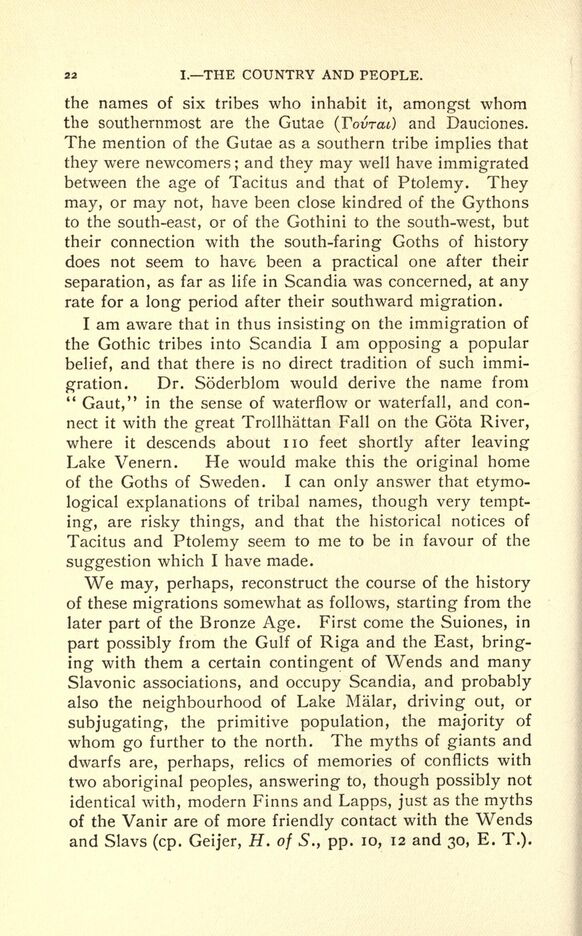
the names of six tribes who inhabit it, amongst whom
the southernmost are the Gutae (Tovrat,) and Dauciones.
The mention of the Gutae as a southern tribe implies that
they were newcomers ;
and they may well have immigrated
between the age of Tacitus and that of Ptolemy. They
may, or may not, have been close kindred of the Gythons
to the south-east, or of the Gothini to the south-west, but
their connection with the south-faring Goths of history
does not seem to have been a practical one after their
separation, as far as life in Scandia was concerned, at any
rate for a long period after their southward migration.
I am aware that in thus insisting on the immigration of
the Gothic tribes into Scandia I am opposing a popular
belief, and that there is no direct tradition of such immi
gration. Dr. Soderblom would derive the name from
"
Gaut," in the sense of waterflow or waterfall, and con
nect it with the great Trollhattan Fall on the Gota River,
where it descends about no feet shortly after leaving
Lake Venern. He would make this the original home
of the Goths of Sweden. I can only answer that etymo
logical explanations of tribal names, though very tempt
ing, are risky things, and that the historical notices of
Tacitus and Ptolemy seem to me to be in favour of the
suggestion which I have made.
We may, perhaps, reconstruct the course of the history
of these migrations somewhat as follows, starting from the
later part of the Bronze Age. First come the Suiones, in
part possibly from the Gulf of Riga and the East, bring
ing with them a certain contingent of Wends and many
Slavonic associations, and occupy Scandia, and probably
also the neighbourhood of Lake Malar, driving out, or
subjugating, the primitive population, the majority of
whom go further to the north. The myths of giants and
dwarfs are, perhaps, relics of memories of conflicts with
two aboriginal peoples, answering to, though possibly not
identical with, modern Finns and Lapps, just as the myths
of the Vanir are of more friendly contact with the Wends
and Slavs (cp. Geijer, H. of S., pp. 10, 12 and 30, E. T.).
<< prev. page << föreg. sida << >> nästa sida >> next page >>


