
Full resolution (JPEG) - On this page / på denna sida - II. The Conversion of Sweden (830—1130 A.D.)
<< prev. page << föreg. sida << >> nästa sida >> next page >>
Below is the raw OCR text
from the above scanned image.
Do you see an error? Proofread the page now!
Här nedan syns maskintolkade texten från faksimilbilden ovan.
Ser du något fel? Korrekturläs sidan nu!
This page has never been proofread. / Denna sida har aldrig korrekturlästs.
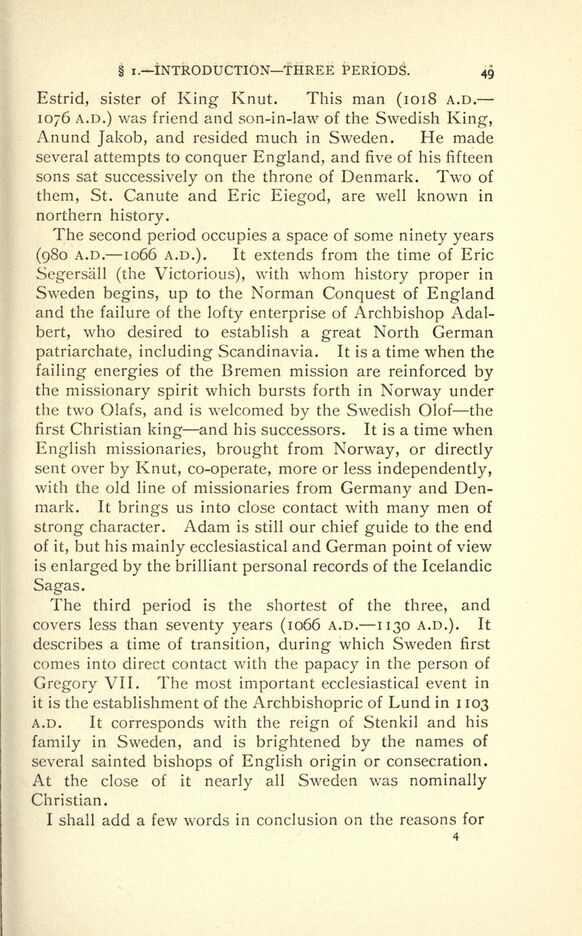
i. INTRODUCTION THREE PERIODS. 49
Estrid, sister of King Knut. This man (1018 A.D.
1076 A.D.) was friend and son-in-law of the Swedish King,
Anund Jakob, and resided much in Sweden. He made
several attempts to conquer England, and five of his fifteen
sons sat successively on the throne of Denmark. Two of
them, St. Canute and Eric Eiegod, are well known in
northern history.
The second period occupies a space of some ninety years
(980 A.D. 1066 A.D.). It extends from the time of Eric
Segersall (the Victorious), with whom history proper in
Sweden begins, up to the Norman Conquest of England
and the failure of the lofty enterprise of Archbishop Adal
bert, who desired to establish a great North German
patriarchate, including Scandinavia. It is a time when the
failing energies of the Bremen mission are reinforced by
the missionary spirit which bursts forth in Norway under
the twr
o Olafs, and is welcomed by the Swedish Olof the
first Christian king and his successors. It is a time when
English missionaries, brought from Norway, or directly
sent over by Knut, co-operate, more or less independently,
with the old line of missionaries from Germany and Den
mark. It brings us into close contact with many men of
strong character. Adam is still our chief guide to the end
of it, but his mainly ecclesiastical and German point of view
is enlarged by the brilliant personal records of the Icelandic
Sagas.
The third period is the shortest of the three, and
covers less than seventy years (1066 A.D. 1130 A.D.). It
describes a time of transition, during which Sweden first
comes into direct contact with the papacy in the person of
Gregory VII. The most important ecclesiastical event in
it is the establishment of the Archbishopric of Lund in 1 103
A.D. It corresponds with the reign of Stenkil and his
family in Sweden, and is brightened by the names of
several sainted bishops of English origin or consecration.
At the close of it nearly all Sweden was nominally
Christian.
I shall add a few words in conclusion on the reasons for
4
<< prev. page << föreg. sida << >> nästa sida >> next page >>


