
Full resolution (JPEG) - On this page / på denna sida - Pages ...
<< prev. page << föreg. sida << >> nästa sida >> next page >>
Below is the raw OCR text
from the above scanned image.
Do you see an error? Proofread the page now!
Här nedan syns maskintolkade texten från faksimilbilden ovan.
Ser du något fel? Korrekturläs sidan nu!
This page has never been proofread. / Denna sida har aldrig korrekturlästs.
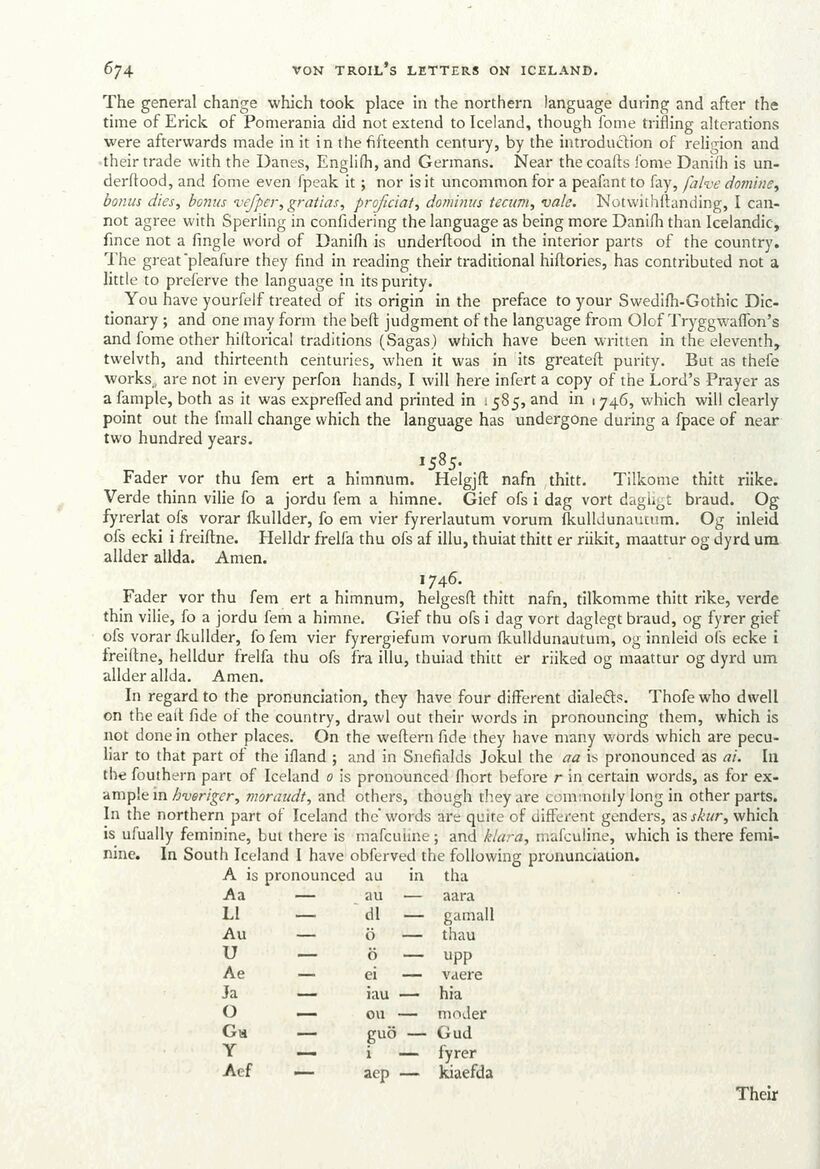
674 VON TROIL’S LETTERS ON ICELAND.
The general change which took place in the northern language during and after the
time of Erick of Pomerania did not extend to Iceland, though fome trifling alterations
were afterwards made in it in the fifteenth century, by the introduction of religion and
their trade with the Danes, Englifh, and Germans. Near the coafts fome Danifh is un-
derftood, and fome even fpeak it; nor isit uncommon for a peafant to fay, /a/ve domine,
bonus dies, bonus vefper, gratias, proficiat, dominus tecum, vale. Notwithftanding, I can-
not agree with Sperling in confidering the language as being more Danihh than Icelandic,
fince not a fingle word of Danifh is underftood in the interior parts of the country.
The great ‘pleafure they find in reading their traditional hiftories, has contributed not a
little to preferve the language in its purity.
You have yourfelf treated of its origin in the preface to your Swedifh-Gothic Dic-
tionary ; and one may form the beft judgment of the language from Olof Tryggwaflon’s
and fome other hiltorical traditions (Sagas) which have been written in the eleventh,
twelvth, and thirteenth centuries, when it was in its greateft purity. But as thefe
works, are not in every perfon hands, I will here infert a copy of the Lord’s Prayer as
a fample, both as it was expreffed and printed in 1585, and in 1746, which will clearly
point out the {mall change which the language has undergone during a fpace of near
two hundred years.
1585.
Fader vor thu fem ert a himnum. Helgjft nafn thitt. Tilkome thitt riike.
Verde thinn vilie fo a jordu fem a himne. Gief ofsi dag vort dagligt braud. Og
fyrerlat ofs vorar fkullder, fo em vier fyrerlautum vorum fkulldunautum. Og inleid
ofs ecki i freiftne. Helldr frelfa thu ofs af illu, thuiat thitt er riikit, maattur og dyrd um
allder allda. Amen.
1746.
Fader vor thu fem ert a himnum, helgesft thitt nafn, tilkomme thitt rike, verde
thin vilie, fo a jordu fem a himne. Gief thu ofsi dag vort daglegt braud, og fyrer gief
ofs vorar fkullder, fo fem vier fyrergiefum vorum fkulldunautum, og innleid ofs ecke i
freiftne, helldur frelfa thu ofs fra illu, thuiad thitt er riiked og maattur og dyrd um
allder allda. Amen.
In regard to the pronunciation, they have four different diale€ts. Thofe who dwell
on the eait fide of the country, drawl out their words in pronouncing them, which is
not donein other places. On the weftern fide they have many words which are pecu-
liar to that part of the ifland; and in Snefialds Jokul the aa is pronounced as ai. In
the fouthern part of Iceland o is pronounced fhort before r in certain words, as for ex-
ample in Sveriger, moraudt, and others, though they are commonly long in other parts,
In the northern part of Iceland the’ words are quite of different genders, as skur, which
is ufually feminine, but there is mafculine ; and é/ara, mafculine, which is there femi-
nine. In South Iceland I have obferved the following pronunciation.
A is pronounced au in tha
Aa — au — = aara
Ll — dl — = gamall
Au —_ 6 — thau
U — 6 — upp
Ae _ ei — ~ vaere
Ja — jiau — hia
O —_ ou — moder
Gu —_— gué — Gud
» 4 — i —~ fyrer
Acf _ aep — kiaefda
Their
<< prev. page << föreg. sida << >> nästa sida >> next page >>


