Full resolution (JPEG) - On this page / på denna sida - Pages ...

<< prev. page << föreg. sida << >> nästa sida >> next page >>
Below is the raw OCR text
from the above scanned image.
Do you see an error? Proofread the page now!
Här nedan syns maskintolkade texten från faksimilbilden ovan.
Ser du något fel? Korrekturläs sidan nu!
This page has never been proofread. / Denna sida har aldrig korrekturlästs.
COXE’S TRAVELS IN RUSSIA, 871
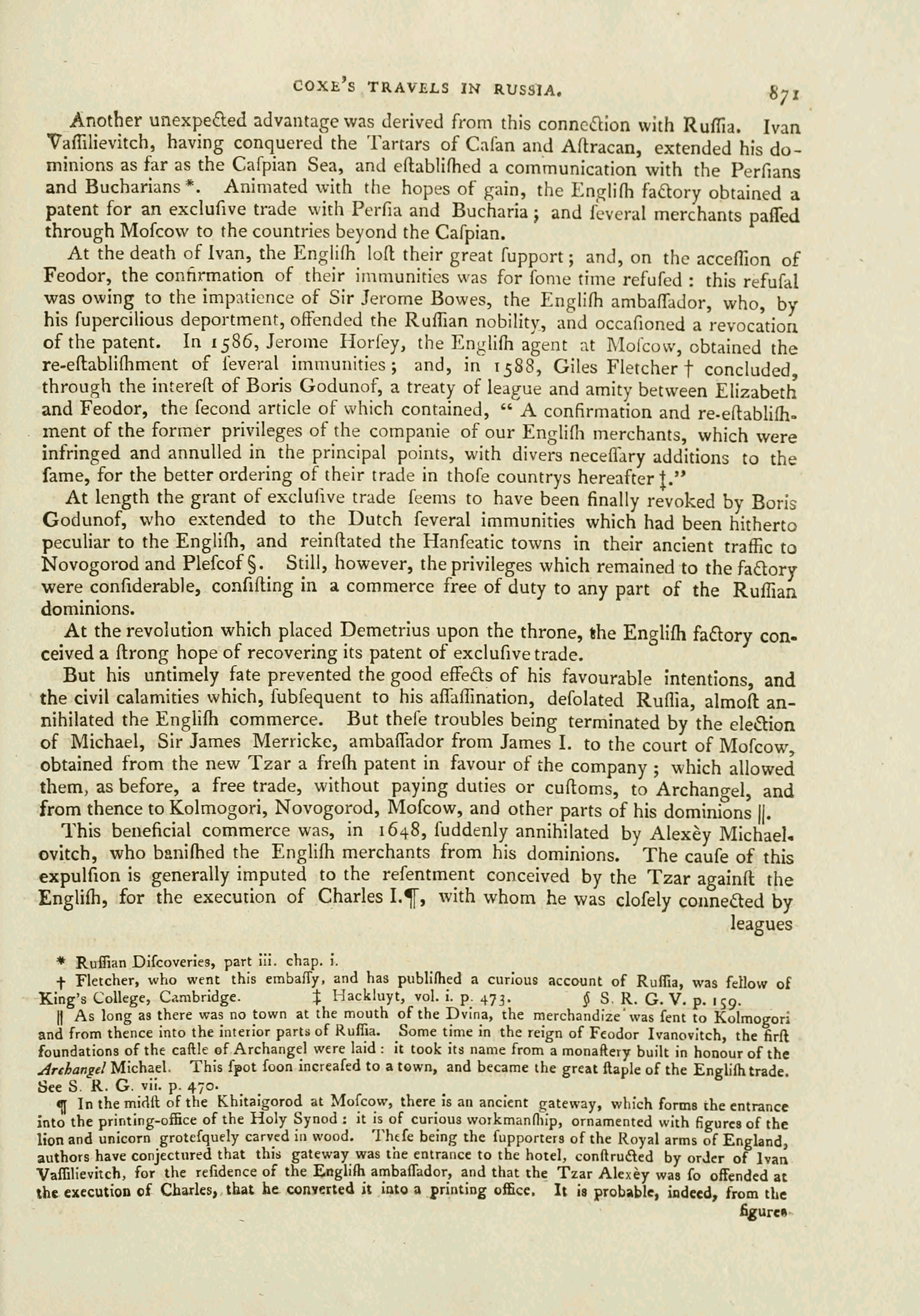
Another unexpected advantage was derived from this conneétion with Ruffia. Ivan
Vaffilievitch, having conquered the Tartars of Cafan and Aftracan, extended his do-
minions as far as the Cafpian Sea, and eftablifhed a communication with the Perfians
and Bucharians*. Animated with the hopes of gain, the Englifh factory obtained a
patent for an exclufive trade with Perfia and Bucharia; and feveral merchants pafled
through Mofcow to the countries beyond the Cafpian.
At the death of Ivan, the Englifh loft their great fupport; and, on the acceffion of
Feodor, the confirmation of their immunities was for fome time refufed: this refufal
was owing to the impatience of Sir Jerome Bowes, the Englifh ambaffador, who, by
his fupercilious deportment, offended the Ruffian nobility, and occafioned a revocation
of the patent. In 1586, Jerome Horfey, the Englifh agent at Mofcow, cbtained the
re-eftablifhment of feveral immunities; and, in 1588, Giles Fletcher + concluded,
through the intereft of Boris Godunof, a treaty of league and amity between Elizabeth
and Feodor, the fecond article of which contained, ‘* A confirmation and re-eftablifh-
- ment of the former privileges of the companie of our Englifh merchants, which were
infringed and annulled in the principal points, with divers neceflary additions to the
fame, for the better ordering of their trade in thofe countrys hereafter {.””
At length the grant of exclufive trade feems to have been finally revoked by Boris
Godunof, who extended to the Dutch feveral immunities which had been hitherto
peculiar to the Englifh, and reinftated the Hanfeatic towns in their ancient traffic to
Novogorod and Plefcof§. Still, however, the privileges which remained to the factory
were confiderable, confifting in a commerce free of duty to any part of the Ruffian
dominions.
At the revolution which placed Demetrius upon the throne, the Englifh factory cons
ceived a {trong hope of recovering its patent of exclufive trade.
But his untimely fate prevented the good effects of his favourable intentions, and
the civil calamities which, fubfequent to his affaffination, defolated Ruflia, almoft an-
nihilated the Englifh commerce. But thefe troubles being terminated by the elestion
of Michael, Sir James Merricke, ambaflador from James I. to the court of Mofcow,
obtained from the new Tzar a frefh patent in favour of the company ; which allowed
them, as before, a free trade, without paying duties or cuftoms, to Archangel, and
from thence to Kolmogori, Novogorod, Mofcow, and other parts of his dominions |].
This beneficial commerce was, in 1648, fuddenly annihilated by Alexéy Michael«
ovitch, who banifhed the Englifh merchants from his dominions. The caufe of this
expulfion is generally imputed to the refentment conceived by the Tzar againit the
Englith, for the execution of Charles I., with whom he was clofely conneéted by
leagues
* Roffian Difcoveries, part iii. chap. i. ; i
+ Fletcher, who went this embafly, and has publifhed a curious account of Ruffia, was fellow of
King’s College, Cambridge. + Hackluyt, vol. i. P- 473- § S.R.G.V. p. 159.
| As long as there was no town at the mouth of the Dvina, the merchandize was fent to Kolmogori
and from thence into the interior parts of Ruffia. Some time in the reign of Feodor Ivanovitch, the firft
foundations of the caftle ef Archangel were laid: it took its name from a monaftery built in honour of the
Archangel Michael. This fpot foon increafed to atown, and became the great ftaple of the Englith trade.
See S. R.G. vil. p. 470. ; : :
In the midft of the Khitaigorod at Mofcow, there is an ancient gateway, which forms the entrance
into the printing-office of the Holy Synod: it is of curious workmanfhip, ornamented with figures of the
lion and unicorn grotefquely carved in wood. ‘Thefe being the fupporters of the Royal arms of England,
authors have conjectured that this gateway was the entrance to the hotel, conftruéted by order of lvan
Vaffilievitch, for the refidence of the Englifh ambaflador, and that the Tzar Alexéy was fo offended at
the execution of Charles, that he converted it intoa printing office, It is probable, indeed, ya the
igures-
<< prev. page << föreg. sida << >> nästa sida >> next page >>