Full resolution (JPEG)
- On this page / på denna sida
- II. Land and People from the Heathen Period
- III. Establishment of Christianity. Contests of the Swedes and Goths for Supremacy. A.D. 800—1250

<< prev. page << föreg. sida << >> nästa sida >> next page >>
Below is the raw OCR text
from the above scanned image.
Do you see an error? Proofread the page now!
Här nedan syns maskintolkade texten från faksimilbilden ovan.
Ser du något fel? Korrekturläs sidan nu!
This page has been proofread at least once.
(diff)
(history)
Denna sida har korrekturlästs minst en gång.
(skillnad)
(historik)
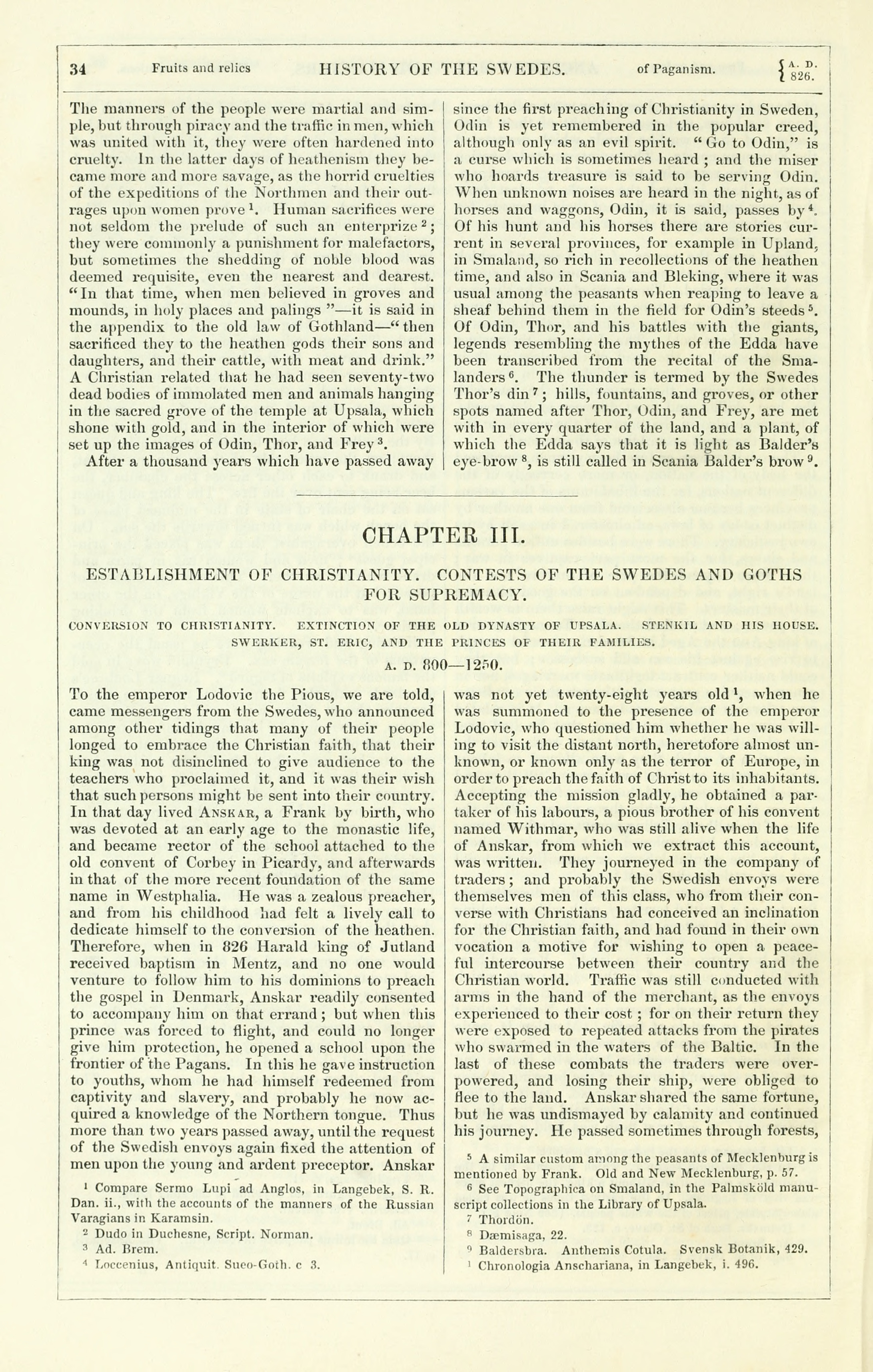
The manners of the people were martial and simple,
but through piracy and the traffic in men, which
was united with it, they were often hardened into
cruelty. In the latter days of heathenism they
became more and more savage, as the horrid cruelties
of the expeditions of the Northmen and their
outrages upon women prove [1]. Human sacrifices were
not seldom the prelude of such an enterprize [2];
they were commonly a punishment for malefactors,
but sometimes the shedding of noble blood was
deemed requisite, even the nearest and dearest.
“In that time, when men believed in groves and
mounds, in holy places and palings”—it is said in
the appendix to the old law of Gothland—“then
sacrificed they to the heathen gods their sons and
daughters, and their cattle, with meat and drink.”
A Christian related that he had seen seventy-two
dead bodies of immolated men and animals hanging
in the sacred grove of the temple at Upsala, which
shone with gold, and in the interior of which were
set up the images of Odin, Thor, and Frey [3].
After a thousand years which have passed away
since the first preaching of Christianity in Sweden,
Odin is yet remembered in the popular creed,
although only as an evil spirit. “Go to Odin,” is
a curse which is sometimes heard; and the miser
who hoards treasure is said to be serving Odin.
When unknown noises are heard in the night, as of
horses and waggons, Odin, it is said, passes by [4].
Of his hunt and his horses there are stories
current in several provinces, for example in Upland,
in Smaland, so rich in recollections of the heathen
time, and also in Scania and Bleking, where it was
usual among the peasants when reaping to leave a
sheaf behind them in the field for Odin’s steeds [5].
Of Odin, Thor, and his battles with the giants,
legends resembling the mythes of the Edda have
been transcribed from the recital of the
Smalanders [6]. The thunder is termed by the Swedes
Thor’s din [7]; hills, fountains, and groves, or other
spots named after Thor, Odin, and Frey, are met
with in every quarter of the land, and a plant, of
which the Edda says that it is light as Balder’s
eye-brow [8], is still called in Scania Balder’s brow [9].
CHAPTER III.
ESTABLISHMENT OF CHRISTIANITY. CONTESTS OF THE SWEDES AND GOTHS
FOR SUPREMACY.
CONVERSION TO CHRISTIANITY. EXTINCTION OF THE OLD DYNASTY OF UPSALA. STENKIL AND HIS HOUSE.
SWERKER, ST. ERIC, AND THE PRINCES OF THEIR FAMILIES.
a. d. 800—1250.
To the emperor Lodovic the Pious, we are told,
came messengers from the Swedes, who announced
among other tidings that many of their people
longed to embrace the Christian faith, that their
king was not disinclined to give audience to the
teachers who proclaimed it, and it was their wish
that such persons might be sent into their country.
In that day lived Anskar, a Frank by birth, who
was devoted at an early age to the monastic life,
and became rector of the school attached to the
old convent of Corbey in Picardy, and afterwards
in that of the more recent foundation of the same
name in Westphalia. He was a zealous preacher,
and from his childhood had felt a lively call to
dedicate himself to the conversion of the heathen.
Therefore, when in 826 Harald king of Jutland
received baptism in Mentz, and no one would
venture to follow him to his dominions to preach
the gospel in Denmark, Anskar readily consented
to accompany him on that errand; but when this
prince was forced to flight, and could no longer
give him protection, he opened a school upon the
frontier of the Pagans. In this he gave instruction
to youths, whom he had himself redeemed from
captivity and slavery, and probably he now
acquired a knowledge of the Northern tongue. Thus
more than two years passed away, until the request
of the Swedish envoys again fixed the attention of
men upon the young and ardent preceptor. Anskar
was not yet twenty-eight years old [10], when he
was summoned to the presence of the emperor
Lodovic, who questioned him whether he was
willing to visit the distant north, heretofore almost
unknown, or known only as the terror of Europe, in
order to preach the faith of Christ to its inhabitants.
Accepting the mission gladly, he obtained a partaker
of his labours, a pious brother of his convent
named Withmar, who was still alive when the life
of Anskar, from which we extract this account,
was written. They journeyed in the company of
traders; and probably the Swedish envoys were
themselves men of this class, who from their
converse with Christians had conceived an inclination
for the Christian faith, and had found in their own
vocation a motive for wishing to open a peaceful
intercourse between their country and the
Christian world. Traffic was still conducted with
arms in the hand of the merchant, as the envoys
experienced to their cost; for on their return they
were exposed to repeated attacks from the pirates
who swarmed in the waters of the Baltic. In the
last of these combats the traders were overpowered,
and losing their ship, were obliged to
flee to the land. Anskar shared the same fortune,
but he was undismayed by calamity and continued
his journey. He passed sometimes through forests,
[1] Compare Sermo Lupi ad Anglos, in Langebek, S. R.
Dan. ii., with the accounts of the manners of the Russian
Varagians in Karamsin.
[2] Dudo in Duchesne, Script. Norman.
[3] Ad. Brem.
[4] Loccenius, Antiquit. Sueo-Gotli. c 3.
[5] A similar custom among the peasants of Mecklenburg is
mentioned by Frank. Old and New Mecklenburg, p. 57.
[6] See Topographica on Smaland, in the Palmsköld
manuscript collections in the Library of Upsala.
[7] Thordön.
[8] Dæmisaga, 22.
[9] Baldersbra. Anthemis Cotula. Svensk Botanik, 429.
[10] Chronologia Anschariana, in Langebek, i. 496.
<< prev. page << föreg. sida << >> nästa sida >> next page >>
Project Runeberg, Sun Dec 10 07:08:34 2023
(aronsson)
(diff)
(history)
(download)
<< Previous
Next >>
https://runeberg.org/histswed/0060.html