Full resolution (JPEG) - On this page / på denna sida - VI. Steno Sturé the Elder. King John. Suanto Sturé. Steno Sturé the Younger, and Christian the Tyrant. A.D. 1470—1520

<< prev. page << föreg. sida << >> nästa sida >> next page >>
Below is the raw OCR text
from the above scanned image.
Do you see an error? Proofread the page now!
Här nedan syns maskintolkade texten från faksimilbilden ovan.
Ser du något fel? Korrekturläs sidan nu!
This page has never been proofread. / Denna sida har aldrig korrekturlästs.
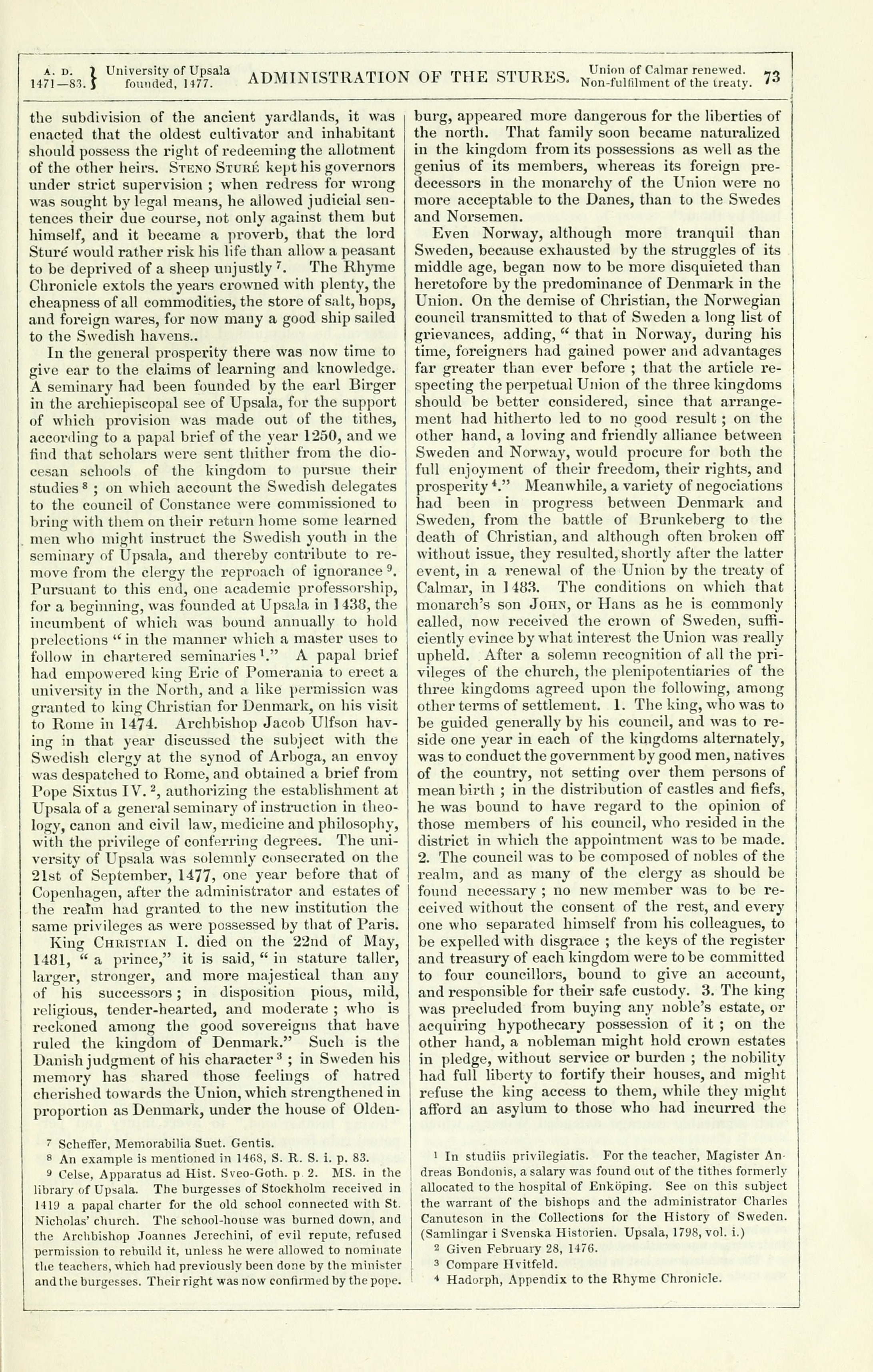
a. d. ; 1471—83. . I University of Upsala f founded, 1477. ADMINISTRATION OF THE STURES. Union of Calmar renewed. Non-fullilment of the treaty. 73
the subdivision of the ancient yardlands, it was
enacted that the oldest cultivator and inhabitant
should possess the right of redeeming the allotment
of the other heirs. Steno Sture kept his governors
under strict supervision ; when redress for wrong
was sought by legal means, he allowed judicial
sentences their due course, not only against them but
himself, and it became a proverb, that the lord
Sture would rather risk his life than allow a peasant
to be deprived of a sheep unjustly 7. The Rhyme
Chronicle extols the years crowned with plenty, the
cheapness of all commodities, the store of salt, hops,
and foreign wares, for now many a good ship sailed
to the Swedish havens..
In the general prosperity there was now time to
give ear to the claims of learning and knowledge.
A seminary had been founded by the earl Birger
in the archiepiscopal see of Upsala, for the support
of which provision was made out of the tithes,
according to a papal brief of the year 1250, and we
find that scholars were sent thither from the
diocesan schools of the kingdom to pursue their
studies 8 ; on which account the Swedish delegates
to the council of Constance were commissioned to
bring with them on their return home some learned
men who might instruct the Swedish youth in the
seminary of Upsala, and thereby contribute to
remove from the clergy the reproach of ignorance 9.
Pursuant to this end, one academic professorship,
for a beginning, was founded at Upsala in 1438, the
incumbent of which was bound annually to hold
prelections " in the manner which a master uses to
follow in chartered seminariesA papal brief
had empowered king Eric of Pomerania to erect a
university in the North, and a like permission was
granted to king Christian for Denmark, on his visit
to Rome in 1474. Archbishop Jacob Ulfson
having in that year discussed the subject with the
Swedish clergy at the synod of Arboga, an envoy
was despatched to Rome, and obtained a brief from
Pope Sixtus IV. 2, authorizing the establishment at
Upsala of a general seminary of instruction in
tlieo-logy, canon and civil law, medicine and philosophy,
with the privilege of conferring degrees. The
university of Upsala was solemnly consecrated on the
21st of September, 1477, one year before that of
Copenhagen, after the administrator and estates of
the realm had granted to the new institution the
same privileges as were possessed by that of Paris.
King Christian I. died on the 22nd of May,
1481, " a prince," it is said, " in stature taller,
larger, stronger, and more majestical than any
of his successors; in disposition pious, mild,
religious, tender-hearted, and moderate ; who is
reckoned among the good sovereigns that have
ruled the kingdom of Denmark." Such is the
Danish judgment of his character3 ; in Sweden his
memory has shared those feelings of hatred
cherished towards the Union, which strengthened in
proportion as Denmark, under the house of Oldeu-
7 Scliefier, Memorabilia Suet. Gentis.
8 An example is mentioned in 146S, S. R. S. i. p. 83.
9 Celse, Apparatus ad Hist. Sveo-Goth. p 2. MS. in the
library of Upsala. The burgesses of Stockholm received in
1419 a papal charter for the old school connected with St.
Nicholas’ church. The school-house was burned down, and
the Archbishop Joannes Jerechini, of evil repute, refused
permission to rebuild it, unless he were allowed to nominate
the teachers, which had previously been done by the minister
and the burgesses. Their right was now confirmed by the pope.
burg, appeared more dangerous for the liberties of
the north. That family soon became naturalized
in the kingdom from its possessions as well as the
genius of its members, whereas its foreign
predecessors in the monarchy of the Union were no
more acceptable to the Danes, than to the Swedes
and Norsemen.
Even Norway, although more tranquil than
Sweden, because exhausted by the struggles of its
middle age, began now to be more disquieted than
heretofore by the predominance of Denmark in the
Union. On the demise of Christian, the Norwegian
council transmitted to that of Sweden a long list of
grievances, adding, " that in Norway, during his
time, foreigners had gained power and advantages
far greater than ever before ; that the article
respecting the perpetual Union of the three kingdoms
should be better considered, since that
arrangement had hitherto led to no good result; on the
other hand, a loving and friendly alliance between
Sweden and Norway, would procure for both the
full enjoyment of their freedom, their rights, and
prosperity4." Meanwhile, a variety of negociations
had been in progress between Denmark and
Sweden, from the battle of Brunkeberg to the
death of Christian, and although often broken off
without issue, they resulted, shortly after the latter
event, in a renewal of the Union by the treaty of
Calmar, in 1183. The conditions on which that
monarch’s son John, or Hans as he is commonly
called, now received the crown of Sweden,
sufficiently evince by what interest the Union was really
upheld. After a solemn recognition of all the
privileges of the church, the plenipotentiaries of the
three kingdoms agreed upon the following, among
other terms of settlement. 1. The king, who was to
be guided generally by his council, and was to
reside one year in each of the kingdoms alternately,
was to conduct the government by good men, natives
of the country, not setting over them persons of
mean birth ; in the distribution of castles and fiefs,
he was bound to have regard to the opinion of
those members of his council, who resided in the
district in which the appointment was to be made.
2. The council was to be composed of nobles of the
realm, and as many of the clergy as should be
found necessary ; no new member was to be
received without the consent of the rest, and every
one who separated himself from his colleagues, to
be expelled with disgrace ; the keys of the register
and treasury of each kingdom were to be committed
to four councillors, bound to give an account,
and responsible for their safe custody. 3. The king
was precluded from buying any noble’s estate, or
acquiring hypothecary possession of it ; on the
other hand, a nobleman might hold crown estates
in pledge, without service or burden ; the nobility
had full liberty to fortify their houses, and might
refuse the king access to them, while they might
afford an asylum to those who had incurred the
1 In studiis privilegiatis. For the teacher, Magister An
dreas Bondonis, a salary was found out of the tithes formerly
allocated to the hospital of Enkoping. See on this subject
the warrant of the bishops and the administrator Charles
Canuteson in the Collections for the History of Sweden.
(Samlingar i Svenska Historien. Upsala, 1798, vol. i.)
2 Given February 28, 1476.
3 Compare Hvitfeld.
4 Hadorph, Appendix to the Rhyme Chronicle.
<< prev. page << föreg. sida << >> nästa sida >> next page >>