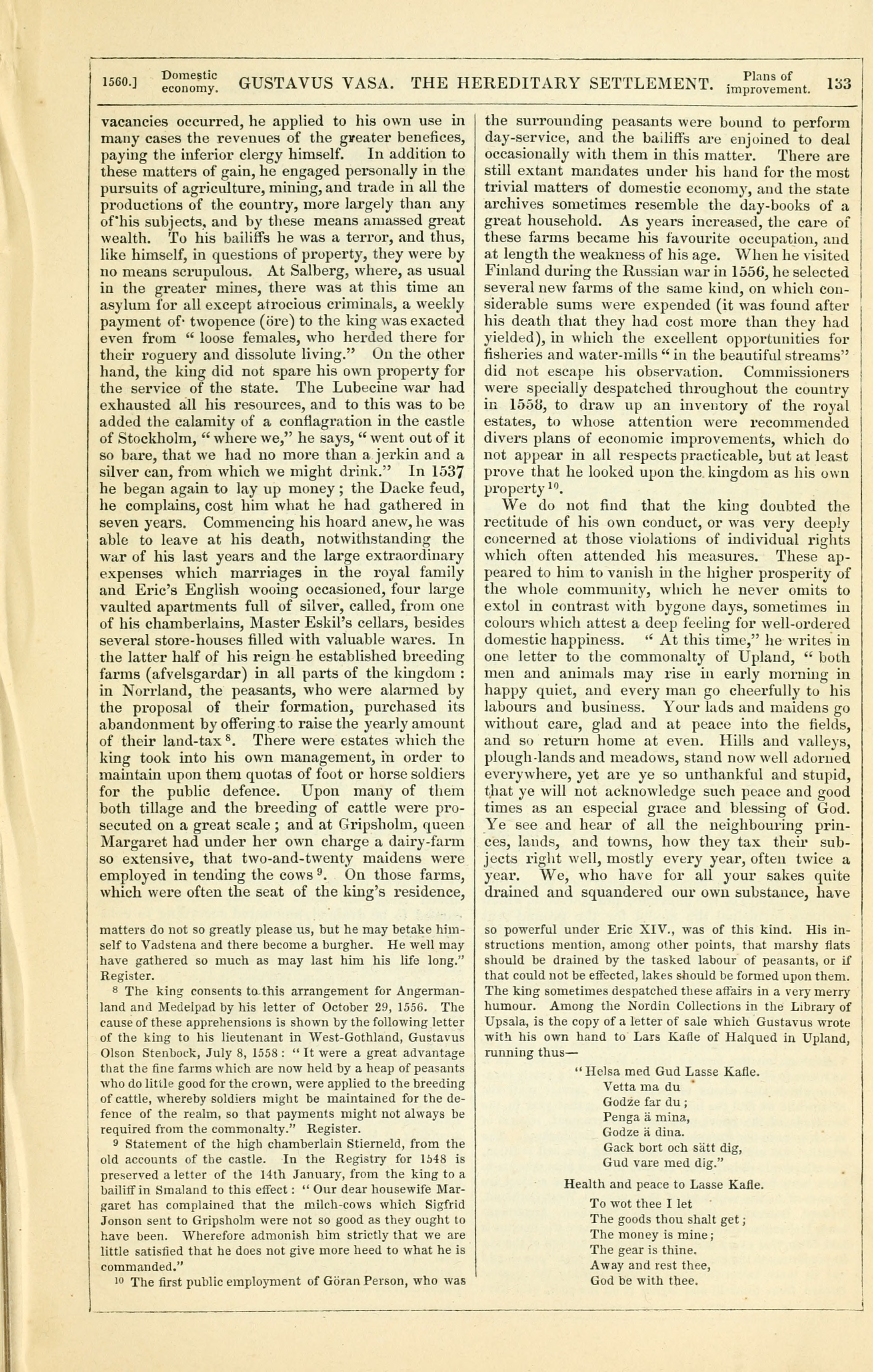
Full resolution (JPEG) - On this page / på denna sida - X. Gustavus Vasa. The Hereditary Settlement. A.D. 1544—1560

<< prev. page << föreg. sida << >> nästa sida >> next page >>
Below is the raw OCR text
from the above scanned image.
Do you see an error? Proofread the page now!
Här nedan syns maskintolkade texten från faksimilbilden ovan.
Ser du något fel? Korrekturläs sidan nu!
This page has never been proofread. / Denna sida har aldrig korrekturlästs.
1 1560.] Domestic economy. GUSTAVUS VASA.
vacancies occurred, he applied to his own use in
many cases the revenues of the greater benefices,
paying the inferior clergy himself. In addition to
these matters of gain, he engaged personally in the
pursuits of agriculture, mining, and trade in all the
productions of the country, more largely than any
of’his subjects, and by these means amassed great
wealth. To his bailiffs he was a terror, and thus,
like himself, in questions of property, they were by
no means scrupulous. At Salberg, where, as usual
in the greater mines, there was at this time an
asylum for all except atrocious criminals, a weekly
payment of- twopence (ore) to the king was exacted
even from " loose females, who herded there for
their roguery and dissolute living." On the other
hand, the king did not spare his own property for
the service of the state. The Lubecine war had
exhausted all his resources, and to this was to be
added the calamity of a conflagration in the castle
of Stockholm, " where we," he says, " went out of it
so bare, that we had no more than a jerkin and a
silver can, from which we might drink." In 1537
he began again to lay up money; the Dacke feud,
he complains, cost him what he had gathered in
seven years. Commencing his hoard anew, he was
able to leave at his death, notwithstanding the
war of his last years and the large extraordinary
expenses which marriages in the royal family
and Eric’s English wooing occasioned, four large
vaulted apartments full of silver, called, from one
of his chamberlains, Master Eskil’s cellars, besides
several store-houses filled with valuable wares. In
the latter half of his reign he established breeding
farms (afvelsgardar) in all parts of the kingdom :
in Norrland, the peasants, who were alarmed by
the proposal of their formation, purchased its
abandonment by offering to raise the yearly amount
of their land-tax8. There were estates which the
king took into his own management, in order to
maintain upon them quotas of foot or horse soldiers
for the public defence. Upon many of them
both tillage and the breeding of cattle were
prosecuted on a great scale ; and at Gripsholm, queen
Margaret had under her own charge a dairy-farm
so extensive, that two-and-twenty maidens were
employed in tending the cows 9. On those farms,
which were often the seat of the king’s residence,
Plans of
improvement.
the surrounding peasants were bound to perform
day-service, and the bailiff’s are enjoined to deal
occasionally with them in this matter. There are
still extant mandates under his hand for the most
trivial matters of domestic economy, and the state
archives sometimes resemble the day-books of a
great household. As years increased, the care of
these farms became his favourite occupation, and
at length the weakness of his age. When he visited
Finland during the Russian war in 1556, he selected
several new farms of the same kind, on which
considerable sums were expended (it was found after
his death that they had cost more than they had
yielded), in which the excellent opportunities for
fisheries and water-mills " in the beautiful streams"
did not escape his observation. Commissioners
were specially despatched throughout the country
in 1558, to draw up an inventory of the royal
estates, to whose attention were recommended
divers plans of economic improvements, which do
not appear in all respects practicable, but at least
prove that he looked upon the kingdom as his own
property10.
We do not find that the king doubted the
rectitude of his own conduct, or was very deeply
concerned at those violations of individual rights
which often attended his measures. These
appeared to him to vanish in the higher prosperity of
the whole community, which he never omits to
extol in contrast with bygone days, sometimes in
colours which attest a deep feeling for well-ordered
domestic happiness. " At this time," he writes in
one letter to the commonalty of Upland, " both
men and animals may rise in early morning in
happy quiet, and every man go cheerfully to his
labours and business. Your lads and maidens go
without care, glad and at peace into the fields,
and so return home at even. Hills and valleys,
plough dands and meadows, stand now well adorned
everywhere, yet are ye so unthankful and stupid,
that ye will not acknowledge such peace and good
times as an especial grace and blessing of God.
Ye see and hear of all the neighbouring
princes, lands, and towns, how they tax their
subjects right well, mostly every year, often twice a
year. We, who have for all your sakes quite
drained and squandered our own substance, have
the hereditary settlement.
matters do not so greatly please us, but he may betake
himself to Vadstena and there become a burgher. He well may
have gathered so much as may last him his life long."
Register.
8 The king consents to this arrangement for
Angerman-land and Medelpad by his letter of October 29, 1556. The
cause of these apprehensions is shown by the following letter
of the king to his lieutenant in West-Gothland, Gustavus
Olson Stenbock, July 8, 1558 : " It were a great advantage
that the fine farms which are now held by a heap of peasants
who do little good for the crown, were applied to the breeding
of cattle, whereby soldiers might be maintained for the
defence of the realm, so that payments might not always be
required from the commonalty." Register.
9 Statement of the high chamberlain Stierneld, from the
old accounts of the castle. In the Registry for 1548 is
preserved a letter of the 14th January, from the king to a
bailiff in Smaland to this effect: " Our dear housewife
Margaret has complained that the milch-cows which Sigfrid
Jonson sent to Gripsholm were not so good as they ought to
have been. Wherefore admonish him strictly that we are
little satisfied that he does not give more heed to what he is
commanded."
10 The first public employment of Goran Person, who was
so powerful under Eric XIV., was of this kind. His
instructions mention, among other points, that marshy flats
should be drained by the tasked labour of peasants, or if
that could not be effected, lakes should be formed upon them.
The king sometimes despatched these affairs in a very merry
humour. Among the Nordin Collections in the Library of
Upsala, is the copy of a letter of sale which Gustavus wrote
with his own hand to Lars Kafle of Halqued in Upland,
running thus—
"Helsa med Gud Lasse Kafle.
Vetta ma du
Godze far du;
Penga a mina,
Godze a dina.
Gack bort och satt dig,
Gud vare med dig."
Health and peace to Lasse Kafle.
To wot thee I let
The goods thou shalt get;
The money is mine;
The gear is thine.
Away and rest thee,
God be with thee.
<< prev. page << föreg. sida << >> nästa sida >> next page >>