Full resolution (JPEG) - On this page / på denna sida - X. Gustavus Vasa. The Hereditary Settlement. A.D. 1544—1560
<< prev. page << föreg. sida << >> nästa sida >> next page >>
Below is the raw OCR text
from the above scanned image.
Do you see an error? Proofread the page now!
Här nedan syns maskintolkade texten från faksimilbilden ovan.
Ser du något fel? Korrekturläs sidan nu!
This page has never been proofread. / Denna sida har aldrig korrekturlästs.
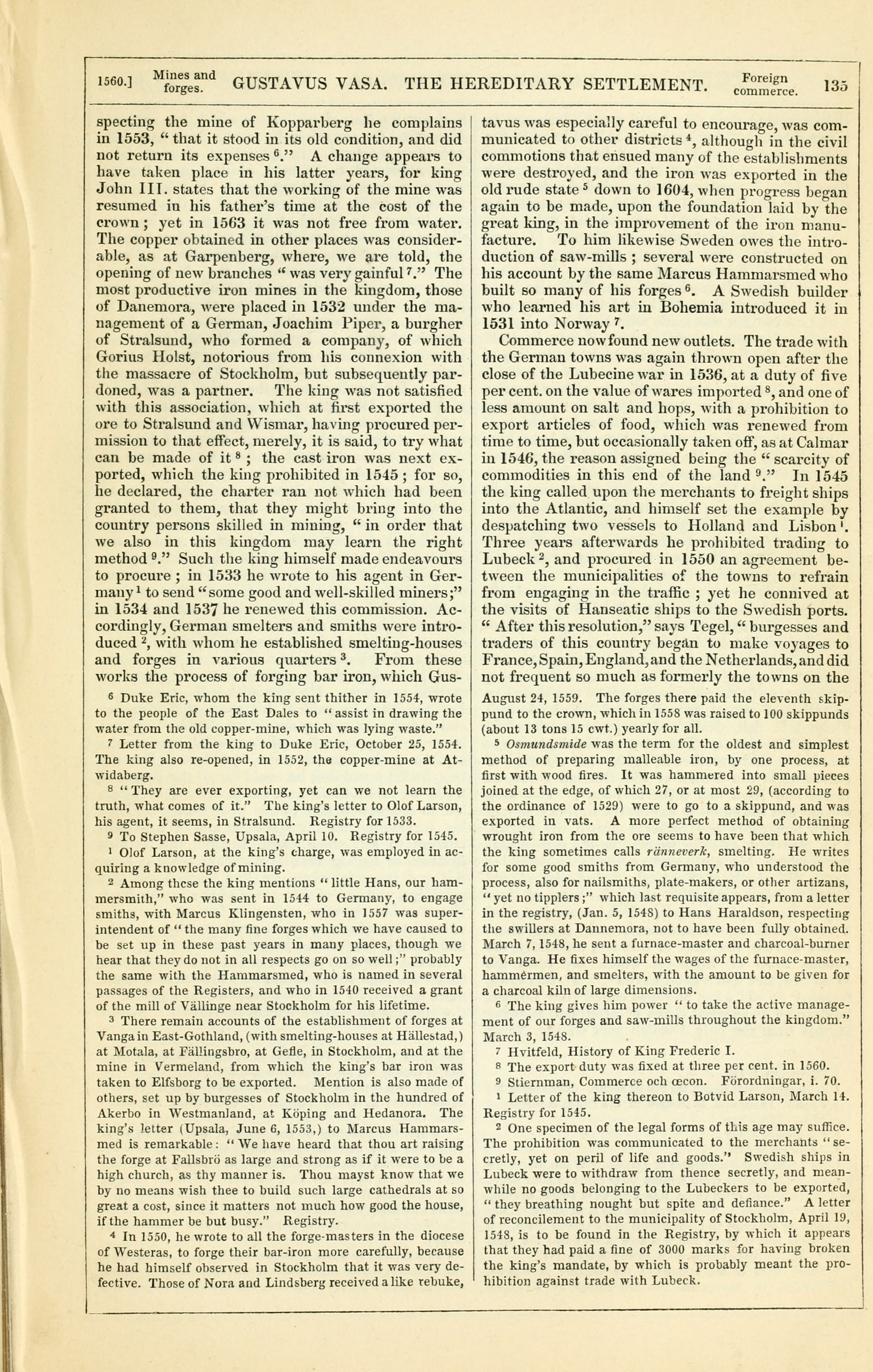
1560.] Mines and forges. GUSTAVUS VASA. THE HEREDITARY SETTLEMENT. Foreign commerce. 135
specting the mine of Kopparberg he complains
in 1553, " that it stood in its old condition, and did
not return its expenses 6." A change appears to
have taken place in his latter years, for king
John III. states that the working of the mine was
resumed in his father’s time at the cost of the
crown; yet in 15G3 it was not free from water.
The copper obtained in other places was
considerable, as at Garpenberg, where, we are told, the
opening of new branches " was very gainful7." The
most productive iron mines in the kingdom, those
of Danemora, were placed in 1532 under the
management of a German, Joachim Piper, a burgher
of Stralsund, who formed a company, of which
Gorius Hoist, notorious fi-om his connexion with
the massacre of Stockholm, but subsequently
pardoned, was a partner. The king was not satisfied
with this association, which at first exported the
ore to Stralsund and Wismar, having procured
permission to that effect, merely, it is said, to try what
can be made of it8 ; the cast iron was next
exported, which the king prohibited in 1545 ; for so,
he declared, the charter ran not which had been
granted to them, that they might bring into the
country persons skilled in mining, " in order that
we also in this kingdom may learn the right
method 9." Such the king himself made endeavours
to procure ; in 1533 he wrote to his agent in
Germany1 to send "some good and well-skilled miners;"
in 1534 and 1537 he renewed this commission.
Accordingly, German smelters and smiths were
introduced 2, with whom he established smelting-houses
and forges in various quarters3. From these
works the process of forging bar iron, which Gus-
6 Duke Eric, whom the king sent thither in 1554, wrote
to the people of the East Dales to " assist in drawing the
water from the old copper-mine, which was lying waste."
7 Letter from the king to Duke Eric, October 25, 1554.
The king also re-opened, in 1552, the copper-mine at
At-widaberg.
8 " They are ever exporting, yet can we not learn the
truth, what comes of it." The king’s letter to Olof Larson,
his agent, it seems, in Stralsund. Registry for 1533.
9 To Stephen Sasse, Upsala, April 10. Registry for 1545.
1 Olof Larson, at the king’s charge, was employed in
acquiring a knowledge of mining.
2 Among these the king mentions " little Hans, our
hammersmith," who was sent in 1544 to Germany, to engage
smiths, with Marcus Klingensten, who in 1557 was
superintendent of " the many fine forges which we have caused to
be set up in these past years in many places, though we
hear that they do not in all respects go on so well;" probably
the same with the Hammarsmed, who is named in several
passages of the Registers, and who in 1540 received a grant
of the mill of Vallinge near Stockholm for his lifetime.
3 There remain accounts of the establishment of forges at
Vangain East-Gothland, (with smelting-houses at Hallestad,)
at Motala, at Fallingsbro, at Gefle, in Stockholm, and at the
mine in Vermeland, from which the king’s bar iron was
taken to Elfsborg to be exported. Mention is also made of
others, set up by burgesses of Stockholm in the hundred of
Akerbo in Westmanland, at Koping and Hedanora. The
king’s letter (Upsala, June 6, 1553,) to Marcus
Hammarsmed is remarkable: " We have heard that thou art raising
the forge at Fallsbro as large and strong as if it were to be a
high church, as thy manner is. Thou mayst know that we
by no means wish thee to build such large cathedrals at so
great a cost, since it matters not much how good the house,
if the hammer be but busy." Registry.
tavus was especially careful to encourage, was
communicated to other districts 4, although in the civil
commotions that ensued many of the establishments
were destroyed, and the iron was exported in the
old rude state5 down to 1604, when progress began
again to be made, upon the foundation laid by the
great king, in the improvement of the iron
manufacture. To him likewise Sweden owes the
introduction of saw-mills ; several were constructed on
his account by the same Marcus Hammarsmed who
built so many of his forges 6. A Swedish builder
who learned his art in Bohemia introduced it in
1531 into Norway 7.
Commerce now found new outlets. The trade with
the German towns was again thrown open after the
close of the Lubecinewar in 1536, at a duty of five
per cent, on the value of wares imported8, and one of
less amount on salt and hops, with a prohibition to
export articles of food, which was renewed from
time to time, but occasionally taken off, as at Calmar
in 1546, the reason assigned being the " scarcity of
commodities in this end of the land9." In 1545
the king called upon the merchants to freight ships
into the Atlantic, and himself set the example by
despatching two vessels to Holland and Lisbon’.
Three years afterwards he prohibited trading to
Lubeck2, and procured in 1550 an agreement
between the municipalities of the towns to refrain
from engaging in the traffic ; yet he connived at
the visits of Hanseatic ships to the Swedish ports.
" After this resolution," says Tegel," burgesses and
traders of this country began to make voyages to
France, Spain, England, and the Netherlands, and did
not frequent so much as formerly the towns on the
4 In 1550, he wrote to all the forge-masters in the diocese
of Westeras, to forge their bar-iron more carefully, because
he had himself observed in Stockholm that it was very
defective. Those of Nora and Lindsberg received a like rebuke,
August 24, 1559. The forges there paid the eleventh
skip-pund to the crown, which in 1558 was raised to 100 skippunds
(about 13 tons 15 cwt.) yearly for all.
5 Osmundsmide was the term for the oldest and simplest
method of preparing malleable iron, by one process, at
first with wood fires. It was hammered into small pieces
joined at the edge, of which 27, or at most 29, (according to
the ordinance of 1529) were to go to a skippund, and was
exported in vats. A more perfect method of obtaining
wrought iron from the ore seems to have been that which
the king sometimes calls riinneverk, smelting. He writes
for some good smiths from Germany, who understood the
process, also for nailsmiths, plate-makers, or other artizans,
’* yet no tipplers;" which last requisite appears, from a letter
in the registry, (Jan. 5, 1548) to Hans Haraldson, respecting
the swiUers at Dannemora, not to have been fully obtained.
March 7,1548, he sent a furnace-master and charcoal-burner
to Vanga. He fixes himself the wages of the furnace-master,
hammermen, and smelters, with the amount to be given for
a charcoal kiln of large dimensions.
6 The king gives him power " to take the active
management of our forges and saw-mills throughout the kingdom."
March 3, 1548.
7 Hvitfeld, History of King Frederic I.
8 The export duty was fixed at three per cent, in 1560.
9 Stiernman, Commerce och oecon. Forordningar, i. 70.
> Letter of the king thereon to Botvid Larson, March 14.
Registry for 1545.
2 One specimen of the legal forms of this age may suffice.
The prohibition was communicated to the merchants
"secretly, yet on peril of life and goods." Swedish ships in
Lubeck were to withdraw from thence secretly, and
meanwhile no goods belonging to the Lubeckers to be exported,
" they breathing nought but spite and defiance." A letter
of reconcilement to the municipality of Stockholm, April 19,
1548, is to be found in the Registry, by which it appears
that they had paid a fine of 3000 marks for having broken
the king’s mandate, by which is probably meant the
prohibition against trade with Lubeck.
<< prev. page << föreg. sida << >> nästa sida >> next page >>