Full resolution (JPEG)
- On this page / på denna sida
- XII. John and Charles. A.D. 1569—1592

<< prev. page << föreg. sida << >> nästa sida >> next page >>
Below is the raw OCR text
from the above scanned image.
Do you see an error? Proofread the page now!
Här nedan syns maskintolkade texten från faksimilbilden ovan.
Ser du något fel? Korrekturläs sidan nu!
This page has never been proofread. / Denna sida har aldrig korrekturlästs.
170
Family of
Vasa. HISTORY OF THE SWEDES. Sus])irions of treason
in the council. [13(;9—
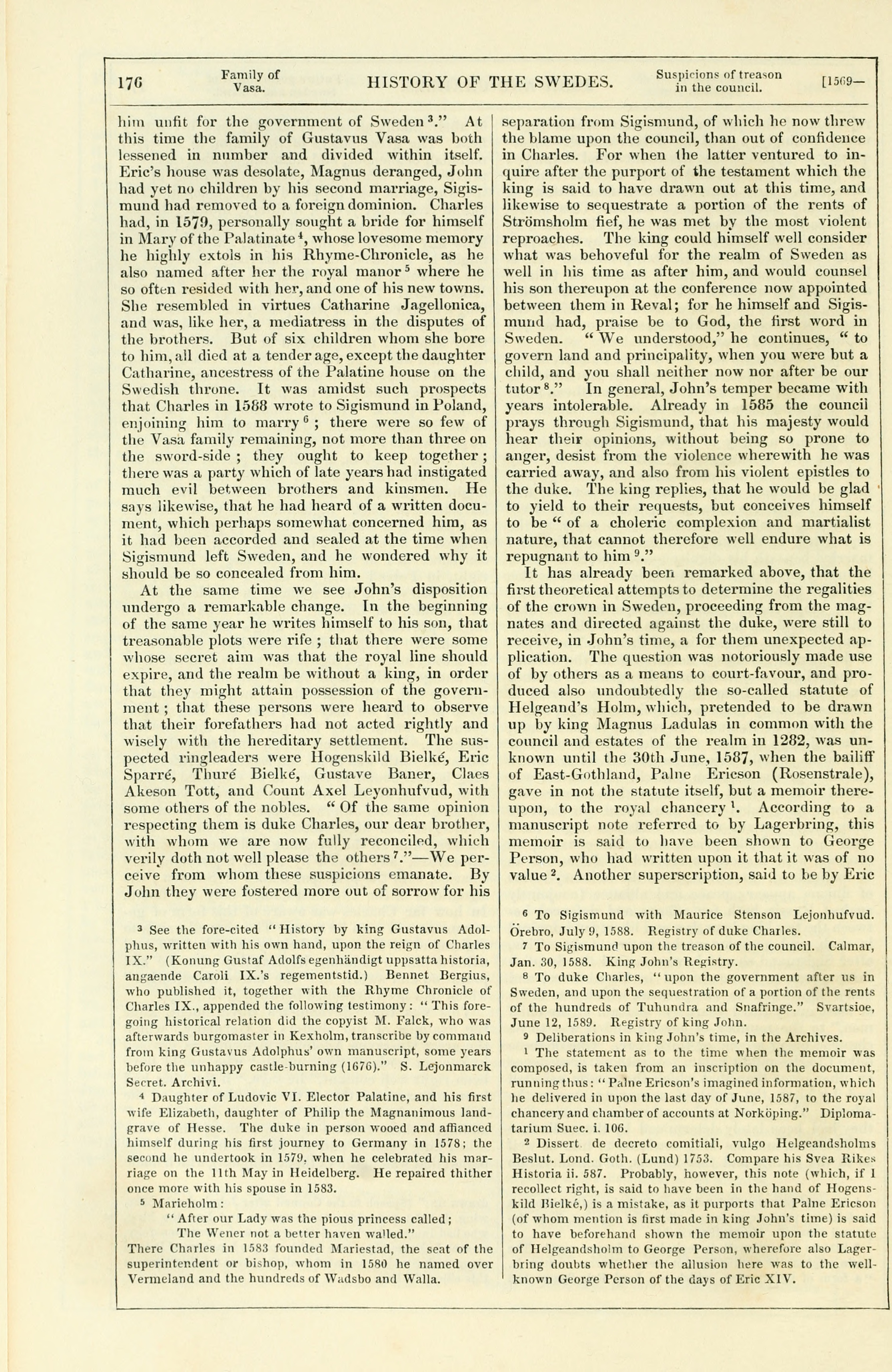
him unfit for the government of Sweden’." At
this time tlie family of Gustavus Vasa was both
lessened in number and divided within itself.
Eric’s house was desolate, Magnus deranged, John
had yet no children by his second mai-riage, Sigis-
mund had removed to a foi’eign dominion. Charles
had, in 1570, personally sought a bride for himself
in Mary of the Palatinate*, whose lovesome memory
he highly extols in his Rhyme-Chronicle, as he
also named after her the royal manor ^
where he
so often resided with her, and one of his new towns.
She resembled in virtues Catharine Jagellonica,
and was, like her, a mediatress in the disputes of
the brothers. But of six children whom she bore
to him, all died at a tender age, except the daughter
Catharine, ancestress of the Palatine house on the
Swedish throne. It was amidst such prospects
that Charles in 1588 wrote to Sigismund in Poland,
enjoining him to marry
"
;
there were so few of
the Vasa family remaining, not more than three on
the sword-side ; they ought to keep together ;
there was a party which of late years had instigated
much evil between brothers and kinsmen. He
says likewise, that he had heard of a written docu-
ment, which perhaps somewhat concerned hira, as
it had been accorded and sealed at the time wlien
Sigismund left Sweden, and he wondered why it
should be so concealed from him.
At the same time we see John’s disposition
imdergo a remarkable change. In the beginning
of the same year he writes himself to his son, that
treasonable plots were rife ;
that there were some
whose secret aim was that the royal line should
expire, and the realm be without a king, in order
that tliey might attain possession of the govern-
ment ;
that these persons were heard to observe
that their forefathers had not acted rightly and
wisely with the hereditary settlement. The svis-
pected ringleaders were Hogenskild Bielk^, Eric
Sparr(J, Thure Bielke, Gustave Baner, Claes
Akeson Tott, and Count Axel Leyonhufvud, with
some others of the nobles. " Of the same opinion
respecting them is duke Charles, our dear brother,
with whom we are now fully reconciled, which
verily doth not well please the others ’."—We per-
ceive from whom these suspicions emanate. By
John they were fostered more out of sorrow for his
3 See the fore-cited
"
History liy king Gustavus Adol-
phus, written with his own hand, upon the reign of Charles
IX." (Konung Gustaf Adolfsegenhiindigt uppsattahistoria,
angaende Caroli IX.’s regementstid.) Bennet Bergius,
who published it, together with the Rhyme Chronicle of
Charles IX., appended the following testimony:
" This fore-
going historical relation did the copyist M. Falck, who was
afterwards burgomaster in Kexholm, transcribe by command
from king Gustavus Adolphus’ own manuscript, some years
before the unhappy castle-burning (167C)." S. Lejonmarck
Secret. Archivi.
*
Daughter of Ludovic VI. Elector Palatine, and his first
wife Elizabeth, daughter of Philip the Magnanimous land-
grave of Hesse. The duke in person wooed and affianced
himself during his first journey to Germany in 1578; the
second be undertook in \^7’J. when he celebrated his mar-
riage on the nth May in Heidelberg. He repaired thither
once more with his spouse in 1583.
5 Marieholm :
" After our Lady was the pious princess called ;
The Wener not a better haven walled."
There Charles in 1583 founded Mariestad, the seat of the
superintendent or bishop, whom in 1580 he named over
Verraeland and the hundreds of Wadsbo and Walla.
separation from Sigismund, of which he now threw
the blame upon the council, than out of confidence
in Charles. For when the latter ventured to in-
quire after the purport of the testament which the
king is said to have drawn out at this time, and
likewise to sequestrate a portion of the rents of
Stromsholm fief, he was met by the most violent
reproaches. The king could himself well consider
what was behoveful for the realm of Sweden as
well in his time as after him, and would counsel
his son thereupon at the conference now appointed
between them in Reval; for he himself and Sigis-
mund had, praise be to God, the first word in
Sweden. " We understood," he continues,
" to
govern land and principality, when you were but a
child, and you shall neither now nor after be our
tutor *." In general, John’s temper became with
years intolerable. Already in 1585 the council
prays through Sigismund, that his majesty would
hear their opinions, without being so prone to
anger, desist from the violence wherewith he was
carried away, and also from his violent epistles to
the duke. The king replies, that he would be glad
’
to yield to their requests, but conceives himself
to be " of a choleric complexion and martialist
nature, that cannot therefore well endure what is
repugnant to him ^."
It has already beeri remarked above, that the
first theoretical attempts to determine the regalities
of the crown in Sweden, proceeding from the mag-
nates and directed against the duke, were still to
receive, in John’s time, a for them unexpected ap-
plication. The question was notoriously made use
of by others as a means to court-favour, and pro-
duced also tmdoubtedly the so-called statute of
Helgeand’s Holm, which, pretended to be drawn
up by king Magnus Ladulas in common with the
council and estates of the realm in 1282, was un-
known until the 30th June, 1587, when the bailiff
of East-Gothland, Paine Ericson (Rosenstrale),
gave in not the statute itself, but a memoir there-
upon, to the royal chancery ’.
According to a
manuscript note referred to by Lagerbring, this
memoir is said to have been shown to George
Person, who had written upon it that it was of no
value 2. Another superscription, said to be by Eric
5 To Sigismund with Maurice Stenson Lejonhufvud.
drebro, Julys, 1588. Registry of duke Charles.
’ To Sigismund upon the treason of the council. Calmar,
Jan. 30, 1588. King John’s Registry.
8 To duke Charles,
"
upon the government after us in
Sweden, and vipon the sequestration of a portion of the rents
of the hundreds of Tuhnndra and Stiafringe." Svartsioe,
June 12, 1589. Registry of king Jolm.
9 Deliberations in king John’s time, in the Archives.
1
The statement as to the time when the memoir was
composed, is taken from an inscription on the document,
running thus: "Paine Ericson’s imagined information, which
he delivered in upon the last day of June, 1587, to the royal
chancery and chamber of accounts at Norkoping." Diploma-
tarium Suec. i. 106.
2 Dissert de dccreto comitiall, vulgo Helgeandsholms
Beslut. Loud. Goth. (Lund) 1753. Compare his Svea Hikes
Historia ii. 587. Probably, however, this note (which, if 1
recollect right, is said to have been in the hand of Hogens-
kild Hielke,) is a mistake, as it purports that Paine Ericson
(of whom mention is first made in king John’s time) is said
to have beforehand shown the memoir upon the statute
of Helgeandsholm to George Person, wherefore also Lager-
bring doubts whetlier the allusion here was to the well-
known George Person of the days of Eric XIV.
<< prev. page << föreg. sida << >> nästa sida >> next page >>
Project Runeberg, Sun Dec 10 07:08:34 2023
(aronsson)
(download)
<< Previous
Next >>
https://runeberg.org/histswed/0202.html