Full resolution (JPEG) - On this page / på denna sida - XII. John and Charles. A.D. 1569—1592

<< prev. page << föreg. sida << >> nästa sida >> next page >>
Below is the raw OCR text
from the above scanned image.
Do you see an error? Proofread the page now!
Här nedan syns maskintolkade texten från faksimilbilden ovan.
Ser du något fel? Korrekturläs sidan nu!
This page has never been proofread. / Denna sida har aldrig korrekturlästs.
1592.]
His departure, and
slay ill Reval. JOHN AND CHARLES.
Remonstrances of tlie
council and tlie army. 179
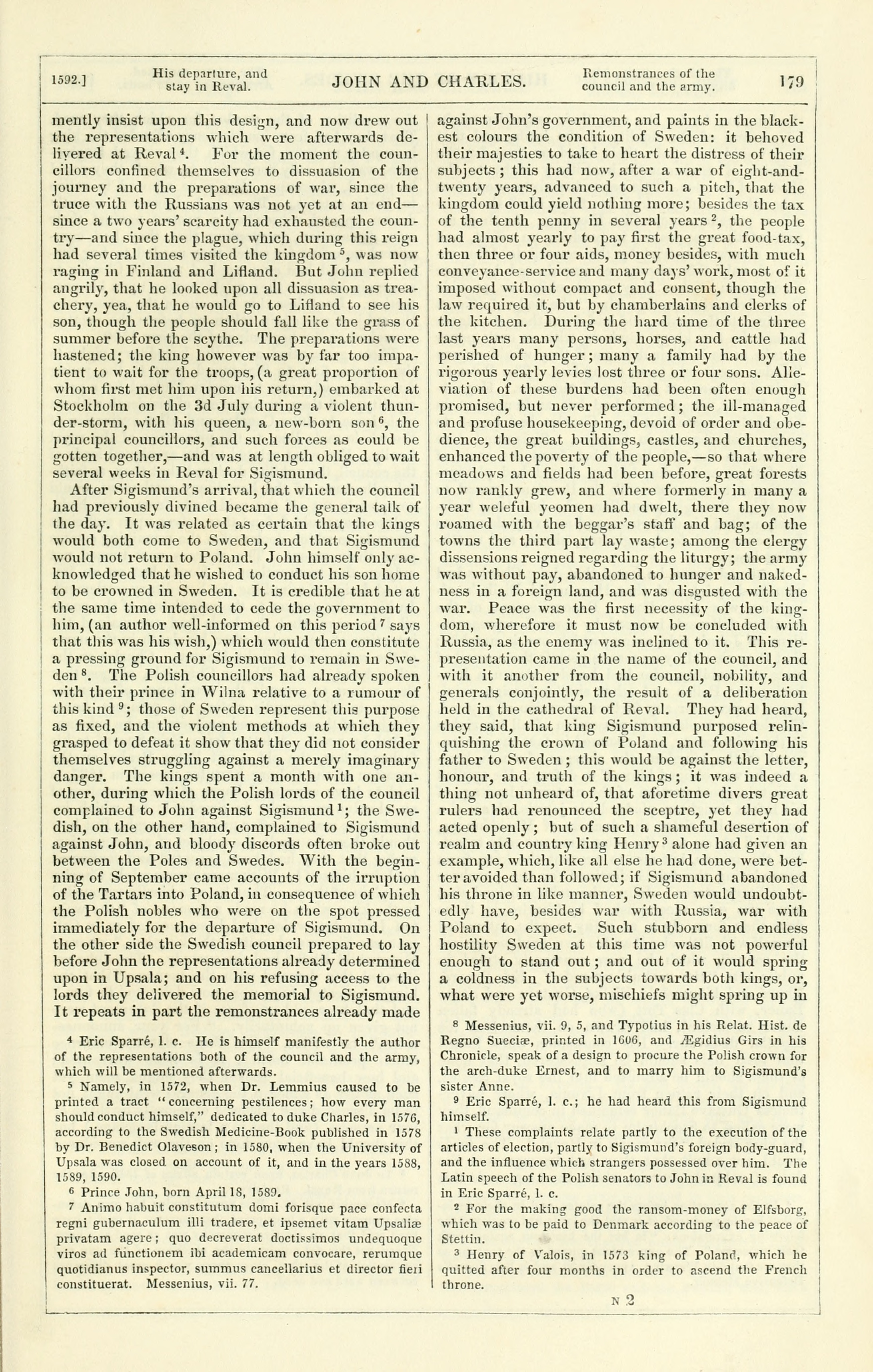
mently insist upon tliis
design, and now drew out I
the representations which were afterwards de-
livered at Reval *. For the moment the coun-
cillors confined themselves to dissuasion of the
journey and the preparations of war, since tlie
truce with the Russians was not yet at an end—
since a two years’ scarcity had exhausted the coun-
try
—and since the plague, which dui-ing this reign
had several times visited the kingdom ^, was now
raging in Finland and Lifland. But Jolni replied
angrilj’, that he looked upon all dissuasion as trea-
chery, yea, that he would go to Lifland to see his
son, though the people should fall like the grass of
summer befoi’e the scythe. The preparations were
hastened; the king however was by far too impa-
tient to wait for the troops, (a great proportion of
whom first met him upon his return,) embarked at
Stockholm on the 3d July during a violent thun-
der-storm, with his queen, a new-born son ^, the
principal councillors, and such forces as could be
gotten together,
—and was at length obliged to wait
several weeks in Reval for Sigisniund.
After Sigismund’s arrival, that which the council
had previously divined became the general talk of
the day. It was related as certain that the kings
would both come to Sweden, and that Sigismund
would not return to Poland. John himself only ac-
knowledged that he wished to conduct his son home
to be crowned in Sweden. It is credible that he at
the same time intended to cede the government to
him, (an author well-informed on this period
’
says
that this was his wish,) which would then constitute
a pressing ground for Sigismund to remain in Swe-
den *. The Polish councillors had already spoken
with their prince in Wilna relative to a rumour of
this kind ^; those of Sweden represent this purpose
as fixed, and the violent methods at which they
grasped to defeat it show that they did not consider
themselves struggling against a merely imaginary
danger. The kings spent a month with one an-
other, during which the Polish lords of the council
complained to John against Sigismund ^; the Swe-
dish, on the other hand, complained to Sigismund
against John, and bloody discords often broke out
between the Poles and Swedes. With the begin-
ning of September came accounts of the ii’ruption
of the Tartars into Poland, in consequence of which
the Polish nobles who were on the spot pressed
immediately for the departure of Sigismund. On
the other side the Swedish council prepared to lay
before John the representations already determined
upon in Upsala; and on his refusmg access to the
lords they delivered the memorial to Sigismund.
It repeats in part the remonstrances already made
••
Eric Sparre, 1. c. He is himself manifestly the author
of the representations hoth of the council and the army,
which will be mentioned afterwards.
s
Namely, in 1572, when Dr. Lemmius caused to he
printed a tract "
concerning pestilences ;
how every man
should conduct himself," dedicated to duke Charles, in 1576,
according to the Swedish Medicine-Book published in 1578
by Dr. Benedict Olaveson ; in 1580, when the University of
Upsala was closed on account of it, and in the years 1588,
1589, 1590.
6 Prince John, born April IS, 1589.
7 Animo habuit constitutum domi forisque pace confecta
regni gubernaculum illi tradere, et ipsemet vitam Upsalias
privatam agere ; quo decreverat doctissimos undequoque
viros ad functionem ibi academicam convocare, reruraque
quotidianus inspector, summus cancellarius et director fieii
constituerat. Messenius, vii. 77.
against John’s government, and paints in the black-
est colours the condition of Sweden: it behoved
their majesties to take to heart the distress of their
subjects ;
this had now, after a war of eight-and-
twenty years, advanced to such a pitch, that the
kingdom could yield nothing more; besides the tax
of the tenth penny in sevei’al years 2, the people
had almost yearly to pay first the great food- tax,
then three or four aids, money besides, with much
conveyance-service and many days’ work, most of it
imposed without compact and consent, though the
law required it, but by chamberlains and clerks of
the kitchen. During the hard time of the three
last years many persons, horses, and cattle had
perished of hunger ; many a family had by the
rigorous yearly levies lost three or four sons. Alle-
viation of these burdens had been often enough
promised, but never performed ;
the ill-managed
and profuse housekeeping, devoid of order and obe-
dience, the great buildings, castles, and churches,
enhanced the poverty of the people,
—so that where
meadows and fields had been before, great forests
now rankly grew, and where formerly in many a
year weleful yeomen had dwelt, there they now
roamed with the beggar’s staff and bag; of the
towns the third part lay waste; among the clergy
dissensions reigned regarding the liturgy; the army
was without pay, abandoned to hunger and naked-
ness in a foreign land, and was disgusted with the
war. Peace was the first necessity of the king-
dom, wherefore it must now be concluded with
Russia, as the enemy was inclined to it. This re-
presentation came in the name of the council, and
with it another from the council, nobility, and
generals conjointly, the result of a deliberation
held in the cathedral of Reval. They had heard,
they said, that king Sigismund purposed relin-
quishing the crown of Poland and following his
father to Sweden ;
this would be against the letter,
honour, and truth of the kings ;
it was indeed a
thing not unheard of, that aforetime divers great
rulers had renounced the sceptre, yet they had
acted openly ;
but of such a shameful desertion of
realm and country king Henry
^
alone had given an
example, which, like all else he had done, were bet-
ter avoided than followed; if Sigismund abandoned
his throne in like manner, Sweden would undoubt-
edly have, besides war with Russia, war with
Poland to expect. Such stubborn and endless
hostility Sweden at this time was not powerful
enough to stand out ;
and out of it would spring
a coldness in the subjects towards both kings, or,
what were yet worse, mischiefs might spring up in
8
Messenius, vii. 9, 5, and Typotius in his Relat. Hist, de
Regno Sueciae, printed in IG06, and ^Egidius Girs in his
Chronicle, speak of a design to procure the Polish crown for
the arch-duke Ernest, and to marry him to Sigismund’s
sister Anne.
3 Eric Sparre, 1. c; he had heard this from Sigismund
himself.
’
These complaints relate partly to the execution of the
articles of election, partly to Sigismund’s foreign body-guard,
and the influence which strangers possessed over him. The
Latin speech of the Polish senators to John in Reval is found
in Eric Sparre, 1. c.
2 For the making good the ransom-money of Elfsborg,
which was to be paid to Denmark according to the peace of
Stettin.
3
Henry of Valois, in 1573 king of Poland, which he
quitted after four months in order to ascend the French
throne.
N 2
<< prev. page << föreg. sida << >> nästa sida >> next page >>