Full resolution (JPEG)
- On this page / på denna sida
- XVII. Gustavus II. Adolphus. The German War. A.D. 1628—1632
<< prev. page << föreg. sida << >> nästa sida >> next page >>
Below is the raw OCR text
from the above scanned image.
Do you see an error? Proofread the page now!
Här nedan syns maskintolkade texten från faksimilbilden ovan.
Ser du något fel? Korrekturläs sidan nu!
This page has never been proofread. / Denna sida har aldrig korrekturlästs.
254
Views of the king as to
Swedisli intervention HISTORY OF THE SWEDES. in tlie wars of Germany.
State of that country.
[1628-
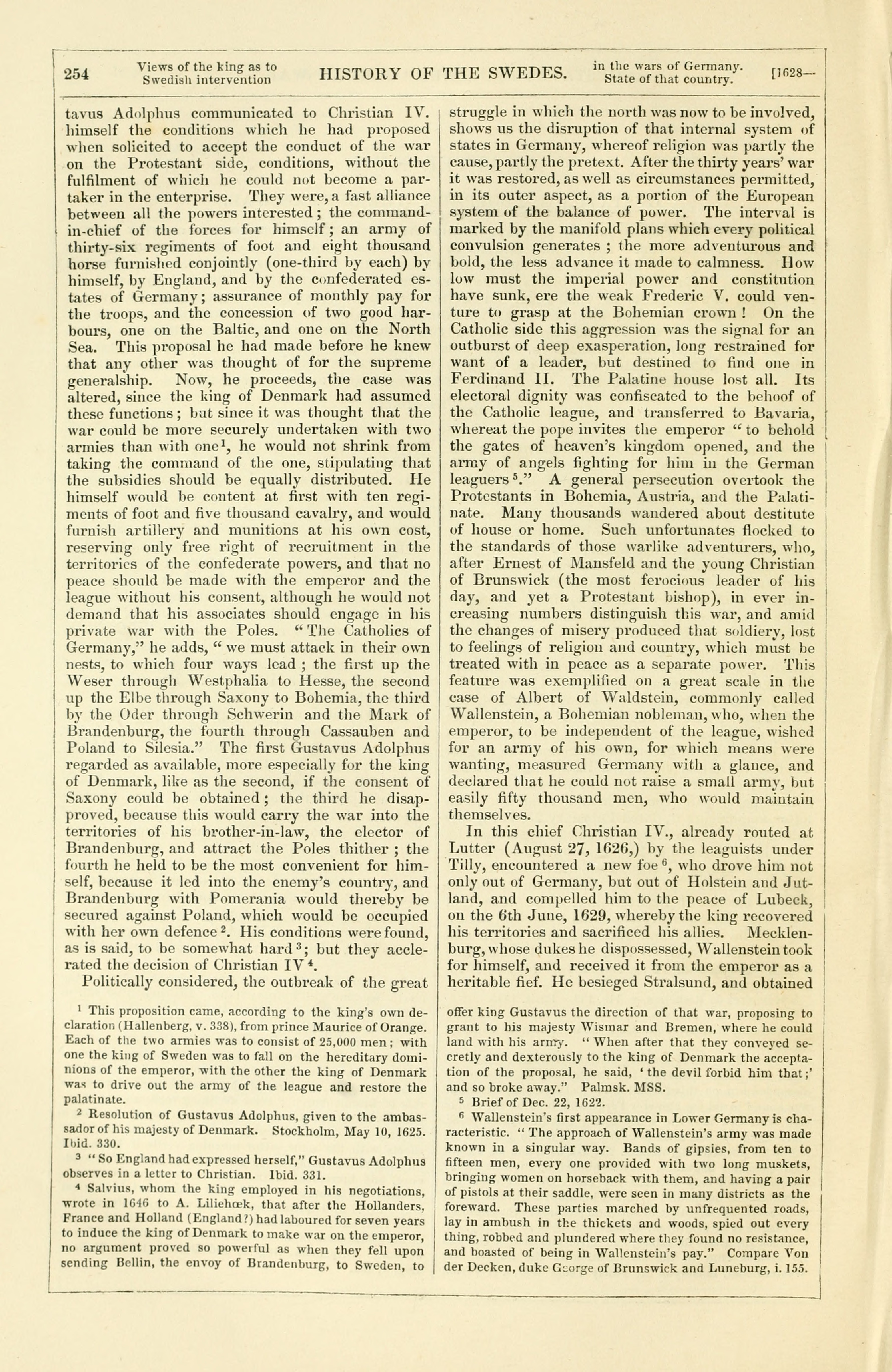
tavus Addlphus communicated to Christian IV.
himself the conditions wliich lie had proposed
when solicited to accept the conduct of the war
on the Protestant side, conditions, without the
fulfilment of which he could not become a par-
taker in the enterprise. They were, a fast alliance
between all the powers interested ;
the command-
in-chief of the forces for himself ;
an army of
thirty-six regiments of foot and eight thousand
horse furnished conjointly (one-third by each) by
himself, by England, and by the c<infederated es-
tates of Germany; assurance of monthly pay for
the troops, and the concession of two good har-
bours, one on the Baltic, and one on the North
Sea. This proposal he had made before he knew
that any other was thought of for the supreme
generalship. Now, he proceeds, the case was
altered, since the king of Denmark had assumed
these functions ;
but since it was thought that the
war could be more securely undertaken with two
armies than with one’, he would not shrink from
taking the command of the one, stipulating that
the subsidies should be equally distributed. He
himself would be content at first with ten regi-
ments of foot and five thousand cavalry, and would
furnish artillery and munitions at his own cost,
reserving only free right of recruitment in the
territories of the confederate powers, and that no
peace should be made with the emperor and the
league without his consent, although he would not
demand that his associates should engage in his
private war with the Poles. " The Catholics of
Germany," he adds,
" we must attack in their own
nests, to which four ways lead ;
the first up the
Weser through Westphalia to Hesse, the second
up the Elbe through Saxony to Bohemia, the third
by the Oder through Schwerin and the Mark of
Brandenburg, the fourth through Cassauben and
Poland to Silesia." The first Gustavus Adolphus
regarded as available, more especially for the king
of Denmark, like as the second, if the consent of
Saxony could be obtained ; the third he disap-
proved, because this would carry the war into the
territories of his brother-iu-law, the elector of
Brandenburg, and attract the Poles thither ;
the
fourth he held to be the most convenient for him-
self, because it led into the enemy’s country, and
Brandenburg with Pomerania would thereby be
secured against Poland, which would be occupied
with her own defence 2. His conditions were found,
as is said, to be somewhat hard ^
; but they accle-
rated the decision of Christian IV*.
Politically considered, the outbreak of the great
’
This proposition came, according to the king’s own de-
claration (Hallenbcrg, v. 338), from prince Maurice of Orange.
Each of the two armies was to consist of 25,000 men ; with
one the king of Sweden was to fall on the hereditary domi-
nions of the emperor, with the other the king of Denmark
was to drive out the array of the league and restore the
palatinate.
*
Resolution of Gustavus Adolphus, given to the ambas-
sador of his majesty of Denmark. Stockholm, May 10, 1625.
Ibid. 330.
3 " So England had expressed herself," Gustavus Adolphus
observes in a letter to Christian. Ibid. 331.
••
Salvius, whom the king employed in his negotiations,
wrote in KHG to A. Liliehoek, that after the Hollanders,
France and Holland (England .’) had laboured for seven years
to induce the king of Denmark to make war on the emperor,
no argument proved so poweiful as when they fell upon
sending Bcllin, the envoy of Brandenburg, to Sweden, to
struggle in which the north was now to be involved,
shows us the disruption of that internal system of
states in Germany, whereof religion was partly the
cause, partly the pretext. After the thirty years’ war
it was restored, as well as circumstances permitted,
in its outer aspect, as a portion of the European
system of the balance of power. The interval is
marked by the manifold plans which every political
convulsion generates ;
the more adventurous and
bold, the less advance it made to calmness. How
low must the imperial power and constitution
have sunk, ere the weak Frederic V. could ven-
ture to grasp at the Bohemian crown ! On the
Catholic side this aggression was the signal for an
outburst of deep exasperation, long restrained for
want of a leader, but destined to find one in
Ferdinand II. The Palatine house lost all. Its
electoral dignity was confiscated to the behoof of
the Catholic league, and transferred to Bavaria,
whereat the pope invites the emperor
" to behold
the gates of heaven’s kingdom opened, and the
army of angels fighting for him in the German
leaguers ^." A general persecution overtook the
Protestants in Bohemia, Austria, and the Palati-
nate. Many thousands wandered about destitute
of house or home. Such unfortunates flocked to
the standards of those warlike adventurers, who,
after Ernest of Mansfeld and the young Christian
of Brunswick (the most ferocious leader of his
day, and yet a Protestant bishop), in ever in-
creasing numbers distinguish this war, and amid
the changes of misery produced that soldiery, lost
to feelings of religion and country, which must be
treated with in peace as a sejiarate power. This
feature was exemplified on a great scale in the
case of Albert of Waldstein, commonly called
Wallensteiu, a Bohemian nobleman, who, when the
emperor, to be independent of the league, wished
for an army of his own, for which means were
wanting, measured Germany with a glance, and
declared that he could not raise a small army, but
easily fifty thousand men, who would maintain
themselves.
In this chief Christian IV., already routed at
Lutter (August 27, 1626,) by the leaguists under
Tilly, encountered a new foe ^, who drove him not
only out of Germany, but out of Holstein and Jut-
land, and compelled him to the peace of Lubeck,
on the 6th June, 1629, whereby the king recovered
his territories and sacrificed his allies. Mecklen-
burg, whose dukes he dispossessed, Wallensteiu took
for himself, and received it from the emperor as a
heritable fief. He besieged Stralsund, and obtained
offer king Gustavus the direction of that war, proposing to I
grant to his majesty Wismar and Bremen, where he could
land with his arm>’.
" When after that they conveyed se-
cretly and dexterously to the king of Denmark the accepta-
tion of the proposal, he said, ’the devil forbid him that;’
and so broke away." Palmsk. MSS.
5 Brief of Dec. 22, 1622.
6 Wallenstein’s first appearance in Lower Germany is cha-
racteristic.
" The approach of Wallenstein’s army was made
known in a singular way. Bands of gipsies, from ten to
fifteen men, every one provided with two long muskets,
bringing women on horseback with them, and having a pair
of pistols at their saddle, were seen in many districts as the
foreward. These parties marched by unfrequented roads,
lay in ambush in the thickets and woods, spied out every
thing, robbed and plundered where they found no resistance,
and boasted of being in Wallenstein’s pay." Compare Von
der Decken, duke George of Brunswick and Luneburg, i. 155.
<< prev. page << föreg. sida << >> nästa sida >> next page >>
Project Runeberg, Sun Dec 10 07:08:34 2023
(aronsson)
(download)
<< Previous
Next >>
https://runeberg.org/histswed/0280.html