Full resolution (JPEG) - On this page / på denna sida - XLII - Gudumkloster
<< prev. page << föreg. sida << >> nästa sida >> next page >>
Below is the raw OCR text
from the above scanned image.
Do you see an error? Proofread the page now!
Här nedan syns maskintolkade texten från faksimilbilden ovan.
Ser du något fel? Korrekturläs sidan nu!
This page has never been proofread. / Denna sida har aldrig korrekturlästs.
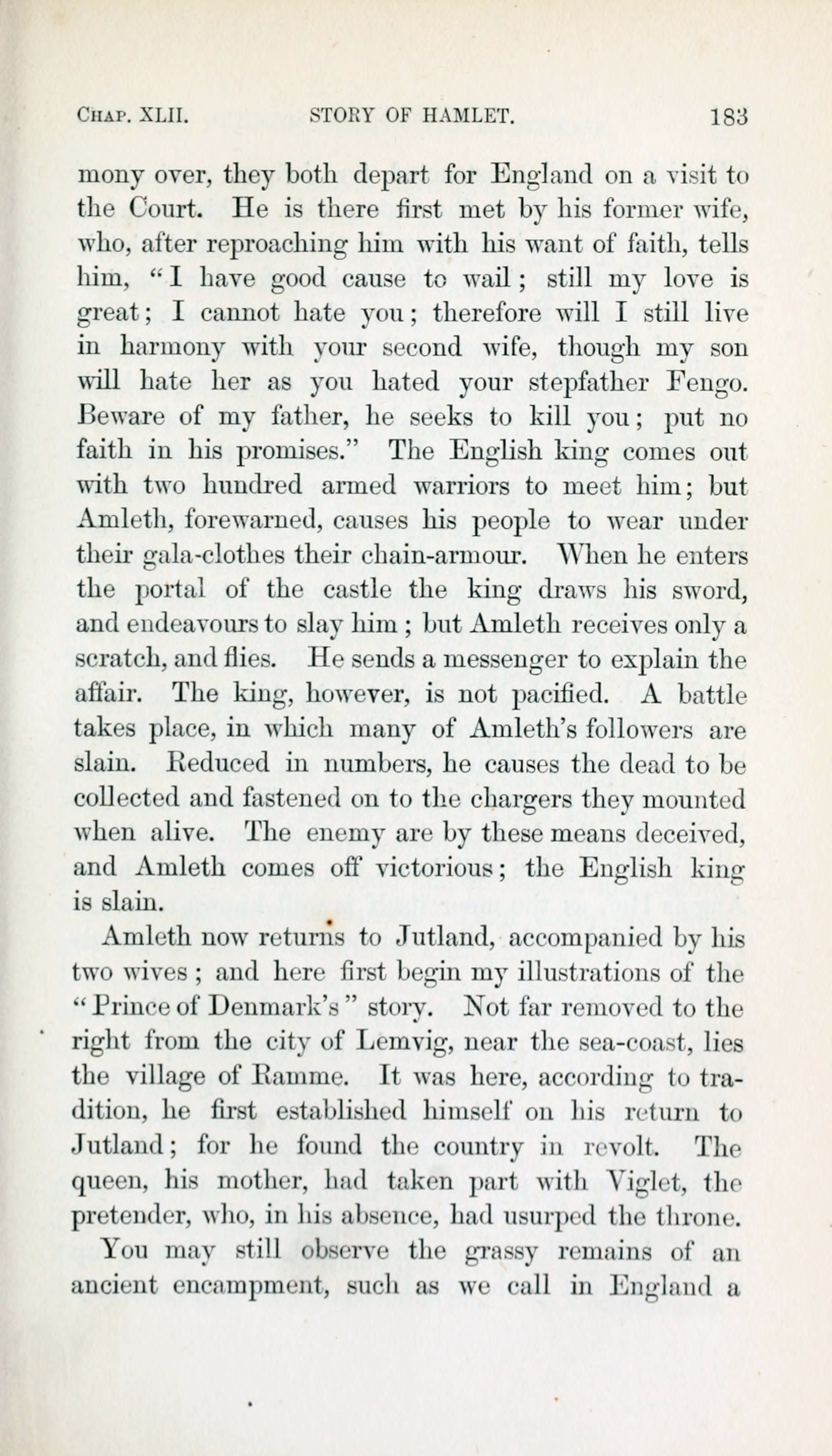
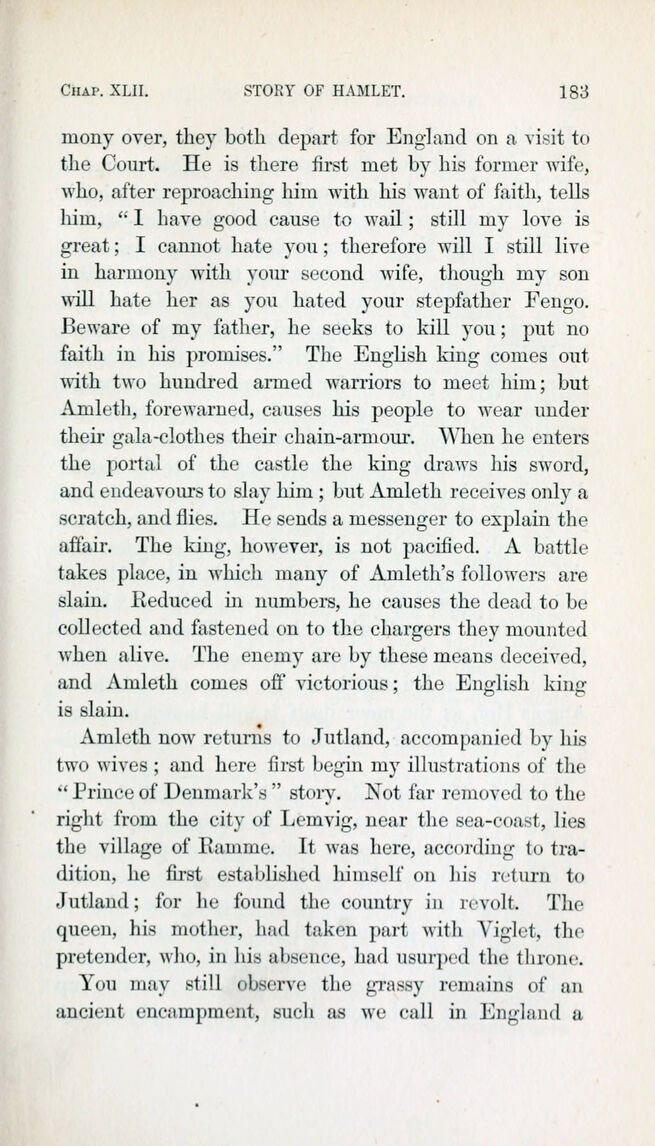
Chap. XLII.
STORY OF HAMLET.
183
mony over, they both depart for England on a visit to
the Court. He is there first met by his former wife,
who, after reproaching him with his want of faith, tells
him, “ I have good cause to wail; still my love is
great; I cannot hate you; therefore will I still live
in harmony with your second wife, though my son
will hate her as you hated your stepfather Fengo.
Beware of my father, he seeks to kill you; put no
faith in his promises.” The English king comes out
with two hundred armed warriors to meet him; but
Amleth, forewarned, causes his people to wear under
their gala-clothes their chain-armour. When he enters
the portal of the castle the king draws his sword,
and endeavours to slay him ; but Amleth receives only a
scratch, and flies. He sends a messenger to explain the
affair. The king, however, is not pacified. A battle
takes place, in which many of Amleth’s followers are
slain. Reduced in numbers, he causes the dead to be
collected and fastened on to the chargers they mounted
when alive. The enemy are by these means deceived,
and Amleth comes off victorious; the English king
is slain.
Amleth now returns to Jutland, accompanied by his
two wives ; and here first begin my illustrations of the
“ Prince of Denmark’s ” story. Not far removed to the
right from the city of Lemvig, near the sea-coast, lies
the village of Ramme. It was here, according to
tradition, he first established himself on his return to
Jutland; for he found the country in revolt. The
queen, his mother, had taken part with Viglct, the
pretender, who, in his absence, had usurped the throne.
You may still observe the grassy remains of an
ancient encampment, such as we call in England a
<< prev. page << föreg. sida << >> nästa sida >> next page >>