
Full resolution (JPEG) - On this page / på denna sida - Sidor ...
<< prev. page << föreg. sida << >> nästa sida >> next page >>
Below is the raw OCR text
from the above scanned image.
Do you see an error? Proofread the page now!
Här nedan syns maskintolkade texten från faksimilbilden ovan.
Ser du något fel? Korrekturläs sidan nu!
This page has never been proofread. / Denna sida har aldrig korrekturlästs.
12
INTBODUOTION.
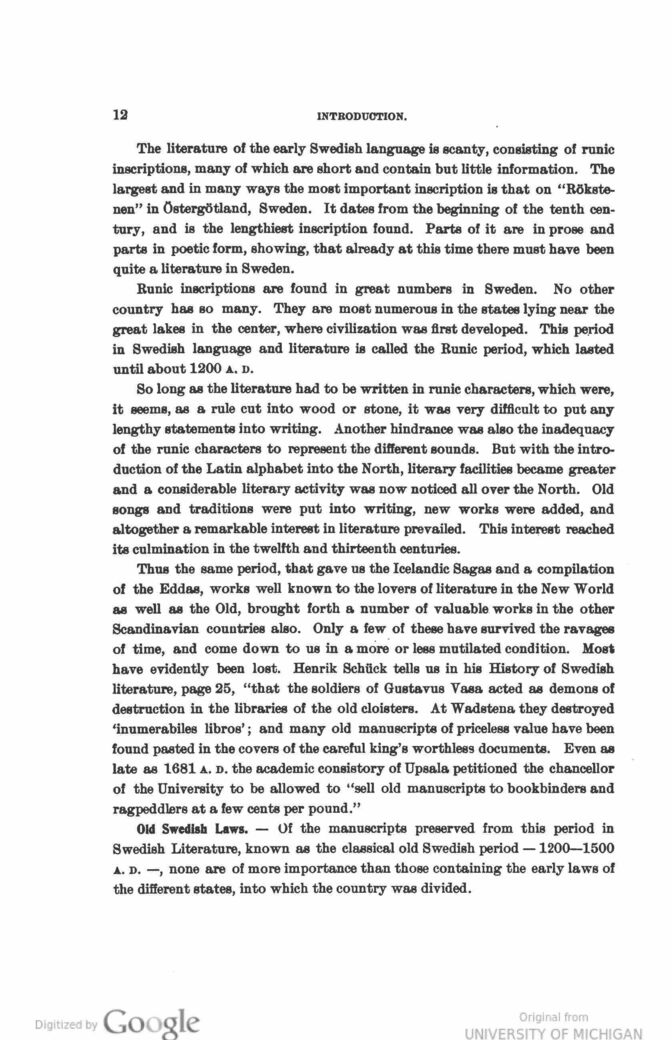
The literature of the early Swedish language is scanty, consisting of runic
inscriptions, many of which are short and contain but little information. The
largest and in many ways the most important inscription is that on
"Rökstenen" in Östergötland, Sweden. It dates from the beginning of the tenth
century, and is the lengthiest inscription found. Parts of it are in prose and
parts in poetic form, showing, that already at this time there must have been
quite a literature in Sweden.
Runic inscriptions are found in great numbers in Sweden. No other
country has so many. They are most numerous in the states lying near the
great lakes in the center, where civilization was first developed. This period
in Swedish language and literature is called the Runic period, which lasted
until about 1200 a. d.
So long as the literature had to be written in runic characters, which were,
it seems, as a rule cut into wood or stone, it was very difficult to put any
lengthy statements into writing. Another hindrance was also the inadequacy
of the runic characters to represent the different sounds. But with the
introduction of the Latin alphabet into the North, literary facilities became greater
and a considerable literary activity was now noticed all over the North. Old
songs and traditions were put into writing, new works were added, and
altogether a remarkable interest in literature prevailed. This interest reached
its culmination in the twelfth and thirteenth centuries.
Thus the same period, that gave us the Icelandic Sagas and a compilation
of the Eddas, works well known to the lovers of literature in the New World
as well as the Old, brought forth a number of valuable works in the other
Scandinavian countries also. Only a few of these have survived the ravages
of time, and come down to us in a more or less mutilated condition. Most
have evidently been lost. Henrik Schiick tells us in his History of Swedish
literature, page 25, "that the soldiers of Gustavus Vasa acted as demons of
destruction in the libraries of the old cloisters. At Wadstena they destroyed
’inumerabiles libros’; and many old manuscripts of priceless value have been
found pasted in the covers of the careful king’s worthless documents. Even as
låte as 1681 a. d. the academic consistory of Upsala petitioned the chancellor
of the University to be allowed to "sell old manuscripts to bookbinders and
ragpeddlers at a few cents per pound."
Old Swedish Laws. — Of the manuscripts preserved from this period in
Swedish Literature, known as the classical old Swedish period — 1200—1500
a. d. —, none are of more importance than those containing the early laws of
the different states, into which the country was divided.
<< prev. page << föreg. sida << >> nästa sida >> next page >>


