
Full resolution (JPEG) - On this page / på denna sida - Sidor ...
<< prev. page << föreg. sida << >> nästa sida >> next page >>
Below is the raw OCR text
from the above scanned image.
Do you see an error? Proofread the page now!
Här nedan syns maskintolkade texten från faksimilbilden ovan.
Ser du något fel? Korrekturläs sidan nu!
This page has never been proofread. / Denna sida har aldrig korrekturlästs.
50
THE LAW OF THE WE8TGOTH8.
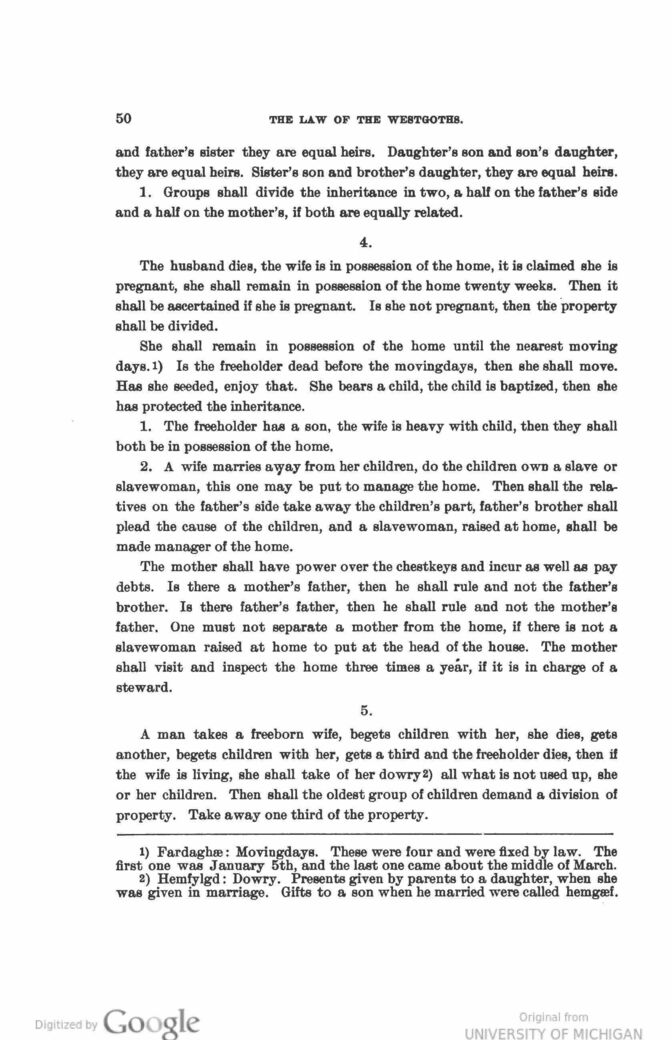
and father’s sister they are equal heirs. Daughter’s son and son’s daughter,
they are equal heirs. Sister’s son and brother’s daughter, they are equal heirs.
1. Groups shall divide the inheritance in two, a half on the father’s side
and a half on the mother’s, if both are equally related.
4.
The husband dies, the wife is in possession of the home, it is claimed she is
pregnant, she shall remain in possession of the home twenty weeks. Then it
shall be ascertained if she is pregnant. Is she not pregnant, then the property
shall be divided.
She shall remain in possession of the home until the nearest moving
days, l) Is the freeholder dead before the movingdays, then she shall move.
Has she seeded, enjoy that. She bears a child, the child is baptized, then she
has protected the inheritance.
1. The freeholder has a son, the wife is heavy with child, then they shall
both be in possession of the home.
2. A wife marries aiyay from her children, do the children own a slave or
slavewoman, this one may be put to manage the home. Then shall the
relatives on the father’s side take away the children’s part, father’s brother shall
plead the cause of the children, and a slavewoman, raised at home, shall be
made manager of the home.
The mother shall have power over the chestkeys and incur as well as pay
debts. Is there a mother’s father, then he shall rule and not the father’s
brother. Is there father’s father, then he shall rule and not the mother’s
father. One must not separate a mother from the home, if there is not a
slavewoman raised at home to put at the head of the house. The mother
shall visit and inspect the home three times a year, if it is in charge of a
steward.
5.
A man takes a freeborn wife, begets children with her, she dies, gets
another, begets children with her, gets a third and the freeholder dies, then if
the wife is living, she shall take of her dowry 2) all what is not used up, she
or her children. Then shall the oldest group of children demand a division of
property. Take away one third of the property.
1) Fardaghæ: Movingdays. These were four and were fixed by law. The
first one was January 5th, and the last one came about the middle of March.
2) Hemfylgd: Dowry. Presents given by parents to a daughter, when she
was given in marriage. Gifts to a son when he married were called hemgæf.
<< prev. page << föreg. sida << >> nästa sida >> next page >>


