Full resolution (JPEG) - On this page / på denna sida - Sidor ...

<< prev. page << föreg. sida << >> nästa sida >> next page >>
Below is the raw OCR text
from the above scanned image.
Do you see an error? Proofread the page now!
Här nedan syns maskintolkade texten från faksimilbilden ovan.
Ser du något fel? Korrekturläs sidan nu!
This page has never been proofread. / Denna sida har aldrig korrekturlästs.
THE LAW OF" THE WE8TGOTH8.
53
14.
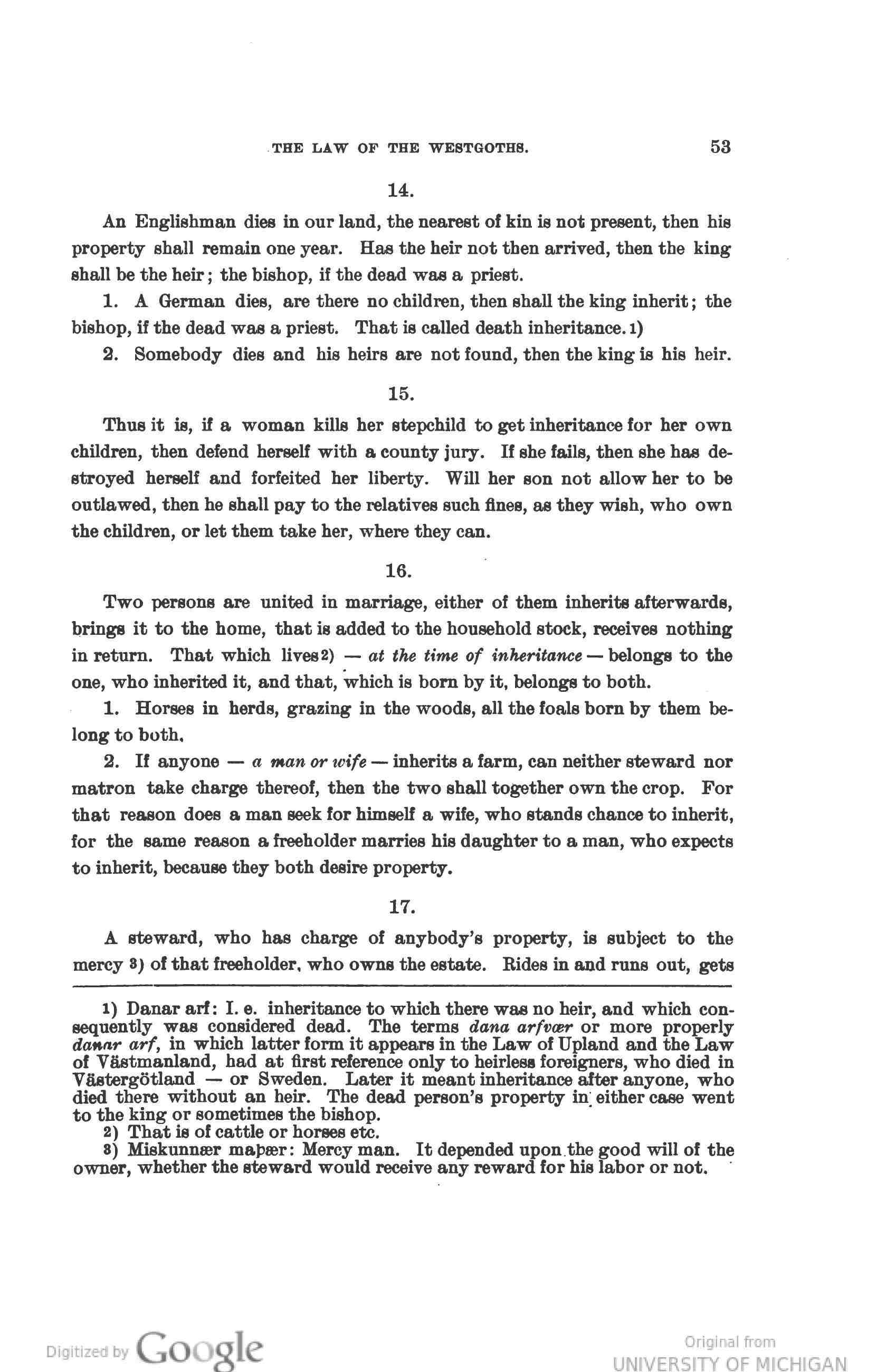
An Englishman dies in our land, the nearest of kin is not present, then his
property shall remain one year. Has the heir not then arrived, then the king
shall be the heir; the bishop, if the dead was a priest.
1. A German dies, are there no children, then shall the king inherit; the
bishop, if the dead was a priest. That is called death inheritance, l)
2. Somebody dies and his heirs are not found, then the king is his heir.
15.
Thus it is, if a woman kills her stepchild to get inheritance for her own
children, then defend herself with a county jury. If she fails, then she has
destroyed herself and forfeited her liberty. Will her son not allow her to be
outlawed, then he shall pay to the relatives such fines, as they wish, who own
the children, or let them take her, where they can.
16.
Two persons are united in marriage, either of them inherits afterwards,
brings it to the home, that is added to the household stock, receives nothing
in return. That which lives 2) — at the time of inheritance — belongs to the
one, who inherited it, and that, which is born by it, belongs to both.
1. Horses in herds, grazing in the woods, all the foals born by them
belong to both.
2. If anyone — a man or wife — inherits a farm, can neither steward nor
matron take charge thereof, then the two shall together own the crop. For
that reason does a man seek for himself a wife, who stands chance to inherit,
for the same reason a freeholder marries his daughter to a man, who expects
to inherit, because they both desire property.
17.
A steward, who has charge of anybody’s property, is subject to the
mercy 8) of that freeholder, who owns the estate. Rides in and runs out, gets
1) Danar arf: I. e. inheritance to which there was no heir, and which
consequently was considered dead. The terms dana arf veer or more properly
dannr arf, in which latter form it appears in the Law of Upland and the Law
of Västmanland, had at first reference only to heirless foreigners, who died in
Västergötland — or Sweden. Later it meant inheritance after anyone, who
died there without an heir. The dead person’s property in; either case went
to the king or sometimes the bishop.
2) That is of cattle or horses etc.
8) Miskunnær mapær: Mercy man. It depended upon the good will of the
owner, whether the steward would receive any reward for his labor or not.
<< prev. page << föreg. sida << >> nästa sida >> next page >>