Full resolution (JPEG) - On this page / på denna sida - Sidor ...
<< prev. page << föreg. sida << >> nästa sida >> next page >>
Below is the raw OCR text
from the above scanned image.
Do you see an error? Proofread the page now!
Här nedan syns maskintolkade texten från faksimilbilden ovan.
Ser du något fel? Korrekturläs sidan nu!
This page has never been proofread. / Denna sida har aldrig korrekturlästs.
46
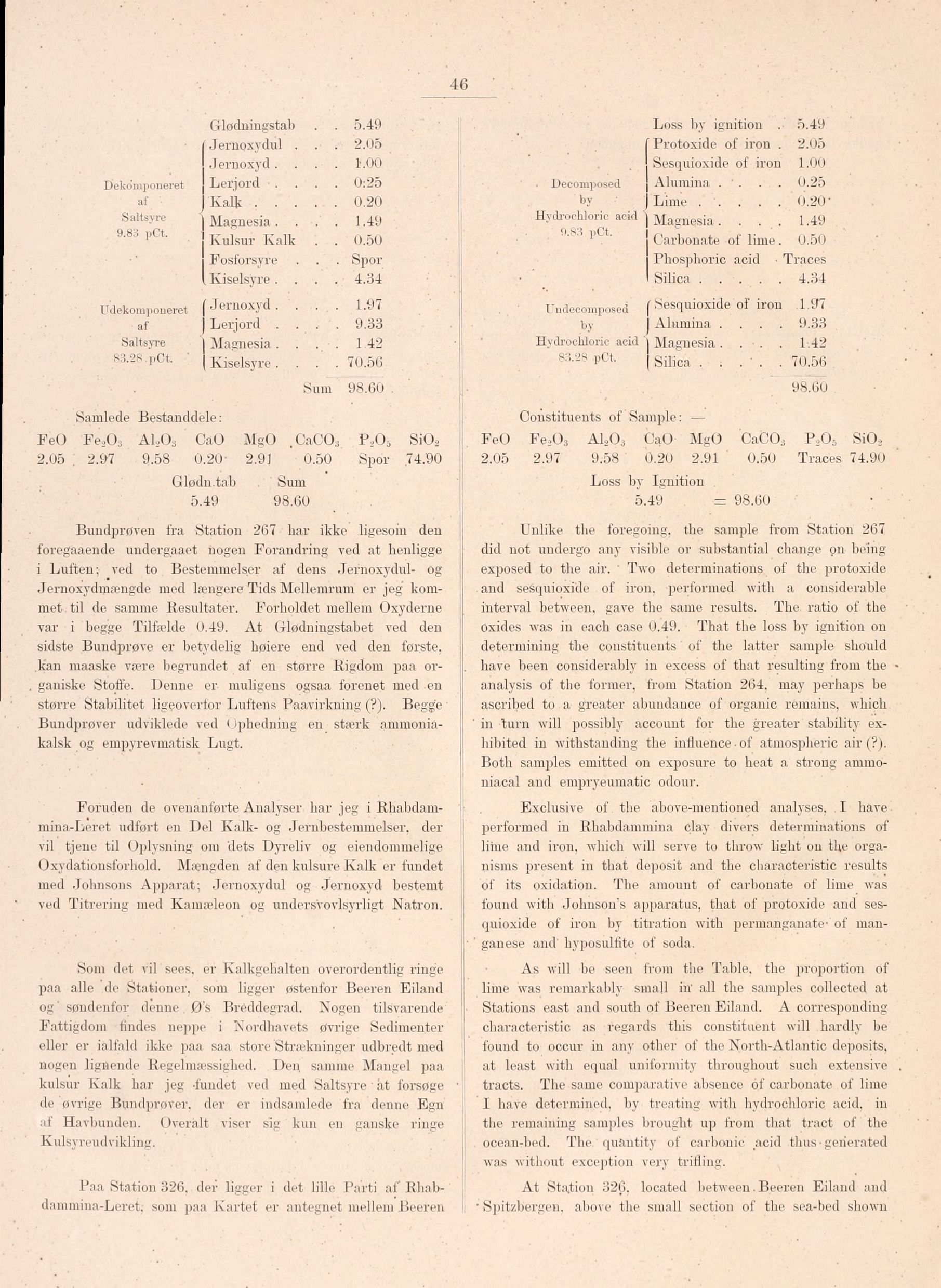
Glødningstal) . . 5.49
Jernoxydul . 2.05
Jernoxyd. . . . 1.00
Dekomponeret Lerjord . . . . 0:25
af Kali..... 0.20
Saltsyre Magnesia. . . . 1 49
9.83 pCt. Kulsur Kalk 0.50
Fosforsyre Spor
Kiselsyre . 4.34
Udekomponeret Jernoxyd. . . . 1.97
af Lerjord . . . . 9.33
Saltsyre Magnesia. . . . 1.42
83.28 .pCt. Kiselsyre. . . . 70.56
Sum 98.60
Samlede Bestanddele:
FeO Fe203 AL,03 CaO MgO tCaC03 P205 Si02
2.05 . 2.97 9.58 0.20- 2.9] 0.50 Spor 74.90
Glødu.tab Sum
5.49 98.60
Bundprøven fra Station 267 har ikke ligesom den
foregaaende undergaaet nogen Forandring ved at henligge
i Luften; ved to Bestemmelser af dens Jernoxydul- og
Jernoxydmængde med længere Tids Mellemrum er jeg
kommet til de samme Resultater. Forholdet mellem Oxyderne
var i begge Tilfælde 0.49. At Glødningstabet ved den
sidste Bundprøve er betydelig høiere end ved den første,
kan maaske være begrundet af en større Rigdom paa
organiske Stoffe. Denne er muligens ogsaa forenet med en
større Stabilitet ligeovertor Luftens Paavirkning (?). Begge
Bundprøver udviklede ved Ophedning en stærk
ammonia-kalsk og empyrevmatisk Lugt.
Foruden de ovenanførte Analyser har jeg i
Rhabdam-mina-Leret udført en Del Kalk- og Jernbestemmelser, der
vil tjene til Oplysning om dets Dyreliv og eiendommelige
Oxydationsforhold. Mængden af den kulsure Kalk er fundet
med Johnsons Apparat; Jernoxydul og Jernoxyd bestemt
ved Titrering med Kamæleon og unders’vovlsyrligt Natron.
Som det vil sees. er Kalkgehalten overordentlig ringe
paa alle de Stationer, som ligger østenfor Beeren Eiland
og’ söndenfor denne. Ø’s Breddegrad. Nogen tilsvarende
Fattigdom findes neppe i Nordhavets øvrige Sedimenter
eller er ialfald ikke paa saa store Strækninger udbredt med
nogen lignende Regelmæssighed. Den samme Mangel paa
kulsur Kalk har jeg -fundet ved med Saltsyre at forsøge
de øvrige Bundprøver, der er indsamlede fra denne Egn
af Havbunden. Overalt viser sig kun en ganske ringe
Kulsyreudvikling.
Paa Station 326. der ligger i det lille Parti af
Rhab-dammina-Leret. som paa Kartet er antegnet mellem Beeren
. Decomposed
by
Hydrochloric acid
0.83 pCt.
Undecomposed
by
Hydrochloric acid
83.28 pCt.
Loss by ignition . 5.49
Protoxide of iron . 2.05
Sesquioxide of iron 1.00
Alumina . . . . 0.25
Lime.....0.20 •
Magnesia. . . . 1.49
Carbonate of lime. 0.50
Phosphoric acid Traces
Silica.....4.34
Sesquioxide of iron .1.97
Alumina .... 9.33
Magnesia. . . . 1.42
Silica . . . ’ . . 70.56
98.60
Constituents of Sample: —
FeO Fe*03 A1203 CaO MgO CaC03 P205 Si02
2.05 2.97 9.58 0.2O 2.91 0.50 Traces 74.90
Loss by Ignition
5.49 = 98.60
Unlike the foregoing, the sample from Station 267
did not undergo any visible or substantial change on being
exposed to the air. " Two determinations of the protoxide
and sesquioxide of iron, performed with a considerable
interval between, gave the same results. The ratio of the
oxides was in each case 0.49. That the loss by ignition on
determining the constituents of the latter sample should
have been considerably in excess of that resulting from the
analysis of the former, from Station 264, may perhaps be
ascribed to a greater abundance of organic remains, which
in ’turn will possibly account for the greater stability
exhibited in withstanding the influence • of atmospheric air (?).
Both samples emitted on exposure to heat a strong
ammo-niacal and empryeumatic odour.
Exclusive of the above-mentioned analyses, . I have
performed in Rhabdammina clay divers determinations of
liine and iron, which will serve to throw light on the
organisms present in that deposit and the characteristic results
of its oxidation. The amount of carbonate of lime was
found with Johnson’s apparatus, that of protoxide and
sesquioxide of iron by titration with permanganate- of
man-’ gan ese and hyposulfite of soda.
As will be seen from the Table, the proportion of
lime was remarkably small in’ all the samples collected at
Stations east and south of Beeren Eiland. A corresponding
characteristic as regards this constituent will hardly be
found to occur in any other of the North-Atlantic deposits,
at least with equal uniformity throughout such extensive
tracts. The same comparative absence of carbonate of lime
I have determined, by treating with hydrochloric acid, in
the remaining samples brought up from that tract of the
ocean-bed. The quantity of carbonic acid thus • generated
was without exception very trifling.
At Station 326, located between. Beeren Eiland and
’ Spitzbergen. above the small section of the sea-bed shown
<< prev. page << föreg. sida << >> nästa sida >> next page >>