Full resolution (JPEG) - On this page / på denna sida - Sidor ...

<< prev. page << föreg. sida << >> nästa sida >> next page >>
Below is the raw OCR text
from the above scanned image.
Do you see an error? Proofread the page now!
Här nedan syns maskintolkade texten från faksimilbilden ovan.
Ser du något fel? Korrekturläs sidan nu!
This page has never been proofread. / Denna sida har aldrig korrekturlästs.
224
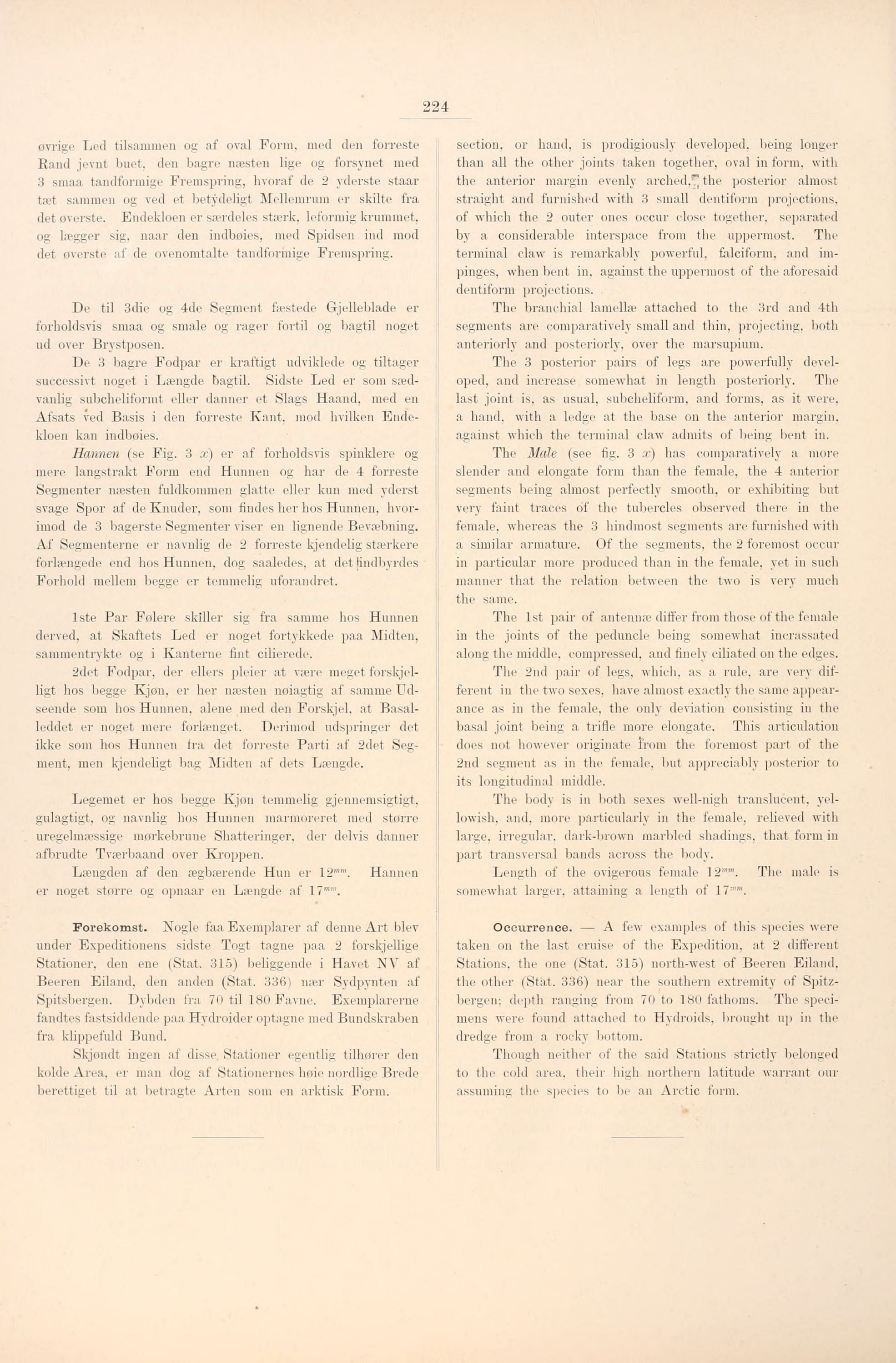
øvrige Led tilsammen og af oval Form. med den forreste
Rand jevnt buet, den bagre næsten Uge og forsynet med
3 smaa tandformige Fremspring, hvoraf de 2 yderste staar
tæt sammen og ved et betydeligt Mellemrum er skilte fra
det øverste. Endekloen er særdeles stærk, leformig krummet,
og lægger sig, naar den indbøies, med Spidsen ind mod
det overste af de ovenomtalte tandformige Fremspring.
De til 3die og 4de Segment fæstede Gjelleblade er
forholdsvis smaa og smale og rager fortil og bagtil noget
ud over Brystposen.
De 3 bagre Fodpar er kraftigt udviklede og tiltager
successivt noget i Længde bagtil. Sidste Led er som
sædvanlig subcheliformt eller danner et Slags Haand, med en
Afsats ved Basis i den forreste Kant, mod hvilken
Endekloen kan indbøies.
Hannen (se Fig. 3 x) er af forholdsvis spinklere og
mere langstrakt Form end Hunnen og har de 4 forreste
Segmenter næsten fuldkommen glatte eller kun med yderst
svage Spor af de Knuder, som findes her hos Hunnen,
hvorimod de 3 bagerste Segmenter viser en lignende Bevæbning.
Af Segmenterne er navnlig de 2 forreste kjendelig stærkere
forlængede end hos Hunnen, dog saaledes, at det (indbyrdes
Forhold mellem begge er temmelig uforandret.
lste Par Folere skiller sig fra samme hos Hunnen
derved, at Skaftets Led er noget fortykkede paa Midten,
sammentrykte og i Kanterne fint cilierede.
2det Fodpar, der ellers pleier at være meget
forskjelligt hos begge Kjøn, er her næsten nøiagtig af samme
Udseende som hos Hunnen, alene med den Forskjel, at
Basalleddet er noget mere forlænget. Derimod udspringer det
ikke som hos Hunnen fra det forreste Parti af 2det
Segment, men kjendeligt bag Midten af dets Længde.
Legemet er hos begge Kjøn temmelig gjennemsigtigt,
gulagtigt, og navnlig hos Hunnen marmoreret med større
uregelmæssige mørkebrune Shatteringer, der delvis danner
afbrudte Tværbaand over Kroppen.
Længden af den ægbærende Hun er 12""". Hannen
er noget større og opnaar en Længde af 17""".
Forekomst. Nogle faa Exemplarer af denne Art lilev
under Expeditionen sidste Togt tagne paa 2 forskjellige
Stationer, den ene (Ståt, 315) beliggende i Havet NV af
Beeren Eiland, den anden (Ståt. 336) nær Sydpynten af
Spitsbergen. Dybden fra 70 til 180 Favne. Exemplarerne
fandtes fastsiddende paa Hydroider optagne med Bundskraben
fra klippefuld Bund.
Skjøndt ingen af disse. Stationer egentlig tilhører den
kolde Area, er man dog af Stationernes høie nordlige Brede
berettiget til at betragte Arten som en arktisk Fonn.
section, or hand, is prodigiously developed, being longer
than all the other joints taken together, oval in form, with
the anterior margin evenly arched.^ the posterior almost
straight and furnished with 3 small dentiform projections,
of which the 2 outer ones occur close together, separated
by a considerable interspace from the uppermost. The
terminal claw is remarkably powerful, falciform, and
impinges, when bent in. against the uppermost of the aforesaid
dentiform projections.
The branchial lamellae attached to the 3rd and 4th
segments are comparatively small and thin, projecting, both
anteriorly and posteriorly, over the marsupium.
The 3 posterior pairs of legs are powerfully
developed, and increase somewhat in length posteriorly. The
last joint is, as usual, subcheliform, and forms, as it were,
a hand, with a ledge at the base on the anterior margin,
against which the terminal claw admits of being bent in.
The Male (see fig. 3 x) lias comparatively a more
slender and elongate form than the female, the 4 anterior
segments being almost perfectly smooth, or exhibiting but
very faint traces of the tubercles observed there in the
female, whereas the 3 hindmost segments are furnished with
a similar armature. Of the segments, the 2 foremost occur
in particular more produced than in the female, vet in such
manner that the relation between the two is very much
the same.
The 1st pair of antennæ differ from those of the female
in the joints of the peduncle being somewhat incrassated
along the middle, compressed, and finely ciliated on the edges.
The 2nd pair of legs, which, as a rule, are very
different in the two sexes, have almost exactly the same
appearance as in tile female, the only deviation consisting in the
basal joint being a trifle more elongate. This articulation
does not however originate from the foremost part of the
2nd segment as in the female, but appreciably posterior to
its longitudinal middle.
The body is in both sexes well-nigh translucent,
yellowish, and, more particularly in the female, relieved with
large, irregular, dark-brown marbled shadings, that form in
part transversal bands across the body.
Length of the ovigerous female 12""". The male is
somewhat larger, attaining a length of 17"’"’.
Occurrence. — A few examples of this species were
taken on the last cruise of the Expedition, at 2 different
Stations, the one (Ståt. 315) north-west of Beeren Eiland.
the other (Ståt. 336) near the southern extremity of
Spitzbergen: depth ranging from 70 to 180 fathoms. The
specimens were found attached to Hydroids, brought up in the
dredge from a rocky bottom.
Though neither of the said Stations strictly belonged
to the cold area, their high northern latitude warrant our
assuming the species fo be an Arctic form.
<< prev. page << föreg. sida << >> nästa sida >> next page >>