Full resolution (JPEG) - On this page / på denna sida - Literature, by Chr. Brinchmann
<< prev. page << föreg. sida << >> nästa sida >> next page >>
Below is the raw OCR text
from the above scanned image.
Do you see an error? Proofread the page now!
Här nedan syns maskintolkade texten från faksimilbilden ovan.
Ser du något fel? Korrekturläs sidan nu!
This page has been proofread at least once.
(diff)
(history)
Denna sida har korrekturlästs minst en gång.
(skillnad)
(historik)
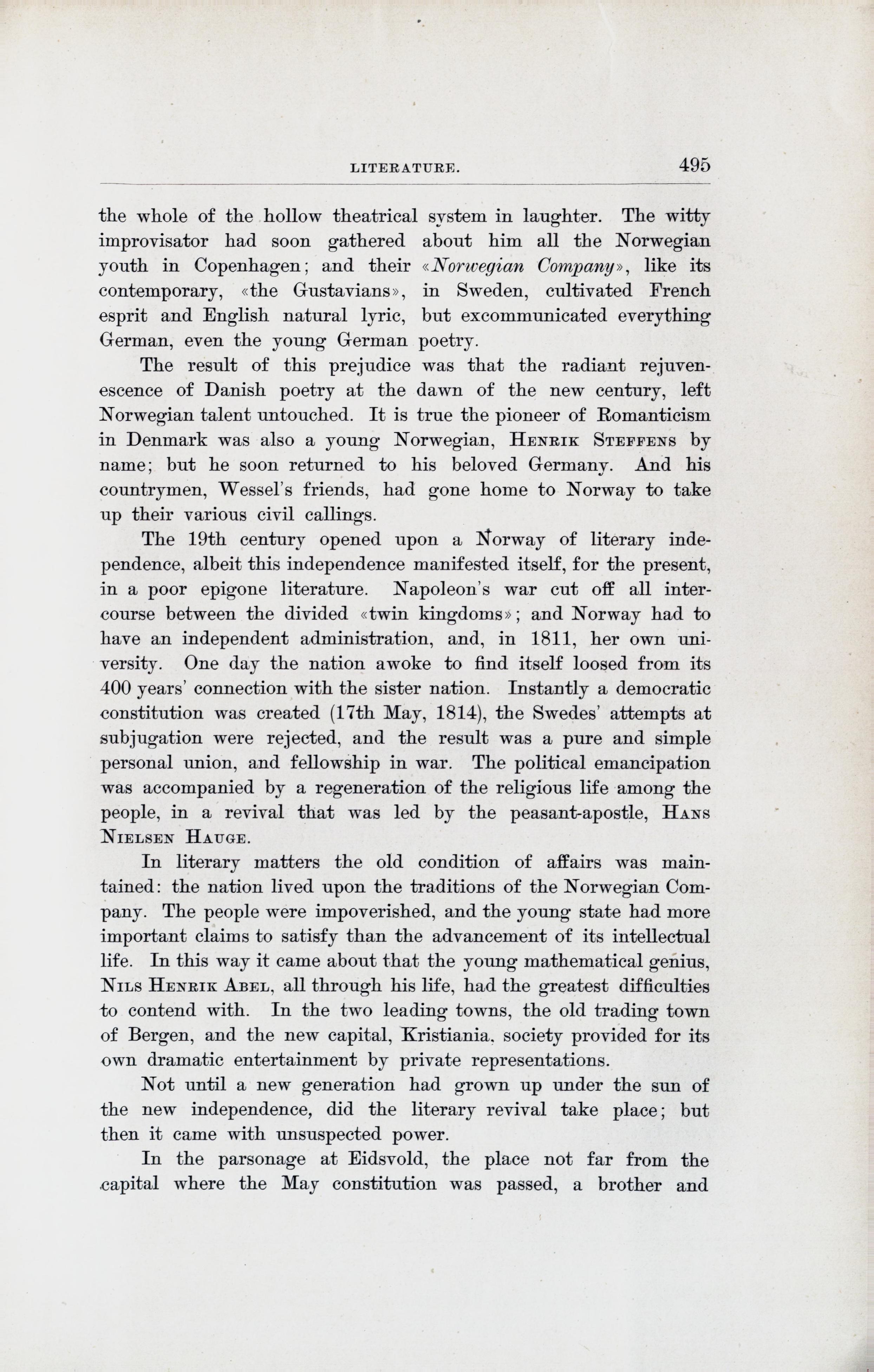
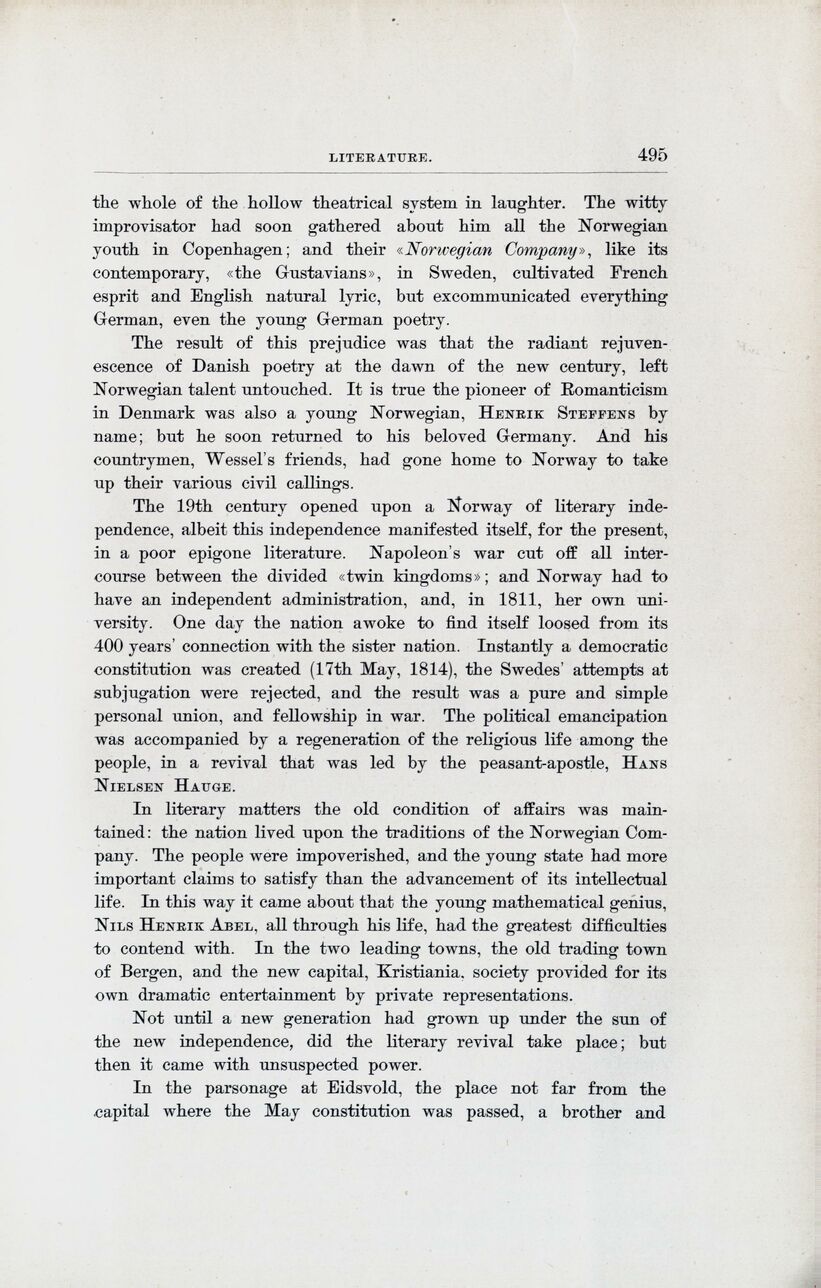
the whole of the hollow theatrical system in laughter. The witty
improvisator had soon gathered about him all the Norwegian
youth in Copenhagen; and their «Norwegian Company», like its
contemporary, «the Gustavians», in Sweden, cultivated French
esprit and English natural lyric, but excommunicated everything
German, even the young German poetry.
The result of this prejudice was that the radiant
rejuvenescence of Danish poetry at the dawn of the new century, left
Norwegian talent untouched. It is true the pioneer of Romanticism
in Denmark was also a young Norwegian, Henrik Steffens by
name; but he soon returned to his beloved Germany. And his
countrymen, Wessel’s friends, had gone home to Norway to take
up their various civil callings.
The 19th century opened upon a Norway of literary
independence, albeit this independence manifested itself, for the present,
in a poor epigone literature. Napoleon’s war cut off all
intercourse between the divided «twin kingdoms»; and Norway had to
have an independent administration, and, in 1811, her own
university. One day the nation awoke to find itself loosed from its
400 years connection with the sister nation. Instantly a democratic
constitution was created (17th May, 1814), the Swedes attempts at
subjugation were rejected, and the result was a pure and simple
personal union, and fellowship in war. The political emancipation
was accompanied by a regeneration of the religious life among the
people, in a revival that was led by the peasant-apostle, Hans
Nielsen Hauge.
In literary matters the old condition of affairs was
maintained: the nation lived upon the traditions of the Norwegian
Company. The people were impoverished, and the young state had more
important claims to satisfy than the advancement of its intellectual
life. In this way it came about that the young mathematical genius,
Nils Henrik Abel, all through his life, had the greatest difficulties
to contend with. In the two leading towns, the old trading town
of Bergen, and the new capital, Kristiania, society provided for its
own dramatic entertainment by private representations.
Not until a new generation had grown up under the sun of
the new independence, did the literary revival take place; but
then it came with unsuspected power.
In the parsonage at Eidsvold, the place not far from the
capital where the May constitution was passed, a brother and
<< prev. page << föreg. sida << >> nästa sida >> next page >>