
Full resolution (JPEG) - On this page / på denna sida - Part 4. Guilt and the Fear of Punishment - 1. Morality and Fear of Punishment - Religion and Fear - Social and Religious Morality
<< prev. page << föreg. sida << >> nästa sida >> next page >>
Below is the raw OCR text
from the above scanned image.
Do you see an error? Proofread the page now!
Här nedan syns maskintolkade texten från faksimilbilden ovan.
Ser du något fel? Korrekturläs sidan nu!
This page has never been proofread. / Denna sida har aldrig korrekturlästs.
PASTORAL PSYCHOLOGY
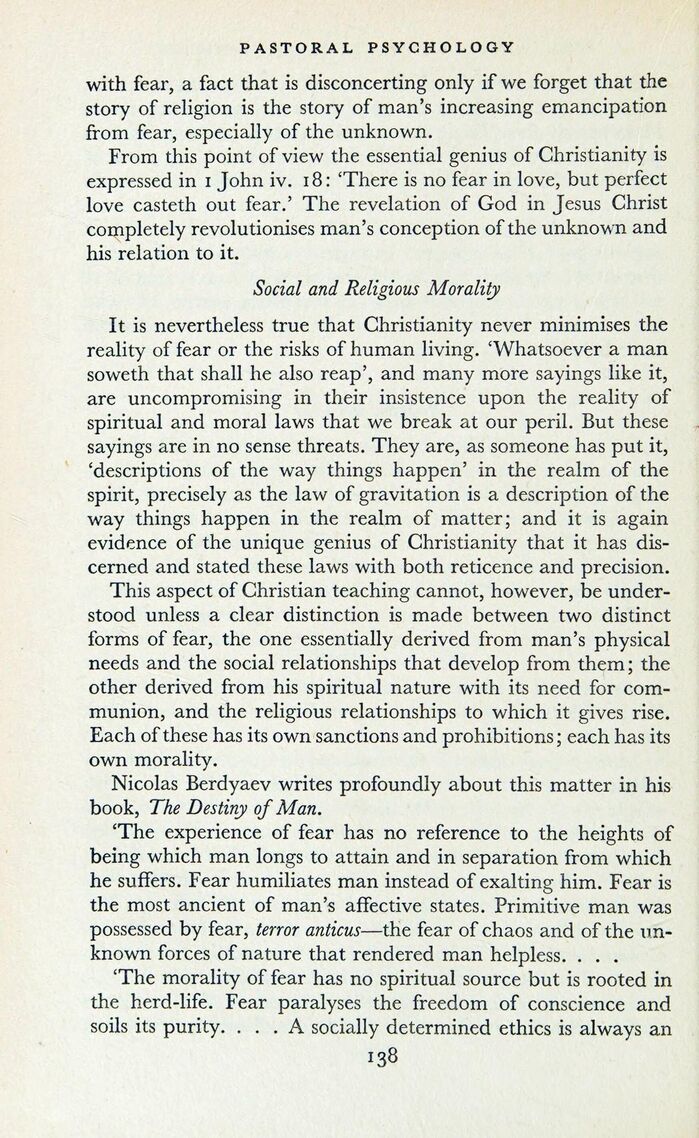
with fear, a fact that is disconcerting only if we forget that the
story of religion is the story of man’s increasing emancipation
from fear, especially of the unknown.
From this point of view the essential genius of Christianity is
expressed in 1 John iv. 18: ‘There is no fear in love, but perfect
love casteth out fear.’ The revelation of God in Jesus Christ
completely revolutionises man’s conception of the unknown and
his relation to it.
Social and Religious Morality
It is nevertheless true that Christianity never minimises the
reality of fear or the risks of human living. ‘Whatsoever a man
soweth that shall he also reap’, and many more sayings like it,
are uncompromising in their insistence upon the reality of
spiritual and moral laws that we break at our peril. But these
sayings are in no sense threats. They are, as someone has put it,
‘descriptions of the way things happen’ in the realm of the
spirit, precisely as the law of gravitation is a description of the
way things happen in the realm of matter; and it is again
evidence of the unique genius of Christianity that it has
discerned and stated these laws with both reticence and precision.
This aspect of Christian teaching cannot, however, be
understood unless a clear distinction is made between two distinct
forms of fear, the one essentially derived from man’s physical
needs and the social relationships that develop from them; the
other derived from his spiritual nature with its need for
communion, and the religious relationships to which it gives rise.
Each of these has its own sanctions and prohibitions; each has its
own morality.
Nicolas Berdyaev writes profoundly about this matter in his
book, The Destiny of Man.
‘The experience of fear has no reference to the heights of
being which man longs to attain and in separation from which
he suffers. Fear humiliates man instead of exalting him. Fear is
the most ancient of man’s affective states. Primitive man was
possessed by fear, terror anticus—the fear of chaos and of the
unknown forces of nature that rendered man helpless. . . .
‘The morality of fear has no spiritual source but is rooted in
the herd-life. Fear paralyses the freedom of conscience and
soils its purity. . . . A socially determined ethics is always an
138
<< prev. page << föreg. sida << >> nästa sida >> next page >>


