Full resolution (JPEG) - On this page / på denna sida - II. The Protein Substances - II. Compound Proteins - B. Nucleoproteins - Cleavage Products of the Nucleoproteins - 2. Purine Bases

<< prev. page << föreg. sida << >> nästa sida >> next page >>
Below is the raw OCR text
from the above scanned image.
Do you see an error? Proofread the page now!
Här nedan syns maskintolkade texten från faksimilbilden ovan.
Ser du något fel? Korrekturläs sidan nu!
This page has never been proofread. / Denna sida har aldrig korrekturlästs.
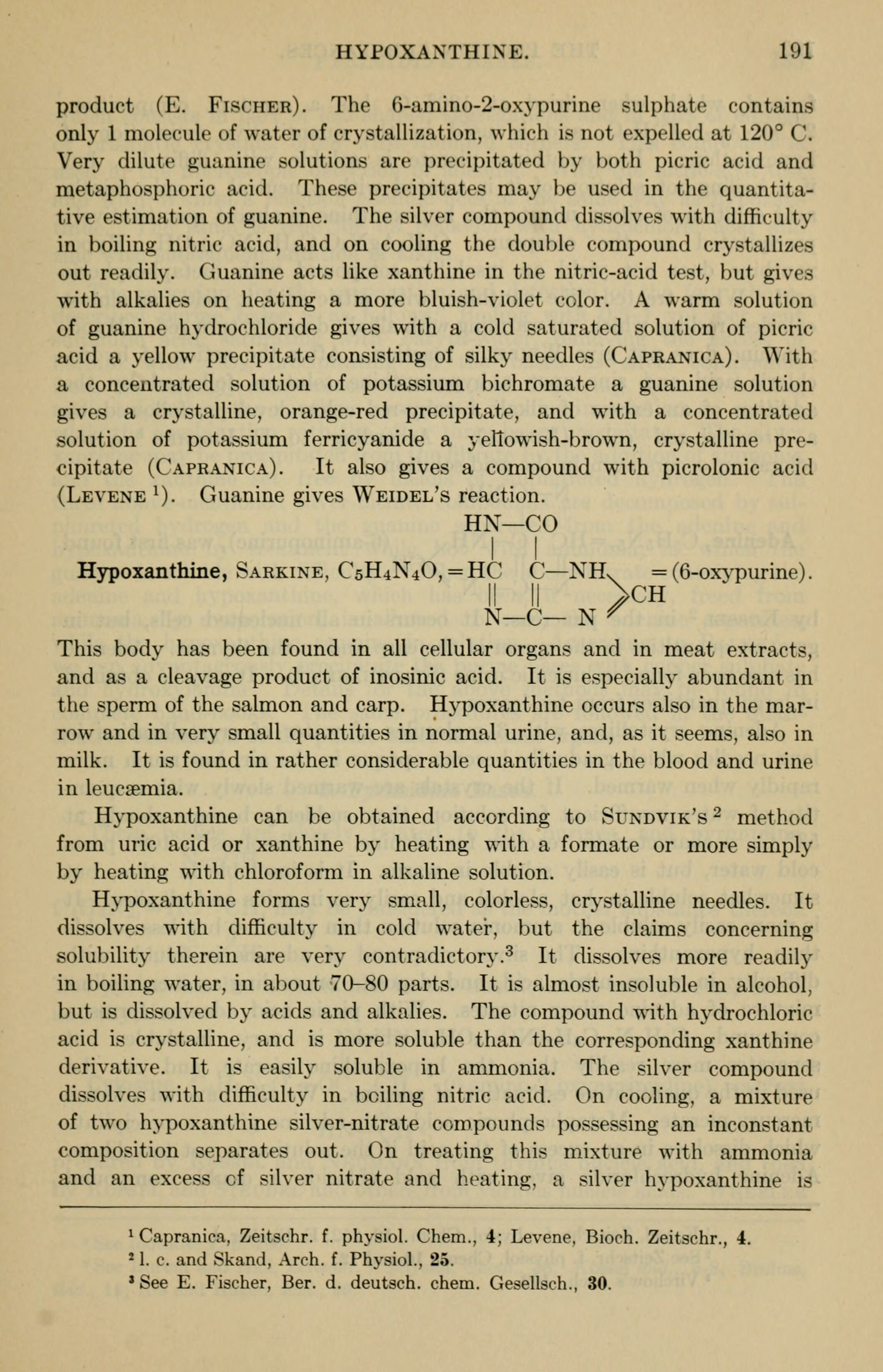
HYPOXANTHINE. 191
product (E. Fischer). The G-amino-2-oxypurine sulphate contains
only 1 molecule of water of crystallization, which is not expelled at 120° C.
Very dilute guanine solutions arc precipitated by both picric acid and
metaphosphoric acid. These precipitates may be used in the quantita-
tive estimation of guanine. The silver compound dissolves with difficulty
in boiling nitric acid, and on cooling the double compound crystallizes
out readily. Guanine acts like xanthine in the nitric-acid test, but gives
with alkalies on heating a more bluish-violet color. A warm solution
of guanine hydrochloride gives with a cold saturated solution of picric
acid a yellow precipitate consisting of silky needles (Capranica). With
a concentrated solution of potassium bichromate a guanine solution
gives a crystalline, orange-red precipitate, and with a concentrated
solution of potassium ferricyanide a yellowish-brown, crystalline pre-
cipitate (Capranica). It also gives a compound with picrolonic acid
(Levene l
). Guanine gives Weidel’s reaction.
HN—CO
I I
Hypoxanthine, Sarkine, C5H4N4O, =HC C—NPL = (6-oxypurine)
.
II II
>CH
N—C— N ^
This body has been found in all cellular organs and in meat extracts,
and as a cleavage product of inosinic acid. It is especially abundant in
the sperm of the salmon and carp. Hypoxanthine occurs also in the mar-
row and in very small quantities in normal urine, and, as it seems, also in
milk. It is found in rather considerable quantities in the blood and urine
in leucsemia.
Hypoxanthine can be obtained according to Sundvik’s 2
method
from uric acid or xanthine by heating with a formate or more simply
by heating with chloroform in alkaline solution.
Hypoxanthine forms very small, colorless, crystalline needles. It
dissolves with difficulty in cold water, but the claims concerning
solubility therein are very contradictory.3
It dissolves more readily
in boiling water, in about 70-80 parts. It is almost insoluble in alcohol,
but is dissolved by acids and alkalies. The compound with hydrochloric
acid is crystalline, and is more soluble than the corresponding xanthine
derivative. It is easily soluble in ammonia. The silver compound
dissolves with difficulty in boiling nitric acid. On cooling, a mixture
of two hypoxanthine silver-nitrate compounds possessing an inconstant
composition separates out. On treating this mixture with ammonia
and an excess of silver nitrate and heating, a silver hypoxanthine is
1
Capranica, Zeitschr. f. physiol. Chem., 4; Levene, Bioch. Zeitsehr., 4.
5
1. c. and Skand, Arch. f. Physiol., 25.
’See E. Fischer, Ber. d. deutsch. chem. Gesellsch., 30.
<< prev. page << föreg. sida << >> nästa sida >> next page >>