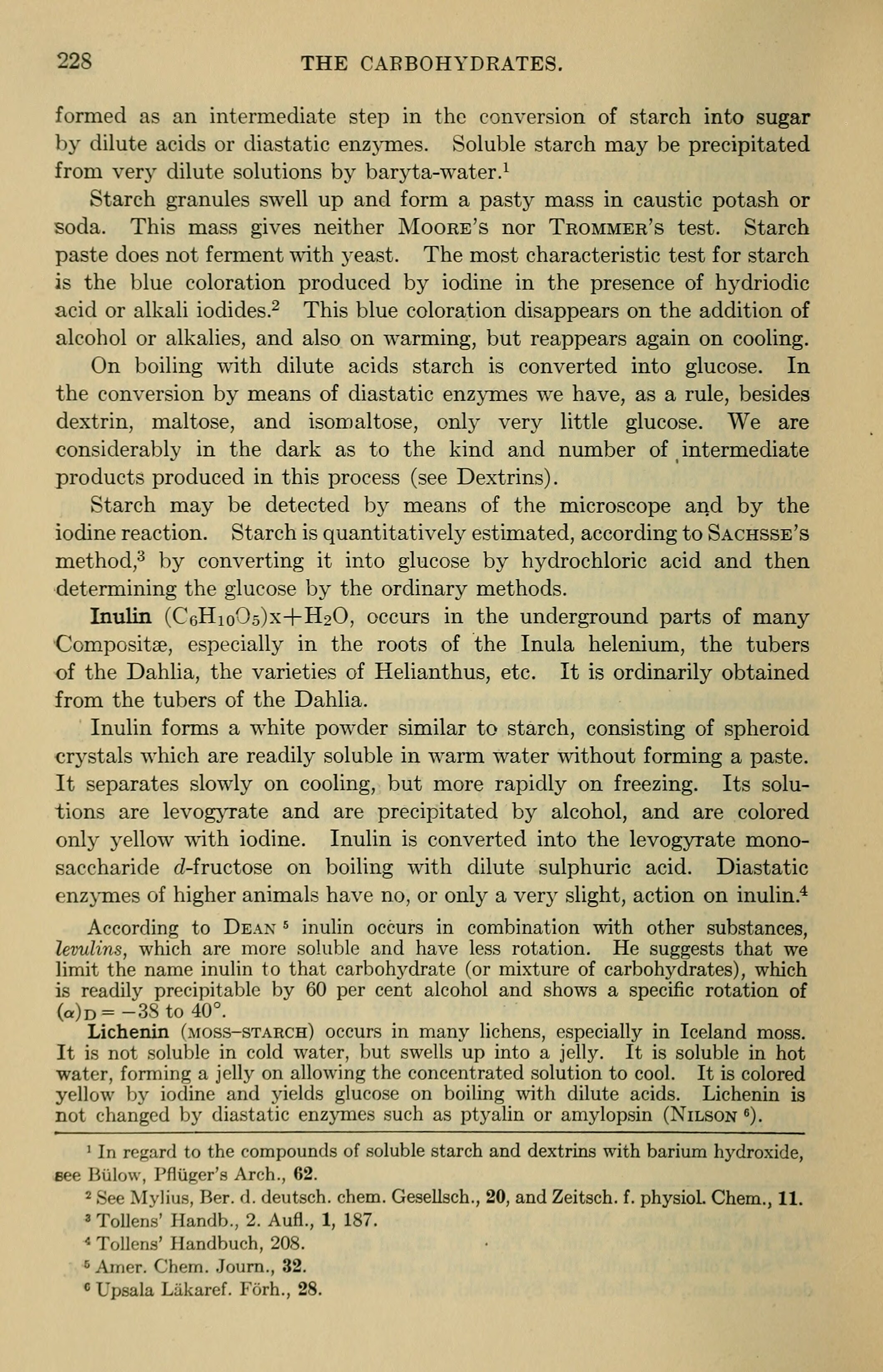
Full resolution (JPEG) - On this page / på denna sida - III. The Carbohydrates - 3. Colloid Polysaccharides - Starch Group
<< prev. page << föreg. sida << >> nästa sida >> next page >>
Below is the raw OCR text
from the above scanned image.
Do you see an error? Proofread the page now!
Här nedan syns maskintolkade texten från faksimilbilden ovan.
Ser du något fel? Korrekturläs sidan nu!
This page has never been proofread. / Denna sida har aldrig korrekturlästs.
228 THE CARBOHYDRATES.
formed as an intermediate step in the conversion of starch into sugar
by dilute acids or diastatic enzymes. Soluble starch may be precipitated
from very dilute solutions by baryta-water.1
Starch granules swell up and form a pasty mass in caustic potash or
soda. This mass gives neither Moore’s nor Trommer’s test. Starch
paste does not ferment with yeast. The most characteristic test for starch
is the blue coloration produced by iodine in the presence of hydriodic
acid or alkali iodides.2
This blue coloration disappears on the addition of
alcohol or alkalies, and also on warming, but reappears again on cooling.
On boiling with dilute acids starch is converted into glucose. In
the conversion by means of diastatic enzymes we have, as a rule, besides
dextrin, maltose, and isomaltose, onl}- very little glucose. We are
considerably in the dark as to the kind and number of intermediate
products produced in this process (see Dextrins)
.
Starch may be detected by means of the microscope and by the
iodine reaction. Starch is quantitatively estimated, according to Sachsse’s
method,3 by converting it into glucose by hydrochloric acid and then
determining the glucose by the ordinary methods.
Inulin (C6Hio05)x+H20, occurs in the underground parts of many
Composite, especially in the roots of the Inula helenium, the tubers
of the Dahlia, the varieties of Helianthus, etc. It is ordinarily obtained
from the tubers of the Dahlia.
Inulin forms a white powder similar to starch, consisting of spheroid
cr}r
stals which are readily soluble in warm water without forming a paste.
It separates slowly on cooling, but more rapidly on freezing. Its solu-
tions are levogyrate and are precipitated by alcohol, and are colored
only yellow with iodine. Inulin is converted into the levogyrate mono-
saccharide d-fructose on boiling with dilute sulphuric acid. Diastatic
enzymes of higher animals have no, or only a ver}r
slight, action on inulin.4
According to Dean 5
inulin occurs in combination with other substances,
levulins, which are more soluble and have less rotation. He suggests that we
limit the name inulin to that carbohydrate (or mixture of carbohydrates), which
is readily precipitable by 60 per cent alcohol and shows a specific rotation of
(«) D =-3Sto40°.
Lichenin (moss-starch) occurs in many lichens, especially in Iceland moss.
It is not soluble in cold water, but swells up into a jelly. It is soluble in hot
water, forming a jelly on allowing the concentrated solution to cool. It is colored
yellow by iodine and yields glucose on boiling with dilute acids. Lichenin is
not changed by diastatic enzymes such as ptyalin or amylopsin (Nilson 6
).
1
In regard to the compounds of soluble starch and dextrins with barium hydroxide,
Bee Biilow, Pfliiger’s Arch., 62.
2
See Mylius, Ber. d. deutsch. chem. Gesellsch., 20, and Zeitsch. f. physioL Chem., 11.
3
Tollens’ Handb., 2. Aufl., 1, 187.
* To] lens’ Handbuch, 208.
6
Amer. Chem. Journ., 32.
c
Upsala Lakaref. Forh., 28.
<< prev. page << föreg. sida << >> nästa sida >> next page >>