Full resolution (JPEG) - On this page / på denna sida - V. The Blood - I. Blood-plasma and Blood-serum - The Blood-serum
<< prev. page << föreg. sida << >> nästa sida >> next page >>
Below is the raw OCR text
from the above scanned image.
Do you see an error? Proofread the page now!
Här nedan syns maskintolkade texten från faksimilbilden ovan.
Ser du något fel? Korrekturläs sidan nu!
This page has never been proofread. / Denna sida har aldrig korrekturlästs.
270 THE BLOOD.
p. m. solids, with only 39.5 p. m. protein, and Halliburton found only
25.4 p. m. protein in frog’s blood. The relation between globulin and
seralbumin is, as shown by the analyses of Hammarsten, Hallibur-
ton, and Rubbrecht,1
very different for various animals, but may also
vary considerably in the same species of animal. In human blood-
serum Hammarsten found more seralbumin than globulin, and the
relation of serglobulin to seralbumin was as 1:1.5. Lewinsky found the
relationship in man greater than 1, indeed 1:1.39-2.13. In regard to the
quantity of the remaining organic constituents of the serum we refer
the reader to Abderhalden’s complete analyses.
In starvation it seems, as first found by Burckhardt and then sub-
stantiated by other investigators, that the quantity of globulins relative
to that of albumin in dogs and also in rats (Robertson 2
), is increased.
According to Robertson, in the horse, ox and rabbit the reverse exists,
namely, the amount of albumin relative to the globulin increases in
starvation. A change in the relation with a decrease in the albumin
and an increase in the globulin may also occur in animals which have
been made sick or in part immune by inoculation with pathogenic
micro-organisms (Langstein and Mayer 3
) . The total protein content
is raised in nearly all cases. The amount of fibrinogen in the plasma
is especially increased by pneumococci, streptococci, and pus-staphy-
lococci (P. Muller 4
).
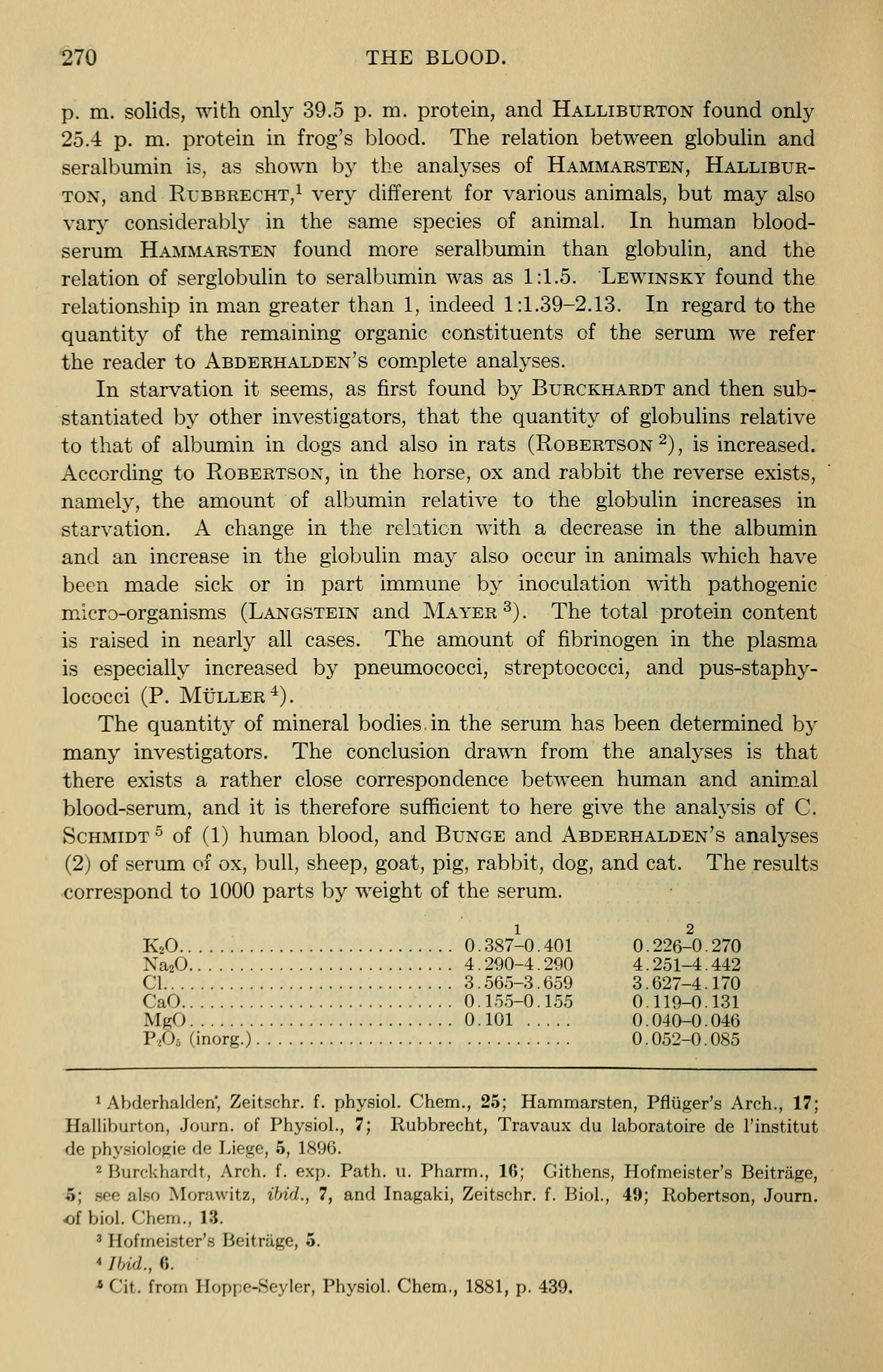
The quantity of mineral bodies in the serum has been determined by
many investigators. The conclusion drawn from the analyses is that
there exists a rather close correspondence between human and animal
blood-serum, and it is therefore sufficient to here give the analysis of C.
Schmidt 5
of (1) human blood, and Bunge and Abderhalden’s analyses
(2) of serum of ox, bull, sheep, goat, pig, rabbit, dog, and cat. The results
correspond to 1000 parts by weight of the serum.
1 2
K2 0.387-0.401 0.226-0.270
Na2 4.290-4.290 4.251-4.442
CI 3.565-3.659 3.627-4.170
CaO 0.155-0.155 0.119-0.131
MgO 0.101 0.040-0046
P,05 (inorg.) 0.052-0.085
1
Abderhalden’, Zeitschr. f. physiol. Chem., 25; Hammarsten, Pfliiger’s Arch., 17;
Halliburton, Journ. of Physiol., 7; Rubbrecht, Travaux du laboratoire de l’institut
de physiologie de Liege, 5, 1896.
2
Burckhardt, Arch. f. exp. Path. u. Pharm., 16; Githens, Hofmeister’s Beitrage,
5; see also Morawitz, ibid., 7, and Inagaki, Zeitschr. f. Biol., 49; Robertson, Journ.
of biol. Chem., 13.
3
Hofmeister’s Beitrage, 5.
’
Ibid., 8.
* Cit. from Hoppe-Seyler, Physiol. Chem., 1881, p. 439.
<< prev. page << föreg. sida << >> nästa sida >> next page >>