
Full resolution (JPEG) - On this page / på denna sida - V. The Blood - II. The Form-elements of the Blood - Blood-pigments
<< prev. page << föreg. sida << >> nästa sida >> next page >>
Below is the raw OCR text
from the above scanned image.
Do you see an error? Proofread the page now!
Här nedan syns maskintolkade texten från faksimilbilden ovan.
Ser du något fel? Korrekturläs sidan nu!
This page has never been proofread. / Denna sida har aldrig korrekturlästs.
BLOOD-PIGMENTS. 277
chromogen (about 4 per cent), containing iron, which in the presence cf
oxygen is easily oxidized into hcematin.
As first shown by Schunck and Marchlewski, and especially by the
work of the latter, a close relation exists between chlorophyll and the
blood-pigment, because a derivative of the first, phylloporphyrin,
stands very close in certain respects to a derivative of the blood-pigment
haematoporphyrin. By the investigations of Nencki in conjunction
with Marchlewski and Zaleski,1
it was shown that haemopyrrol could
be prepared from the derivatives of both the leaf-pigment and the blood-
pigments by reduction, and also the investigations of Piloty and Will-
statter on chlorophyll and blood pigments have further developed
the interesting biological fact that the chlorophyll and blood pigments
are closely related bodies.
The haemoglobin prepared from different kinds of blood has not
exactly the same composition, which seems to indicate the presence
of different haemoglobins. The analyses by different investigators of
the haemoglobin from the same kind of blood do not always agree with
one another, which probably depends upon the somewhat varying methods
of preparation. The following analyses are given as examples of the
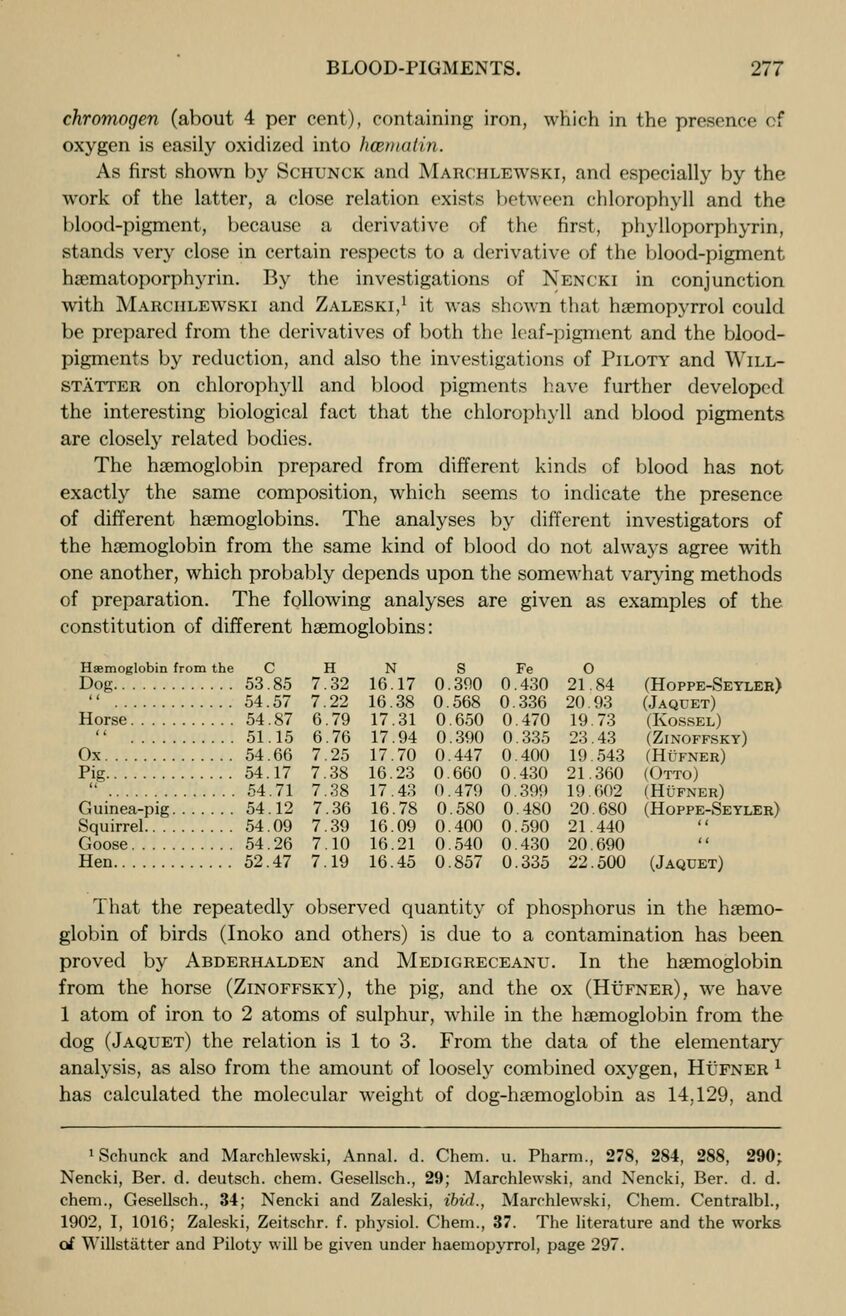
constitution of different haemoglobins:
Hemoglobin from the C H N S Fe
Dog 53.85 7.32 16.17 0.390 0.430 21.84 (Hoppe-Seyler)
" 54.57 7.22 16.38 0.568 0.336 20.93 (Jaquet)
Horse 54.87 6.79 17.31 0.650 0.470 19.73 (Kossel)
" 51.15 6.76 17.94 0.390 0.335 23.43 (Zinoffsky)
Ox 54.66 7.25 17.70 0.447 0.400 19.543 (Hufner)
Pig 54.17 7.38 16.23 0.660 0.430 21.360 (Otto)
" 54.71 7.38 17.43 0.479 0.399 19.602 (Hufner)
Guinea-pig 54.12 7.36 16.78 0.580 0.480 20.680 (Hoppe-Seyler)
Squirrel 54.09 7.39 16.09 0.400 0.590 21.440
Goose 54.26 7.10 16.21 0.540 0.430 20.690
Hen 52.47 7.19 16.45 0.857 0.335 22.500 (Jaquet)
That the repeatedly observed quantity of phosphorus in the haemo-
globin of birds (Inoko and others) is due to a contamination has been
proved by Abderhalden and Medigreceanu. In the haemoglobin
from the horse (Zinoffsky), the pig, and the ox (Hufner), we have
1 atom of iron to 2 atoms of sulphur, while in the haemoglobin from the
dog (Jaquet) the relation is 1 to 3. From the data of the elementary
analysis, as also from the amount of loosely combined oxygen, Hufner ’
has calculated the molecular weight of dog-haemoglobin as 14.129, and
Schunck and Marchlewski, Annal. d. Chem. u. Pharm., 278, 284, 288, 290;
Nencki, Ber. d. deutsch. chem. Gesellsch., 29; Marchlewski, and Nencki, Ber. d. d.
chem., Gesellsch., 34; Nencki and Zaleski, ibid., Marchlewski, Chem. Centralbl.,
1902, I, 1016; Zaleski, Zeitschr. f. physiol. Chem., 37. The literature and the works
of Willstatter and Piloty will be given under haemopyrrol, page 297.
<< prev. page << föreg. sida << >> nästa sida >> next page >>


