Full resolution (JPEG) - On this page / på denna sida - V. The Blood - III. The Blood as a Mixture of Plasma and Blood-corpuscles
<< prev. page << föreg. sida << >> nästa sida >> next page >>
Below is the raw OCR text
from the above scanned image.
Do you see an error? Proofread the page now!
Här nedan syns maskintolkade texten från faksimilbilden ovan.
Ser du något fel? Korrekturläs sidan nu!
This page has never been proofread. / Denna sida har aldrig korrekturlästs.
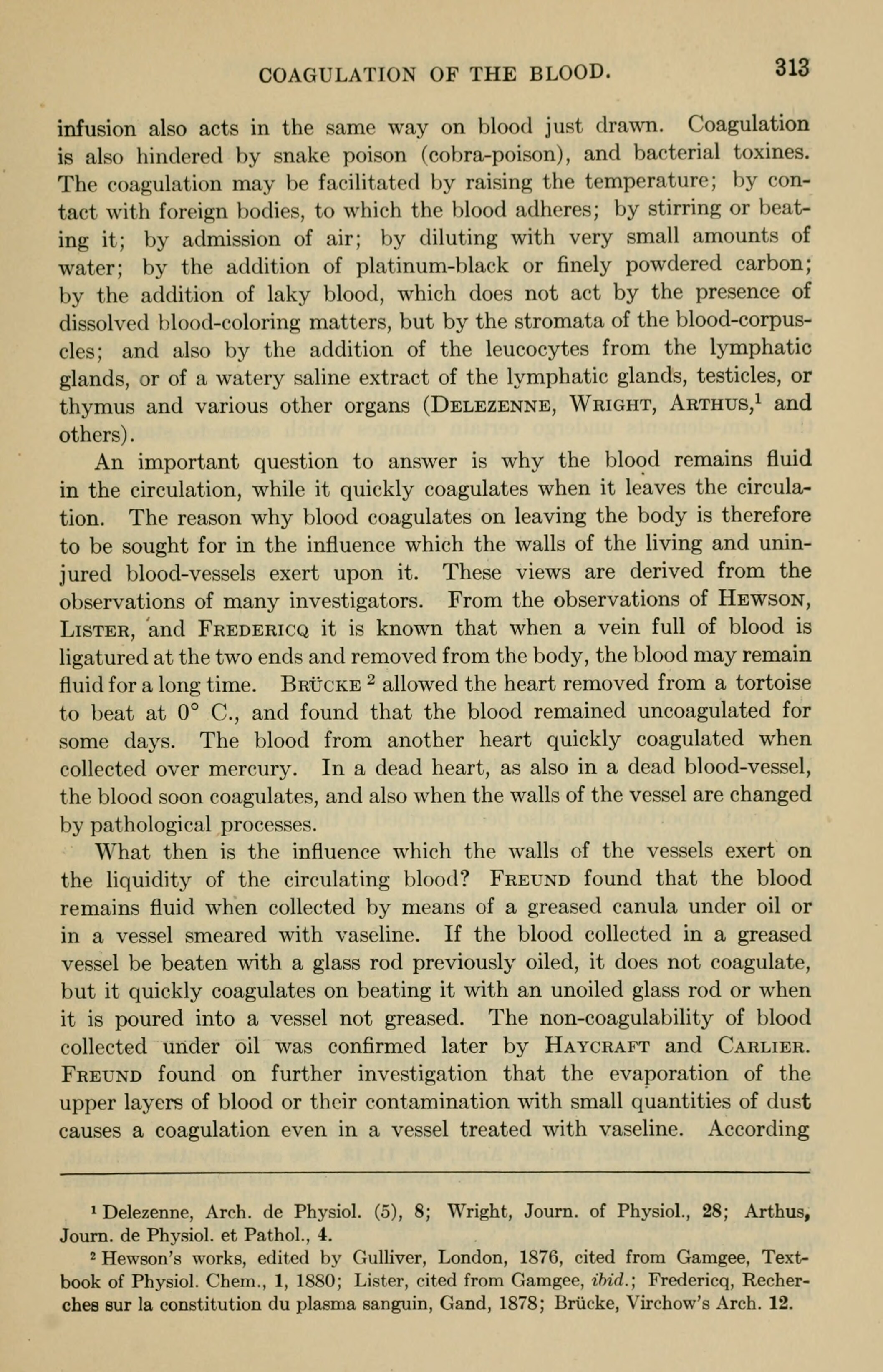
COAGULATION OF THE BLOOD. 313
infusion also acts in the same way on blood just drawn. Coagulation
is also hindered by snake poison (cobra-poison), and bacterial toxines.
The coagulation may be facilitated by raising the temperature; by con-
tact with foreign bodies, to which the blood adheres; by stirring or beat-
ing it; by admission of air; by diluting with very small amounts of
water; by the addition of platinum-black or finely powdered carbon;
by the addition of laky blood, which does not act by the presence of
dissolved blood-coloring matters, but by the stromata of the blood-corpus-
cles; and also by the addition of the leucocytes from the lymphatic
glands, or of a watery saline extract of the lymphatic glands, testicles, or
thymus and various other organs (Delezenne, Wright, Arthus,1
and
others)
.
An important question to answer is why the blood remains fluid
in the circulation, while it quickly coagulates when it leaves the circula-
tion. The reason why blood coagulates on leaving the body is therefore
to be sought for in the influence which the walls of the living and unin-
jured blood-vessels exert upon it. These views are derived from the
observations of many investigators. From the observations of Hewson,
Lister, and Fredericq it is known that when a vein full of blood is
ligatured at the two ends and removed from the body, the blood may remain
fluid for a long time. Brucke 2
allowed the heart removed from a tortoise
to beat at 0° C, and found that the blood remained uncoagulated for
some days. The blood from another heart quickly coagulated when
collected over mercury. In a dead heart, as also in a dead blood-vessel,
the blood soon coagulates, and also when the walls of the vessel are changed
by pathological processes.
What then is the influence which the walls of the vessels exert on
the liquidity of the circulating blood? Freund found that the blood
remains fluid when collected by means of a greased canula under oil or
in a vessel smeared with vaseline. If the blood collected in a greased
vessel be beaten with a glass rod previously oiled, it does not coagulate,
but it quickly coagulates on beating it with an unoiled glass rod or when
it is poured into a vessel not greased. The non-coagulability of blood
collected under oil was confirmed later by Haycraft and Carlier.
Freund found on further investigation that the evaporation of the
upper layers of blood or their contamination with small quantities of dust
causes a coagulation even in a vessel treated with vaseline. According
1
Delezenne, Arch, de Physiol. (5), 8; Wright, Journ. of Physiol., 28; Arthus,
Journ. de Physiol, et Pathol., 4.
2
Hewson’s works, edited by Gulliver, London, 1876, cited from Gamgee, Text-
book of Physiol. Chem., 1, 1880; Lister, cited from Gamgee, ibid.; Fredericq, Recher-
ches sur la constitution du plasma sanguin, Gand, 1878; Brucke, Virchow’s Arch. 12.
<< prev. page << föreg. sida << >> nästa sida >> next page >>