Full resolution (JPEG) - On this page / på denna sida - VI. Chyle, Lymph, Transudates and Exudates - III. Pus

<< prev. page << föreg. sida << >> nästa sida >> next page >>
Below is the raw OCR text
from the above scanned image.
Do you see an error? Proofread the page now!
Här nedan syns maskintolkade texten från faksimilbilden ovan.
Ser du något fel? Korrekturläs sidan nu!
This page has never been proofread. / Denna sida har aldrig korrekturlästs.
364 CHYLE, LYMPH, TRANSUDATES AND EXUDATES.
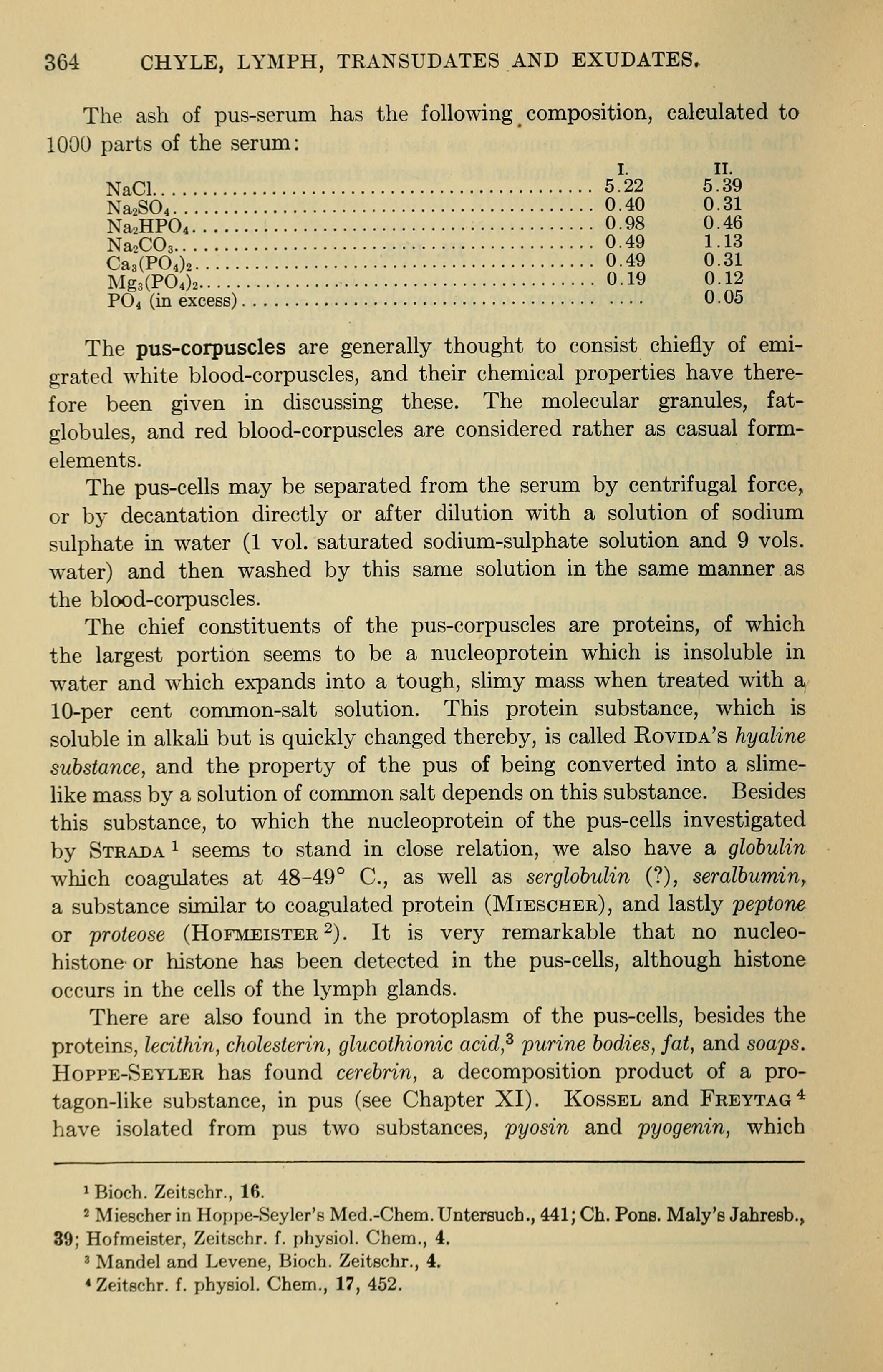
The ash of pus-serum has the following i
composition, calculated to
1000 parts of the serum:
i. ii.
NaCl 5.22 5.39
Na2SO< 0.40 0.31
Na2 HP04 0.98 0.46
Na2C03
0.49 1.13
Ca3 (P04 ) 2 0.49 0.31
Mg3 (P04 ) 2 0.19 0.12
P04 (in excess) 0.05
The pus-corpuscles are generally thought to consist chiefly of emi-
grated white blood-corpuscles, and their chemical properties have there-
fore been given in discussing these. The molecular granules, fat-
globules, and red blood-corpuscles are considered rather as casual form-
elements.
The pus-cells may be separated from the serum by centrifugal force,
or by decantation directly or after dilution with a solution of sodium
sulphate in water (1 vol. saturated sodium-sulphate solution and 9 vols,
water) and then washed by this same solution in the same manner as
the blood-corpuscles.
The chief constituents of the pus-corpuscles are proteins, of which
the largest portion seems to be a nucleoprotein which is insoluble in
water and which expands into a tough, slimy mass when treated with a
10-per cent common-salt solution. This protein substance, which is
soluble in alkali but is quickly changed thereby, is called Rovida’s hyaline
substance, and the property of the pus of being converted into a slime-
like mass by a solution of common salt depends on this substance. Besides
this substance, to which the nucleoprotein of the pus-cells investigated
by Strada 1
seems to stand in close relation, we also have a globulin
which coagulates at 48-49° C, as well as serglobulin (?), seralbumint
a substance similar to coagulated protein (Miescher), and lastly peptone
or proteose (Hofmeister 2
). It is very remarkable that no nucleo-
histone or histone has been detected in the pus-cells, although histone
occurs in the cells of the lymph glands.
There are also found in the protoplasm of the pus-cells, besides the
proteins, lecithin, cholesterin, glucolhionic acid,3 purine bodies, fat, and soaps.
Hoppe-Seyler has found cerebrin, a decomposition product of a pro-
tagon-like substance, in pus (see Chapter XI). Kossel and Freytag 4
have isolated from pus two substances, pyosin and pyogenin, which
1
Bioch. Zeitschr., 16.
2
Miescher in Hoppe-Seyler’s Med.-Chem. Untersuch., 441; Ch. Pone. Maly’s Jahresb.,
39; Hofmeister, Zeitschr. f. physiol. Chem., 4.
3
Mandel and Levene, Bioch. Zeitschr., 4.
Zeitschr. f. physiol. Chem., 17, 452.
<< prev. page << föreg. sida << >> nästa sida >> next page >>