Full resolution (JPEG) - On this page / på denna sida - VIII. Digestion - I. The Salivary Glands and the Saliva
<< prev. page << föreg. sida << >> nästa sida >> next page >>
Below is the raw OCR text
from the above scanned image.
Do you see an error? Proofread the page now!
Här nedan syns maskintolkade texten från faksimilbilden ovan.
Ser du något fel? Korrekturläs sidan nu!
This page has never been proofread. / Denna sida har aldrig korrekturlästs.
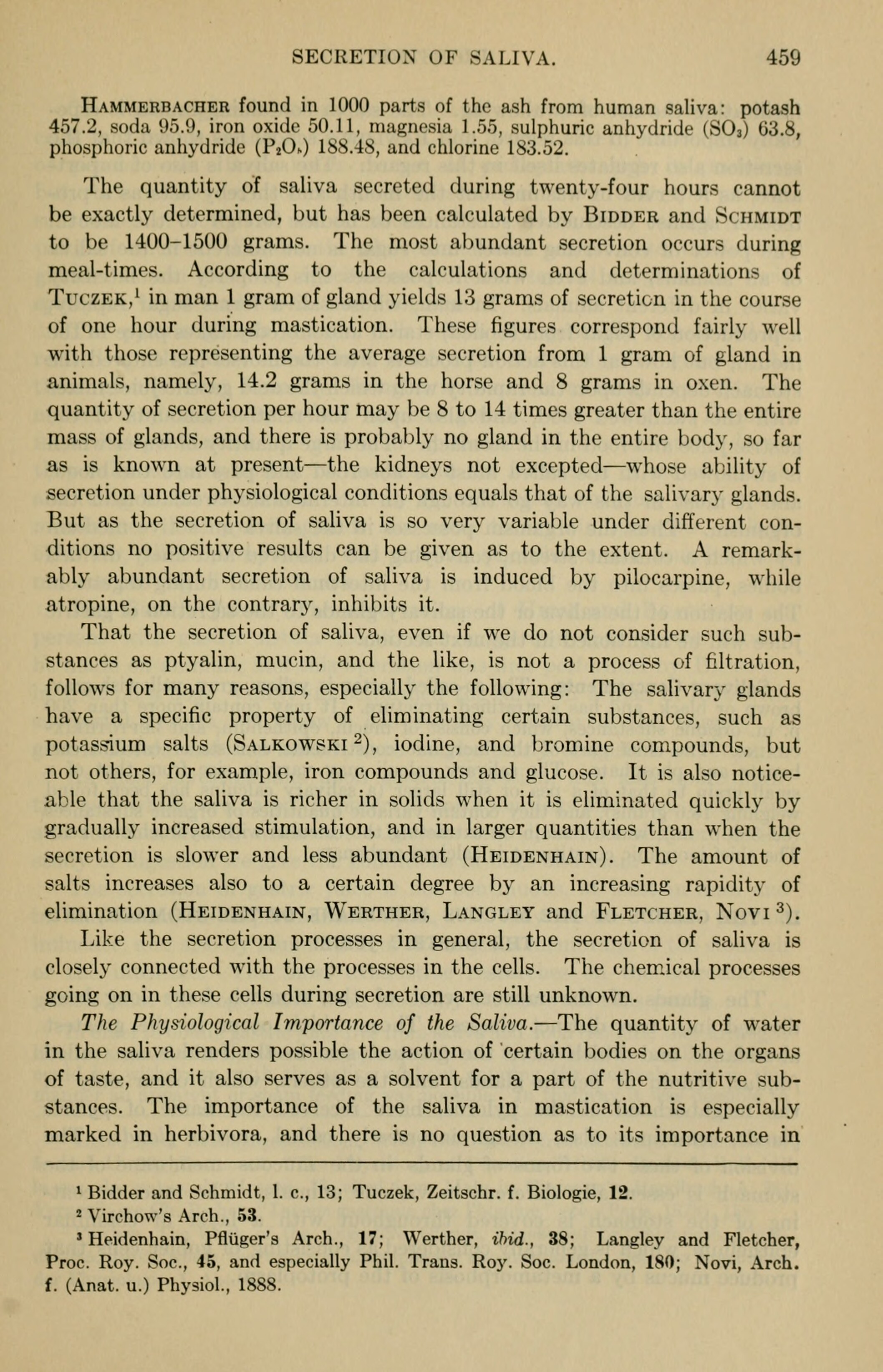
SECRETION OF SALIVA. 459
Hammerbacher found in 1000 parts of the ash from human saliva: potash
457.2, soda 95.9, iron oxide 50.11, magnesia 1.55, sulphuric anhydride (S03 ) G3.8,
phosphoric anhydride (PiO») 188.48, and chlorine 183.52.
The quantity of saliva secreted during twenty-four hours cannot
be exactly determined, but has been calculated by Bidder and Schmidt
to be 1400-1500 grams. The most abundant secretion occurs during
meal-times. According to the calculations and determinations of
Tuczek,1
in man 1 gram of gland yields 13 grams of secretion in the course
of one hour during mastication. These figures correspond fairly well
with those representing the average secretion from 1 gram of gland in
animals, namely, 14.2 grams in the horse and 8 grams in oxen. The
quantity of secretion per hour may be 8 to 14 times greater than the entire
mass of glands, and there is probably no gland in the entire body, so far
as is known at present—the kidneys not excepted—whose ability of
secretion under physiological conditions equals that of the salivary glands.
But as the secretion of saliva is so very variable under different con-
ditions no positive results can be given as to the extent. A remark-
ably abundant secretion of saliva is induced by pilocarpine, while
atropine, on the contrary, inhibits it.
That the secretion of saliva, even if we do not consider such sub-
stances as ptyalin, mucin, and the like, is not a process of filtration,
follows for many reasons, especially the following: The salivary glands
have a specific property of eliminating certain substances, such as
potassium salts (Salkowpki 2
), iodine, and bromine compounds, but
not others, for example, iron compounds and glucose. It is also notice-
able that the saliva is richer in solids when it is eliminated quickly by
gradually increased stimulation, and in larger quantities than when the
secretion is slower and less abundant (Heidenhain). The amount of
salts increases also to a certain degree by an increasing rapidity of
elimination (Heidenhain, Werther, Langley and Fletcher, Novi 3
).
Like the secretion processes in general, the secretion of saliva is
closely connected with the processes in the cells. The chemical processes
going on in these cells during secretion are still unknown.
The Physiological Importance of the Saliva.—The quantity of water
in the saliva renders possible the action of certain bodies on the organs
of taste, and it also serves as a solvent for a part of the nutritive sub-
stances. The importance of the saliva in mastication is especially
marked in herbivora, and there is no question as to its importance in
1
Bidder and Schmidt, 1. c, 13; Tuczek, Zeitschr. f. Biologie, 12.
2
Virchow’s Arch., 53.
1
Heidenhain, Pfluger’s Arch., 17; Werther, ibid., 38; Langley and Fletcher,
Proc. Roy. Soc, 45, and especially Phil. Trans. Roy. Soc. London, 180; Novi, Arch,
f. (Anat. u.) Physiol., 1888.
<< prev. page << föreg. sida << >> nästa sida >> next page >>