Full resolution (JPEG) - On this page / på denna sida - XI. Brain and Nerves - Appendix. The Tissues and Fluids of the Eye

<< prev. page << föreg. sida << >> nästa sida >> next page >>
Below is the raw OCR text
from the above scanned image.
Do you see an error? Proofread the page now!
Här nedan syns maskintolkade texten från faksimilbilden ovan.
Ser du något fel? Korrekturläs sidan nu!
This page has never been proofread. / Denna sida har aldrig korrekturlästs.
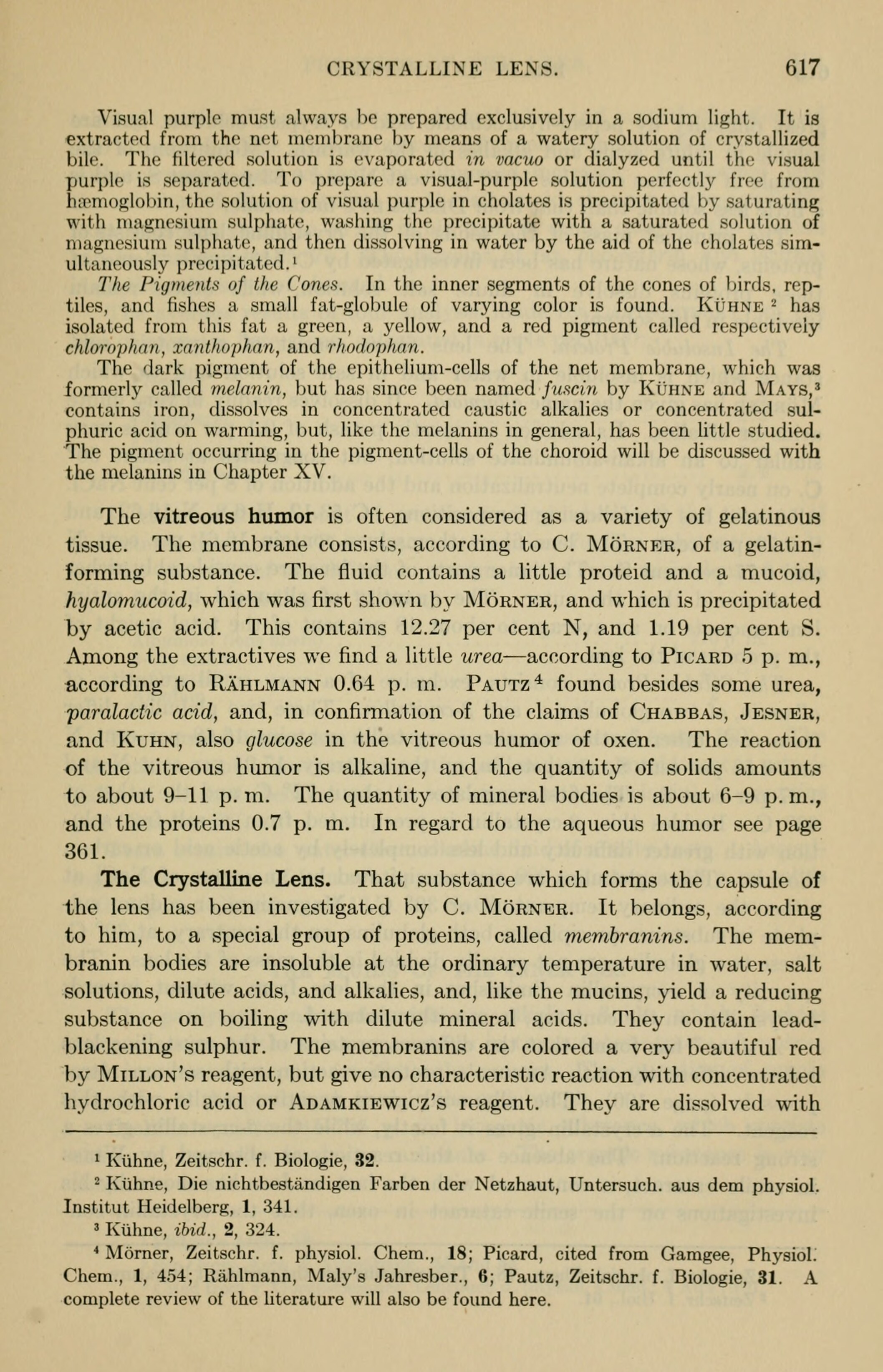
CRYSTALLINE LENS. 617
Visual purple must always be prepared exclusively in a sodium light. It is
extracted from the net membrane by means of a watery solution of crystallized
bile. The filtered solution is evaporated in vacuo or dialyzed until the visual
purple is separated. To prepare a visual-purple solution perfectly free from
hemoglobin, the solution of visual purple in cholates is precipitated by saturating
with magnesium sulphate, washing the precipitate with a saturated solution of
magnesium sulphate, and then dissolving in water by the aid of the cholates sim-
ultaneously precipitated. 1
The Pigments of the Cones. In the inner segments of the cones of birds, rep-
tiles, and fishes a small fat-globule of varying color is found. Kuhne 2
has
isolated from this fat a green, a yellow, and a red pigment called respectively
chlorophan, xanthophan, and rhodophan.
The dark pigment of the epithelium-cells of the net membrane, which was
formerly called melanin, but has since been named fuscin by Kuhne and Mays, 3
contains iron, dissolves in concentrated caustic alkalies or concentrated sul-
phuric acid on warming, but, like the melanins in general, has been little studied.
The pigment occurring in the pigment-cells of the choroid will be discussed with
the melanins in Chapter XV.
The vitreous humor is often considered as a variety of gelatinous
tissue. The membrane consists, according to C. Morner, of a gelatin-
forming substance. The fluid contains a little proteid and a mucoid,
hyalomucoid, which was first shown by Morner, and which is precipitated
by acetic acid. This contains 12.27 per cent N, and 1.19 per cent S.
Among the extractives we find a little urea—according to Picard 5 p. m.,
according to Rahlmann 0.64 p. m. Pautz 4
found besides some urea,
paralactic acid, and, in confirmation of the claims of Chabbas, Jesner,
and Kuhn, also glucose in the vitreous humor of oxen. The reaction
of the vitreous humor is alkaline, and the quantity of solids amounts
to about 9-11 p. m. The quantity of mineral bodies is about 6-9 p. m.,
and the proteins 0.7 p. m. In regard to the aqueous humor see page
361.
The Crystalline Lens. That substance which forms the capsule of
the lens has been investigated by C. Morner. It belongs, according
to him, to a special group of proteins, called membranins. The mem-
branin bodies are insoluble at the ordinary temperature in water, salt
solutions, dilute acids, and alkalies, and, like the mucins, yield a reducing
substance on boiling with dilute mineral acids. They contain lead-
blackening sulphur. The membranins are colored a very beautiful red
by Millon’s reagent, but give no characteristic reaction with concentrated
hydrochloric acid or Adamkiewicz’s reagent. They are dissolved with
1
Kuhne, Zeitschr. f. Biologie, 32.
2
Kuhne, Die nichtbestiindigen Farben der Netzhaut, Untersuch. aus dem physiol.
Institut Heidelberg, 1, 341.
3
Kuhne, ibid., 2, 324.
4
Morner, Zeitschr. f. physiol. Chem., 18; Picard, cited from Gamgee, Physiol.
Chem., 1, 454; Rahlmann, Maly’s Jahresber., 6; Pautz, Zeitschr. f. Biologie, 31. A
complete review of the literature will also be found here.
<< prev. page << föreg. sida << >> nästa sida >> next page >>