Full resolution (JPEG) - On this page / på denna sida - II. The Russian revolution: its causes and effects
<< prev. page << föreg. sida << >> nästa sida >> next page >>
Below is the raw OCR text
from the above scanned image.
Do you see an error? Proofread the page now!
Här nedan syns maskintolkade texten från faksimilbilden ovan.
Ser du något fel? Korrekturläs sidan nu!
This page has never been proofread. / Denna sida har aldrig korrekturlästs.
THE RUSSIAN REVOLUTION 43
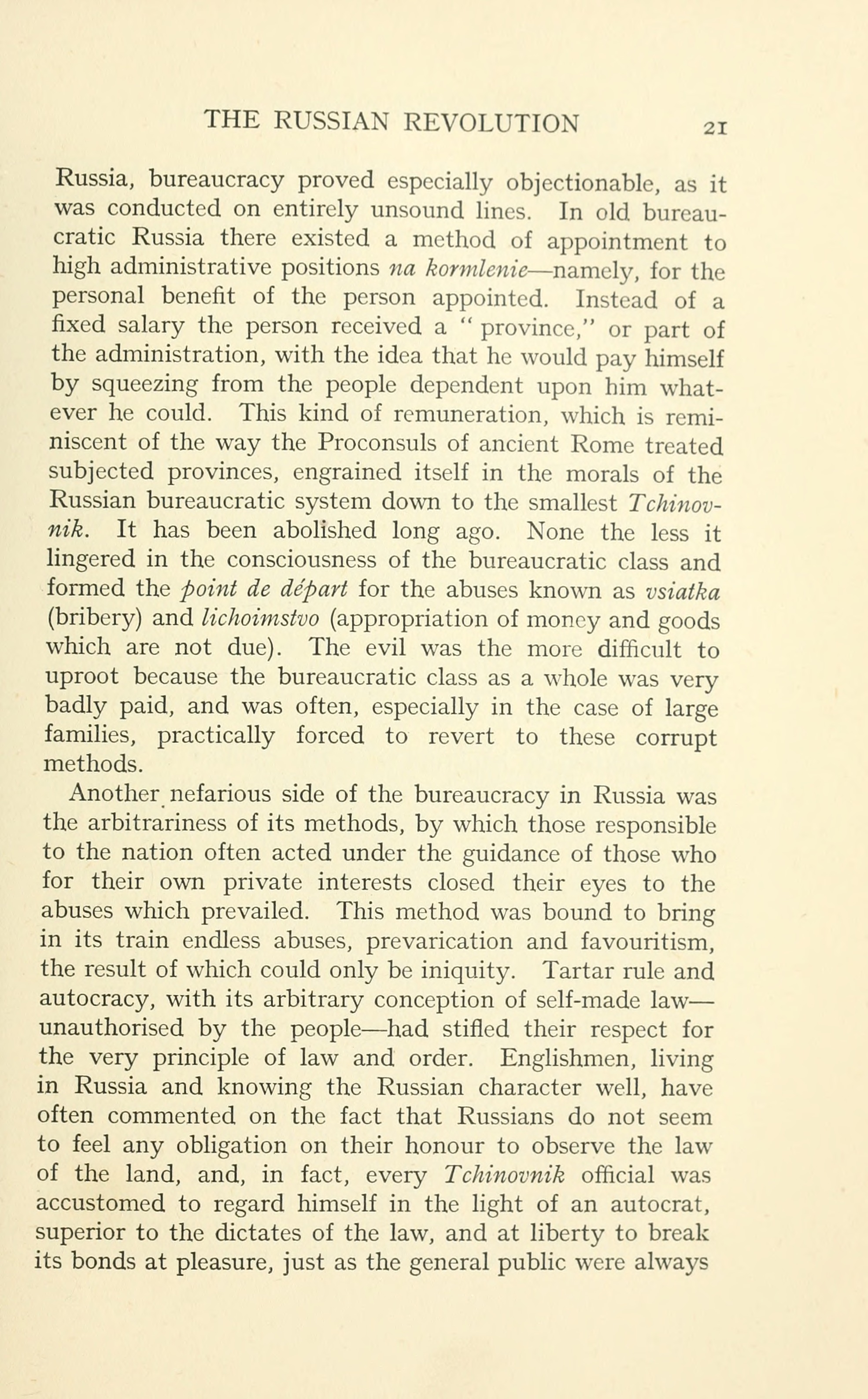
Russia, bureaucracy proved especially objectionable, as it
was conducted on entirely unsound lines. In old
bureaucratic Russia there existed a method of appointment to
high administrative positions na kormlenie—namely, for the
personal benefit of the person appointed. Instead of a
fixed salary the person received a " province," or part of
the administration, with the idea that he would pay himself
by squeezing from the people dependent upon him
whatever he could. This kind of remuneration, which is
reminiscent of the way the Proconsuls of ancient Rome treated
subjected provinces, engrained itself in the morals of the
Russian bureaucratic system down to the smallest
Tchinov-nik. It has been abolished long ago. None the less it
lingered in the consciousness of the bureaucratic class and
formed the point de depart for the abuses known as vsiatka
(bribery) and lichoimstvo (appropriation of money and goods
which are not due). The evil was the more difficult to
uproot because the bureaucratic class as a whole was very
badly paid, and was often, especially in the case of large
families, practically forced to revert to these corrupt
methods.
Another nefarious side of the bureaucracy in Russia was
the arbitrariness of its methods, by which those responsible
to the nation often acted under the guidance of those who
for their own private interests closed their eyes to the
abuses which prevailed. This method was bound to bring
in its train endless abuses, prevarication and favouritism,
the result of which could only be iniquity. Tartar rule and
autocracy, with its arbitrary conception of self-made law—
unauthorised by the people—had stifled their respect for
the very principle of law and order. Englishmen, living
in Russia and knowing the Russian character well, have
often commented on the fact that Russians do not seem
to feel any obligation on their honour to observe the law
of the land, and, in fact, every Tchinovnik official was
accustomed to regard himself in the light of an autocrat,
superior to the dictates of the law, and at liberty to break
its bonds at pleasure, just as the general public were always
<< prev. page << föreg. sida << >> nästa sida >> next page >>