
Full resolution (JPEG) - On this page / på denna sida - IX. The economic resources of Russia with special reference to British industrial and commercial opportunities
<< prev. page << föreg. sida << >> nästa sida >> next page >>
Below is the raw OCR text
from the above scanned image.
Do you see an error? Proofread the page now!
Här nedan syns maskintolkade texten från faksimilbilden ovan.
Ser du något fel? Korrekturläs sidan nu!
This page has never been proofread. / Denna sida har aldrig korrekturlästs.
102 PROBLEMS CONFRONTING RUSSIA
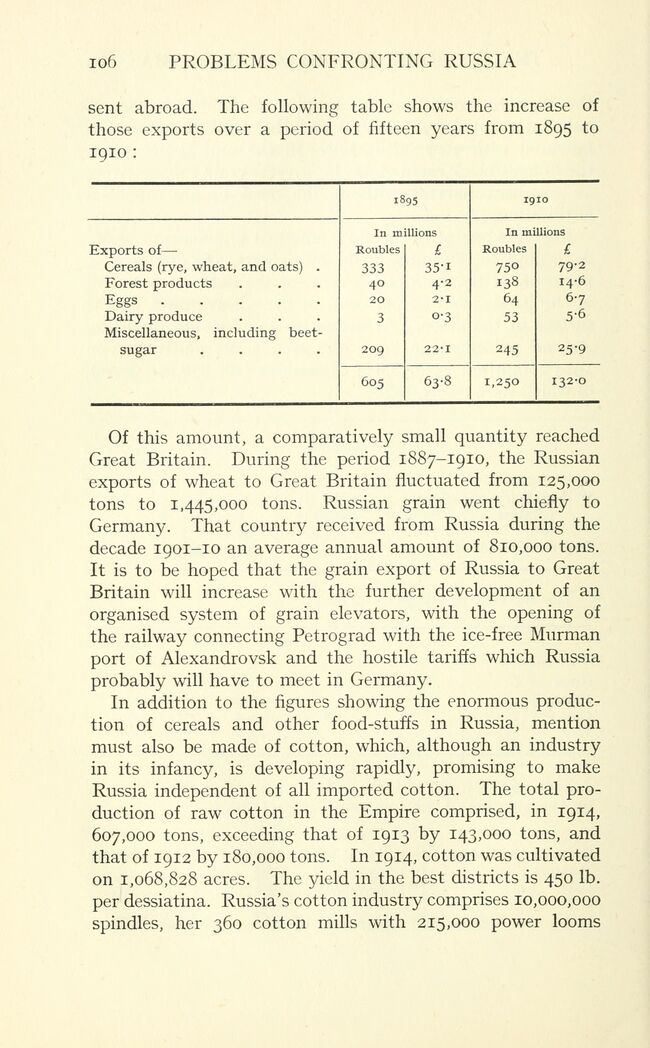
sent abroad. The following table shows the increase of
those exports over a period of fifteen years from 1895 to
1910 :
1895 1910
In millions In millions
Exports of— Roubles L Roubles I
Cereals (rye, wheat, and oats) . 333 35-i 75° 79-2
Forest products 40 4-2 138 14-6
Eggs..... 20 2-1 64 6-7
Dairy produce 3 °’3 53 5-6
Miscellaneous, including beet-
sugar .... 209 22-1 245 25-9
605 63-8 1,250 132-0
Of this amount, a comparatively small quantity reached
Great Britain. During the period 1887-1910, the Russian
exports of wheat to Great Britain fluctuated from 125,000
tons to 1,445,000 tons. Russian grain went chiefly to
Germany. That country received from Russia during the
decade 1901-10 an average annual amount of 810,000 tons.
It is to be hoped that the grain export of Russia to Great
Britain will increase with the further development of an
organised system of grain elevators, with the opening of
the railway connecting Petrograd with the ice-free Murman
port of Alexandrovsk and the hostile tariffs which Russia
probably will have to meet in Germany.
In addition to the figures showing the enormous
production of cereals and other food-stuffs in Russia, mention
must also be made of cotton, which, although an industry
in its infancy, is developing rapidly, promising to make
Russia independent of all imported cotton. The total
production of raw cotton in the Empire comprised, in 1914,
607,000 tons, exceeding that of 1913 by 143,000 tons, and
that of 1912 by 180,000 tons. In 1914, cotton was cultivated
on 1,068,828 acres. The yield in the best districts is 450 lb.
per dessiatina. Russia’s cotton industry comprises 10,000,000
spindles, her 360 cotton mills with 215,000 power looms
<< prev. page << föreg. sida << >> nästa sida >> next page >>


