Full resolution (JPEG) - On this page / på denna sida - Sidor ...

<< prev. page << föreg. sida << >> nästa sida >> next page >>
Below is the raw OCR text
from the above scanned image.
Do you see an error? Proofread the page now!
Här nedan syns maskintolkade texten från faksimilbilden ovan.
Ser du något fel? Korrekturläs sidan nu!
This page has never been proofread. / Denna sida har aldrig korrekturlästs.
302
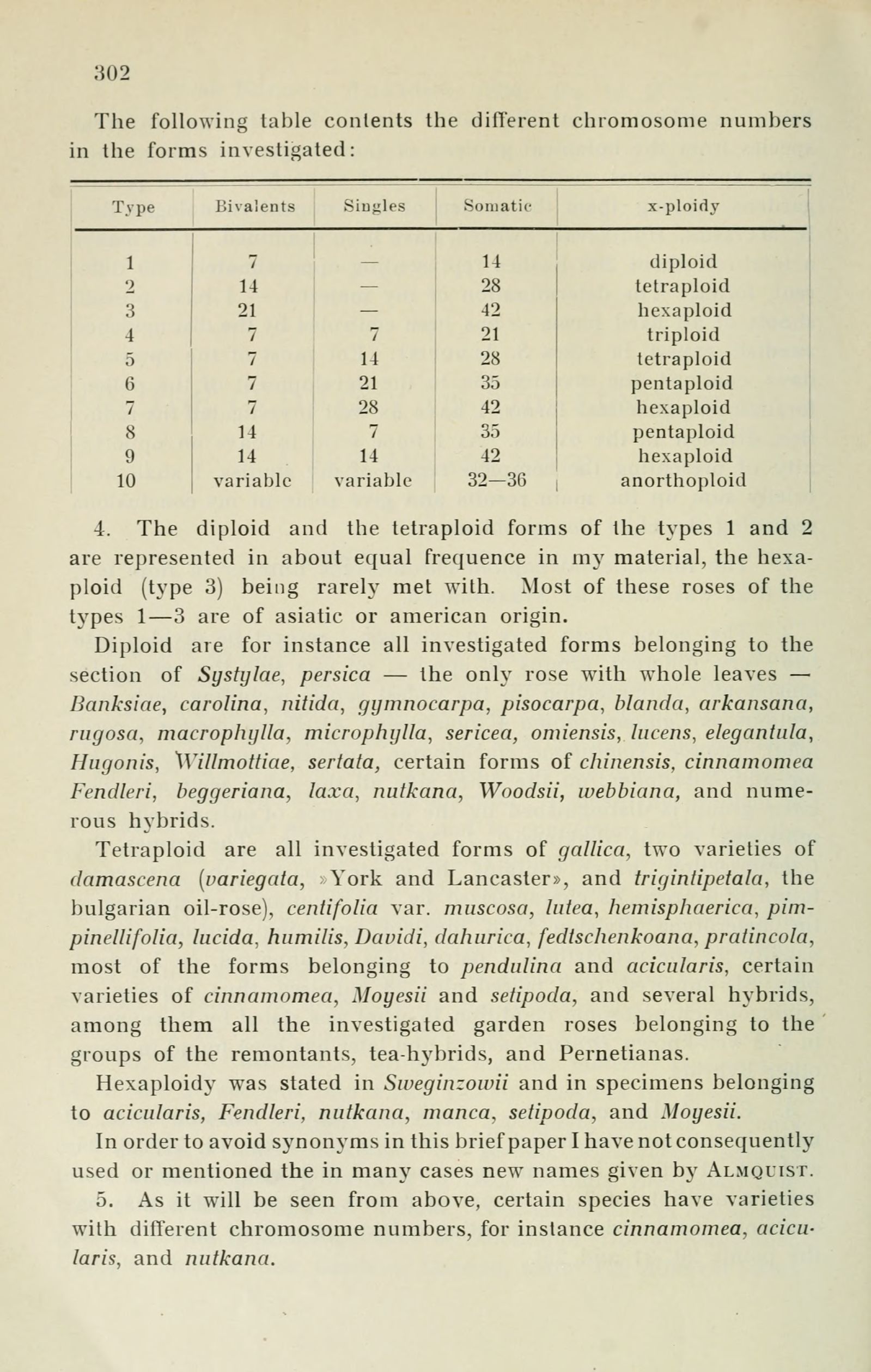
The following table contents the different chromosome numbers
in the forms investigated:
Type Bivalents Singles Somatic x-ploidy
1 7 = 14 diploid
2 | 14 == 28 | tetraploid
3 | 21 -— 42 hexaploid
4 | 7 7 21 triploid
5 7 14 28 tetraploid
6 7" 21 35 | pentaploid
7 | 7 28 42 | hexaploid
8 14 fi 35 | pentaploid
9 | 14 14 42 | hexaploid
10 | variable variable 32—36 anorthoploid |
4. The diploid and the tetraploid forms of the types 1 and 2
are represented in about equal frequence in my material, the hexa-
ploid (type 3) being rarely met with. Most of these roses of the
types 1—3 are of asiatic or american origin.
Diploid are for instance all investigated forms belonging to the
section of Systylae, persica — the only rose with whole leaves —
Banksiae, carolina, nitida, gymnocarpa, pisocarpa, blanda, arkansana,
rugosa, macrophylla, microphylla, sericea, omiensis, lucens, elegantula,
Hugonis, Willmottiae, sertata, certain forms of chinensis, cinnamomea
Fendleri, beggeriana, laxa, nutkana, Woodsii, webbiana, and nume-
rous hybrids.
Tetraploid are all investigated forms of gallica, two varieties of
damascena (variegata, »York and Lancaster», and frigintipetala, the
bulgarian oil-rose), centifolia var. muscosa, lutea, hemisphaerica, pim-
pinellifolia, lucida, humilis, Davidi, dahurica, fedischenkoana, pratincola,
most of the forms belonging to pendulina and acicularis, certain
varieties of cinnamomea, Moyesii and selipoda, and several hybrids,
among them all the investigated garden roses belonging to the
groups of the remontants, tea-hybrids, and Pernetianas.
Hexaploidy was stated in Sweginzowii and in specimens belonging
to acicularis, Fendleri, nutkana, manca, setipoda, and Moyesi.
In order to avoid synonyms in this briefpaper Ihavenotconsequently
used or mentioned the in many cases new names given by ALMQUIST.
5. As it will be seen from above, certain species have varieties
with different chromosome numbers, for instance cinnamomea, acicu-
laris, and nutkana.
<< prev. page << föreg. sida << >> nästa sida >> next page >>