Full resolution (JPEG) - On this page / på denna sida - Sidor ...
<< prev. page << föreg. sida << >> nästa sida >> next page >>
Below is the raw OCR text
from the above scanned image.
Do you see an error? Proofread the page now!
Här nedan syns maskintolkade texten från faksimilbilden ovan.
Ser du något fel? Korrekturläs sidan nu!
This page has never been proofread. / Denna sida har aldrig korrekturlästs.
58
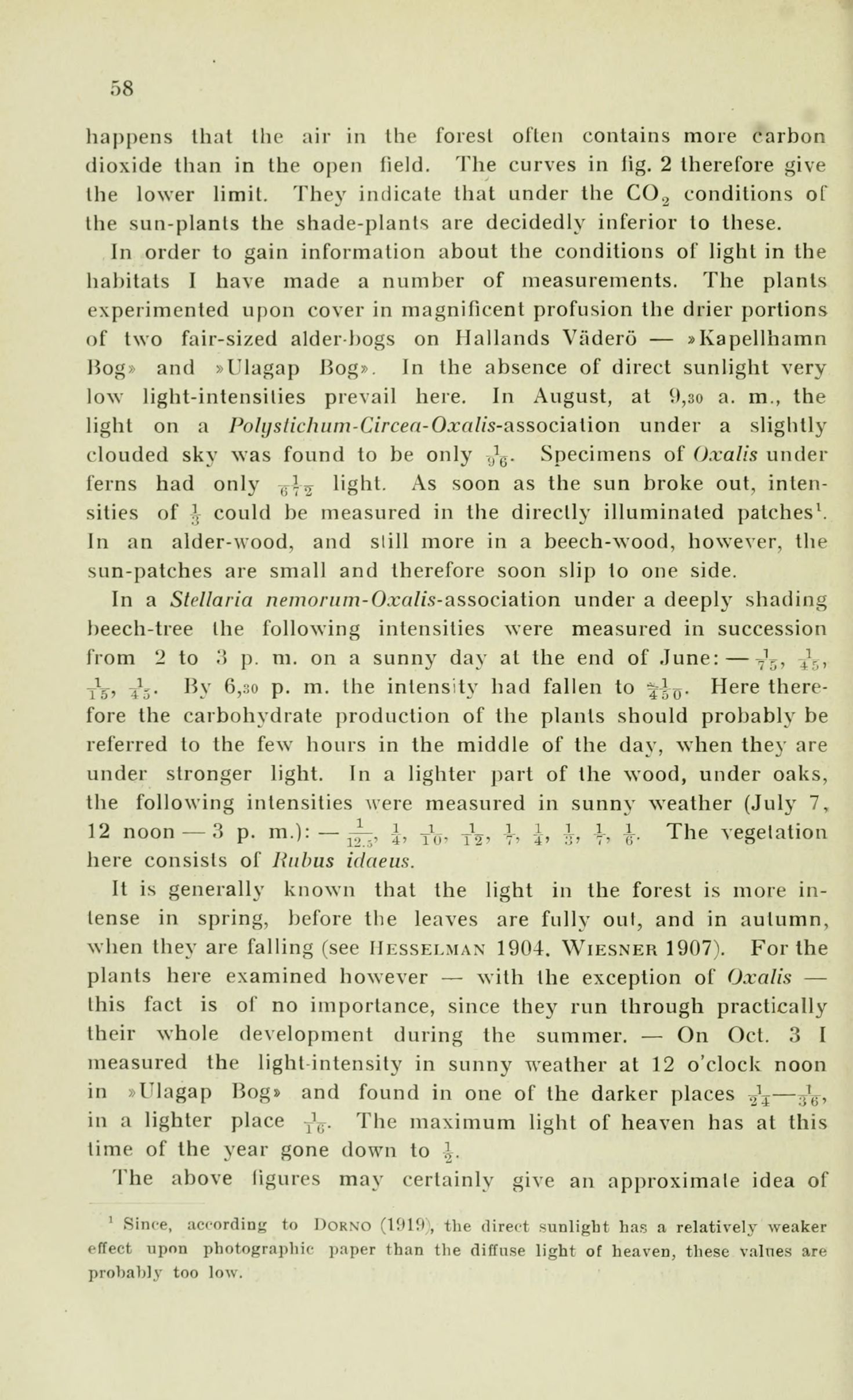
happens that the air in the forest often contains more Carbon
dioxide than in the open field. The curves in fig. 2 therefore give
the lower limit. They indicate that under the CO, conditions of
the sun-plants the shade-plants are decidedly inferior to these.
In order to gain information about the conditions of light in the
habitats I have made a number of measurements. The plants
experimented upon cover in magnificent profusion the drier portions
of two fair-sized alder-bogs on Hallands Väderö — »Kapellhamn
Bog» and »Ulagap Bog». In the absence of direct sunlight very
low light-intensilies prevail here. In August, at 9,30 a. m., the
light on a Polystichum-Circea-Oxalis-association under a slightly
clouded sky was found to be only j;. Specimens of Oxalis under
ferns had only 41, light. As soon as the sun broke out, inten-
sities of + could be measured in the directly illuminated patches’.
In an alder-wood, and still more in a beech-wood, however, the
sun-patches are small and therefore soon slip to one side.
In a Stellaria nemorum-Oxalis-association under a deeply shading
beech-tree the following intensities were measured in succession
from 2 to 3 p. m. on a sunny day at the end of June: — 4c, 4,
zs, 35. By 6,30 p. m. the intensity had fallen to 317. Here there-
fore the carbohydrate production of the plants should probably be
referred to the few hours in the middle of the day, when they are
under stronger light. In a lighter part of the wood, under oaks,
the following intensities were measured in sunny weather (July 7,
12 noon —3 p. m): — 5; 4, yy, ty, 4 1, 4, 4, & The vegetation
here consists of Rubus idaeus.
It is generally known that the light in the forest is more in-
lense in spring, before the leaves are fully out, and in autumn,
when they are falling (see HEssELMAN 1904, WIESNER 1907). For the
plants here examined however — with the exception of Oxalis —
this fact is of no importance, since they run through practically
their whole development during the summer. — On Oct. 3 I
measured the lightintensity in sunny weather at 12 o’clock noon
in »Ulagap Bog» and found in one of the darker places 4;—,
in a lighter place j;. The maximum light of heaven has at this
lime of the year gone down to 3.
The above figures may certainly give an approximale idea of
’ Since, according to Dorno (1919), the direct sunlight has a relatively weaker
effect upon photographic paper than the diffuse light of heaven, these values are
probably too low.
<< prev. page << föreg. sida << >> nästa sida >> next page >>