Full resolution (JPEG) - On this page / på denna sida - Sidor ...

<< prev. page << föreg. sida << >> nästa sida >> next page >>
Below is the raw OCR text
from the above scanned image.
Do you see an error? Proofread the page now!
Här nedan syns maskintolkade texten från faksimilbilden ovan.
Ser du något fel? Korrekturläs sidan nu!
This page has never been proofread. / Denna sida har aldrig korrekturlästs.
303
degree of acidity does not seem to be of very great importance,
though cases of the disease are not reported from soils with lower
Pg than 6. (l. e., p. 15); unfavourable external conditions, however,
seem to increase the susceplibility of the plants. These conclusions
have recently been supported by further investigations (ARRHENIUS
1924, [3]. In the second experiment the spots were more abundant
in II, (Ca = 90), less in I (Ca = 100) and slowly decreasing from
II to VII, but evident even in VI (Ca = 10), which, the same ex-
planation of the point I as in the first experiment being given,
seems to the author also to support ARRHENIUS’ view.
In considering the different curves of the first experiment we
find, first, that the general aspect of the curves of the three parallel
series is nearly the same and the same as the curve of the selected
pots, as well as that of the average curve. This is at least true,
if we disregard the fact that in the first series the ordinate of
point IV is slightly greater than those of the points I and VI (instead
of being essentially less). As the average dry weights of these
latter points were extremely low! and have comparatively high
mean errors (13.0—14.1 % of the maximal dry weight of the series),
the author thinks there are reasons for disregarding the deviation
in the aspect of this curve. We find further that the curves show
an optimal point at I, and another at VI. The difference between
the ordinates of the optimal points can be disregarded in comparison
with their mean errors. All the curves fall to a very low relative
dry-weight at II, the plants in this case being very weak and se-
verely affected by the grey-spot disease. The values between this
point and the point at VI differ so much in their relation to each
other in the three parallel curves that no safe conclusions can be
made concerning this relation. All the curves fall sharply from
the point at VI down to a very low value at VIL From all these
facts the author concludes that the average curve shows with a
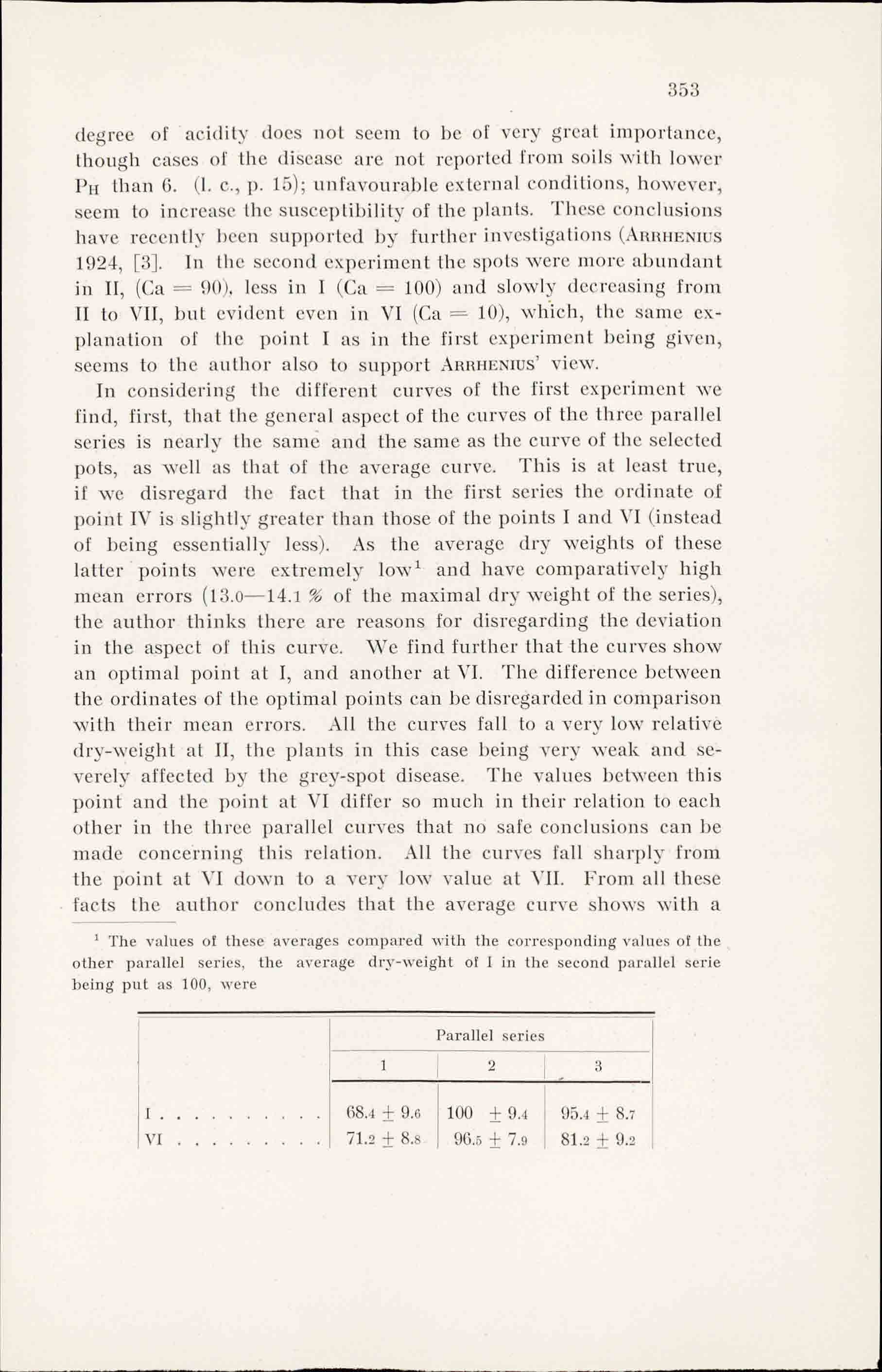
’ The values of these averages compared with the corresponding values of the
other parallel series, the average dry-weight of I in the second parallel serie
being put as 100, were
Parallel series
| 1 2
[..........| 0810-49; |100 +94
IV ge wes le ved EE Gua 90.5 + 7.9
<< prev. page << föreg. sida << >> nästa sida >> next page >>