
Full resolution (JPEG) - On this page / på denna sida - Sidor ...
<< prev. page << föreg. sida << >> nästa sida >> next page >>
Below is the raw OCR text
from the above scanned image.
Do you see an error? Proofread the page now!
Här nedan syns maskintolkade texten från faksimilbilden ovan.
Ser du något fel? Korrekturläs sidan nu!
This page has never been proofread. / Denna sida har aldrig korrekturlästs.
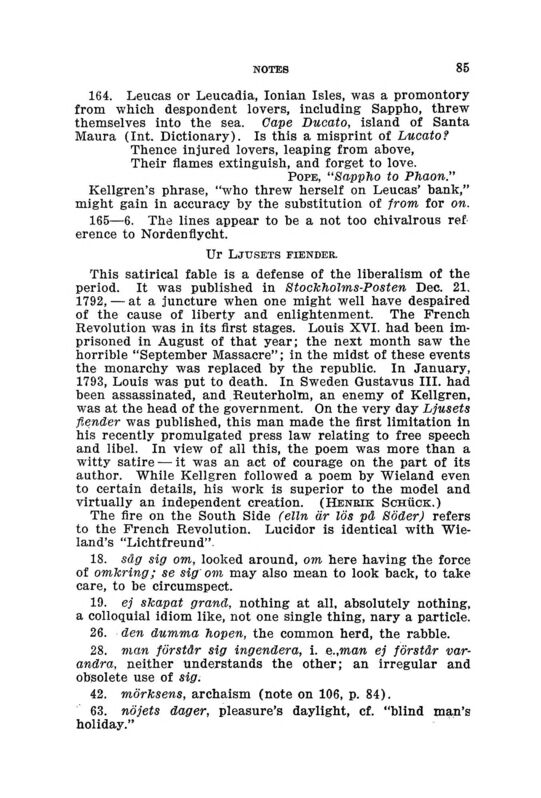
NOTES 85
164. Leucas or Leucadia, Ionian Isles, was a promontory
from which despondent lovers, including Sappho, threw
themselves into the sea. Cape Ducato, island of Santa
Maura (Int. Dictionary). Is this a misprint of Lucato?
’Thence injured lovers, leaping from above,
Their flames extinguish, and forget to love.
PoPE, "Sappho to Phaon.”
Kellgren’s phrase, "who threw herself on Leucas” bank,”
might gain in accuracy by the substitution of from for on.
165—6. The lines appear to be a not too chivalrous ref
erence to Nordenflycht.
Ur LJUSETS FIENDER.
This satirical fable is a defense of the liberalism of the
period. It was published in Stockholms-Posten Dec. 21.
1792, — at a juncture when one might well have despaired
of the cause of liberty and enlightenment. The French
Revolution was in its first stages. Louis XVI. had been
imprisoned in August of that year; the next month saw the
horrible "September Massacre”; in the midst of these events
the monarchy was replaced by the republic. In January,
1793, Louis was put to death. In Sweden Gustavus III. had
been assassinated, and Reuterholm, an enemy of Kellgren,
was at the head of the government. On the very day Ljusets
fiender was published, this man made the first limitation in
his recently promulgated press law relating to free speech
and libel. In view of all this, the poem was more than a
witty satire — it was an act of courage on the part of its
author. While Kellgren followed a poem by Wieland even
to certain details, his work is superior to the model and
virtually an independent creation. (HENRIK SCHUCK.)
The fire on the South Side (elln är lös på Söder) refers
to the French Revolution. Lucidor is identical with
Wielands "Lichtfreund”.
18. såg sig om, looked around, om here having the force
of omkring; se sig om may also mean to look back, to take
care, to be circumspect.
19. ej skapat grand, nothing at all, absolutely nothing,
a colloquial idiom like, not one single thing, nary a particle.
26. den dumma hopen, the common herd, the rabble.
28. man förstår sig ingendera, i. e..man ej förstår
varandra, neither understands the other; an irregular and
obsolete use of sig:
42. mörksens, archaism (note on 106, p. 84).
"63. nöjets dager, pleasure’s daylight, cf. "blind man’s
holiday.” 4
<< prev. page << föreg. sida << >> nästa sida >> next page >>


