
Full resolution (JPEG) - On this page / på denna sida - II. The Swedish People - 3. National Character and Social Conditions. Introd. by [G. Sundbärg] J. Asproth
<< prev. page << föreg. sida << >> nästa sida >> next page >>
Below is the raw OCR text
from the above scanned image.
Do you see an error? Proofread the page now!
Här nedan syns maskintolkade texten från faksimilbilden ovan.
Ser du något fel? Korrekturläs sidan nu!
This page has never been proofread. / Denna sida har aldrig korrekturlästs.
NATIONAL CHARACTER ANI) SOCIAL CONDITIONS.
147
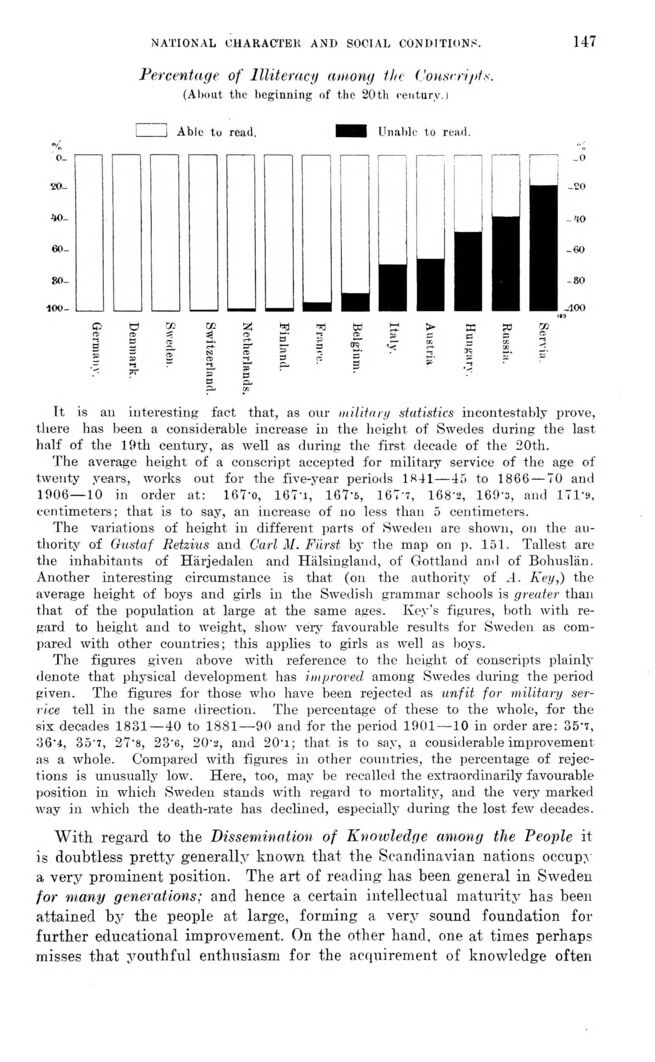
Percentage of Illiteracy among the < ’onscrijit*
(About the beginning of the 20th century.)
Unable to read.
It is an interesting fact that, as our military statistics incontestably prove,
there has been a considerable increase in the height of Swedes during the last
half of the 19th century, as well as during the first decade of the 20th.
The average height of a conscript accepted for military service of the age of
twenty years, works out for the five-year periods 1K41—45 to 1866 — 70 and
1906 — 10 in order at: 167*0, 167*1, 167*8, 167-7, 168*2, 169*3, and 171*9,
centimeters; that is to say, an increase of no less than 5 centimeters.
The variations of height in different parts of Sweden are shown, on the
authority of Gustaf Retzius and Gari il/. Fiirst by the map on p. 151. Tallest are
the inhabitants of Härjedalen and Hälsingland, of Gottland and of Bohuslän.
Another interesting circumstance is that (on the authority of Key,) the
average height of boys and girls in the Swedish grammar schools is greater than
that of the population at large at the same ages. Key’s figures, both with
regard to height and to weight, show very favourable results for Sweden as
compared with other countries; this applies to girls as well as boys.
The figures given above with reference to the height of conscripts plainly
denote that physical development has improved among Swedes during the period
given. The figures for those who have been rejected as unfit for military
service tell in the same direction. The percentage of these to the whole, for the
six decades 1831—40 to 1881—90 and for the period 1901—10 in order are: 35-7,
36*4, 35’7, 27’8, 23*e, 20’a, and 20"i; that is to say, a considerable improvement
as a whole. Compared with figures in other countries, the percentage of
rejections is unusually low. Here, too, may be recalled the extraordinarily favourable
position in which Sweden stands with regard to mortality, and the very marked
way in which the death-rate has declined, especially during the lost few decades.
With regard to the Dissemination of Knowledge among the People it
is doubtless pretty generally known that the Scandinavian nations occupy
a very prominent position. The art of reading has been general in Sweden
for many generations: and hence a certain intellectual maturity has been
attained by the people at large, forming a very sound foundation for
further educational improvement. On the other hand, one at times perhaps
misses that youthful enthusiasm for the acquirement of knowledge often
<< prev. page << föreg. sida << >> nästa sida >> next page >>


