
Full resolution (JPEG) - On this page / på denna sida - II. The Swedish People - 3. National Character and Social Conditions. Introd. by [G. Sundbärg] J. Asproth - Customs and Mode of Life. By [G. Sundbärg and J. P. Velander] Einar J:son Thulin and V. Själander
<< prev. page << föreg. sida << >> nästa sida >> next page >>
Below is the raw OCR text
from the above scanned image.
Do you see an error? Proofread the page now!
Här nedan syns maskintolkade texten från faksimilbilden ovan.
Ser du något fel? Korrekturläs sidan nu!
This page has never been proofread. / Denna sida har aldrig korrekturlästs.
174
II. THE SWEDISH PEOPLE.
favourably on the physical development of the Swedish people, and on the
death-rate. The reader is referred to the sections on these subjects.
Households in Sweden were still very large far into the 19th century; but
in recent times their size has on an average diminished, as the number of
servants has been restricted, and employers nowadays seldom have their
workpeople living with them. Thus the number of female servants to every thousand
households was at the censuses of 1870 and 1900, 195 and 113 respectively.
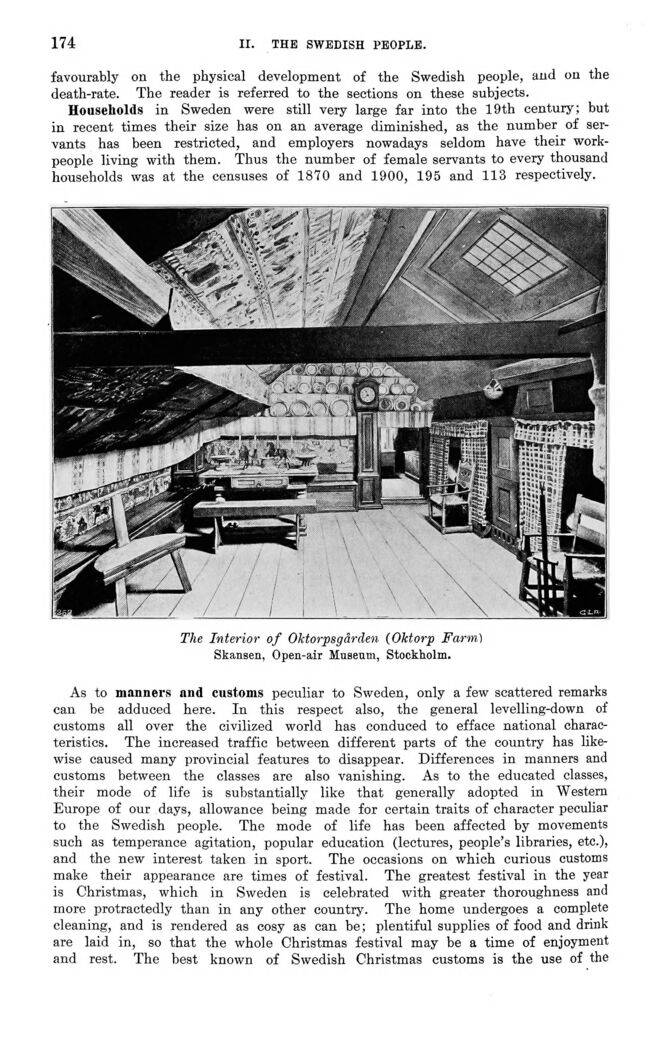
The Interior of Oktorpsgården (Oktorp Farm)
Skansen, Open-air Museum, Stockholm.
As to manners and customs peculiar to Sweden, only a few scattered remarks
can be adduced here. In this respect also, the general levelling-down of
customs all over the civilized world has conduced to efface national
characteristics. The increased traffic between different parts of the country has
likewise caused many provincial features to disappear. Differences in manners and
customs between the classes are also vanishing. As to the educated classes,
their mode of life is substantially like that generally adopted in Western
Europe of our days, allowance being made for certain traits of character peculiar
to the Swedish people. The mode of life has been affected by movements
such as temperance agitation, popular education (lectures, people’s libraries, etc.),
and the new interest taken in sport. The occasions on which curious customs
make their appearance are times of festival. The greatest festival in the year
is Christmas, which in Sweden is celebrated with greater thoroughness and
more protractedly than in any other country. The home undergoes a complete
cleaning, and is rendered as cosy as can be; plentiful supplies of food and drink
are laid in, so that the whole Christmas festival may be a time of enjoyment
and rest. The best known of Swedish Christmas customs is the use of the
<< prev. page << föreg. sida << >> nästa sida >> next page >>


