
Full resolution (JPEG) - On this page / på denna sida - III. Constitution and Administration. Introd. by E. Hildebrand - 2. State Administration. By E. Söderberg - Army. By H. Hult
<< prev. page << föreg. sida << >> nästa sida >> next page >>
Below is the raw OCR text
from the above scanned image.
Do you see an error? Proofread the page now!
Här nedan syns maskintolkade texten från faksimilbilden ovan.
Ser du något fel? Korrekturläs sidan nu!
This page has never been proofread. / Denna sida har aldrig korrekturlästs.
■2-20
III. CONSTITUTION AND ADMINISTRATION.
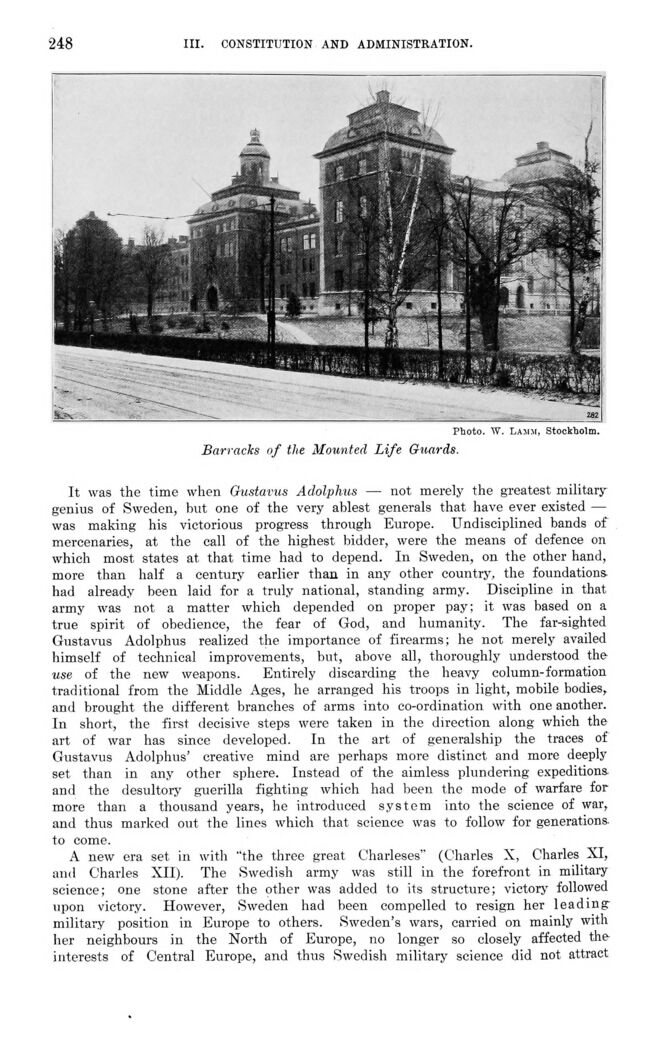
Photo. W. Lamm, Stockholm.
Barracks of the Mounted Life Guards.
It was the time when Gustavus Adolphus — not merely the greatest military
genius of Sweden, but one of the very ablest generals that have ever existed —
was making his victorious progress through Europe. Undisciplined bands of
mercenaries, at the call of the highest bidder, were the means of defence on
which most states at that time had to depend. In Sweden, on the other hand,
more than half a century earlier than in any other country, the
foundations-had already been laid for a truly national, standing army. Discipline in that
army was not a matter which depended on proper pay; it was based on a
true spirit of obedience, the fear of God, and humanity. The far-sighted
Gustavus Adolphus realized the importance of firearms; he not merely availed
himself of technical improvements, but, above all, thoroughly understood the
use of the new weapons. Entirely discarding the heavy column-formation
traditional from the Middle Ages, he arranged his troops in light, mobile bodies,
and brought the different branches of arms into co-ordination with one another.
In short, the first decisive steps were taken in the direction along which the
art of war has since developed. In the art of generalship the traces of
Gustavus Adolphus’ creative mind are perhaps more distinct and more deeply
set than in any other sphere. Instead of the aimless plundering expeditions,
and the desultory guerilla fighting which had been the mode of warfare for
more than a thousand years, he introduced system into the science of war,
and thus marked out the lines which that science was to follow for generations,
to come.
A new era set in with "the three great Charleses" (Charles X, Charles XI,
and Charles XII). The Swedish army was still in the forefront in military
science; one stone after the other was added to its structure; victory followed
upon victory. However, Sweden had been compelled to resign her leading
military position in Europe to others. Sweden’s wars, carried on mainly with
her neighbours in the North of Europe, no longer so closely affected the
interests of Central Europe, and thus Swedish military science did not attract
<< prev. page << föreg. sida << >> nästa sida >> next page >>


