Full resolution (JPEG) - On this page / på denna sida - IV. Education and Mental Culture. Introd. by P. E. Lindström - 4. Technical Instruction. By S. A. Söderblom
<< prev. page << föreg. sida << >> nästa sida >> next page >>
Below is the raw OCR text
from the above scanned image.
Do you see an error? Proofread the page now!
Här nedan syns maskintolkade texten från faksimilbilden ovan.
Ser du något fel? Korrekturläs sidan nu!
This page has never been proofread. / Denna sida har aldrig korrekturlästs.
technical instruction.
423
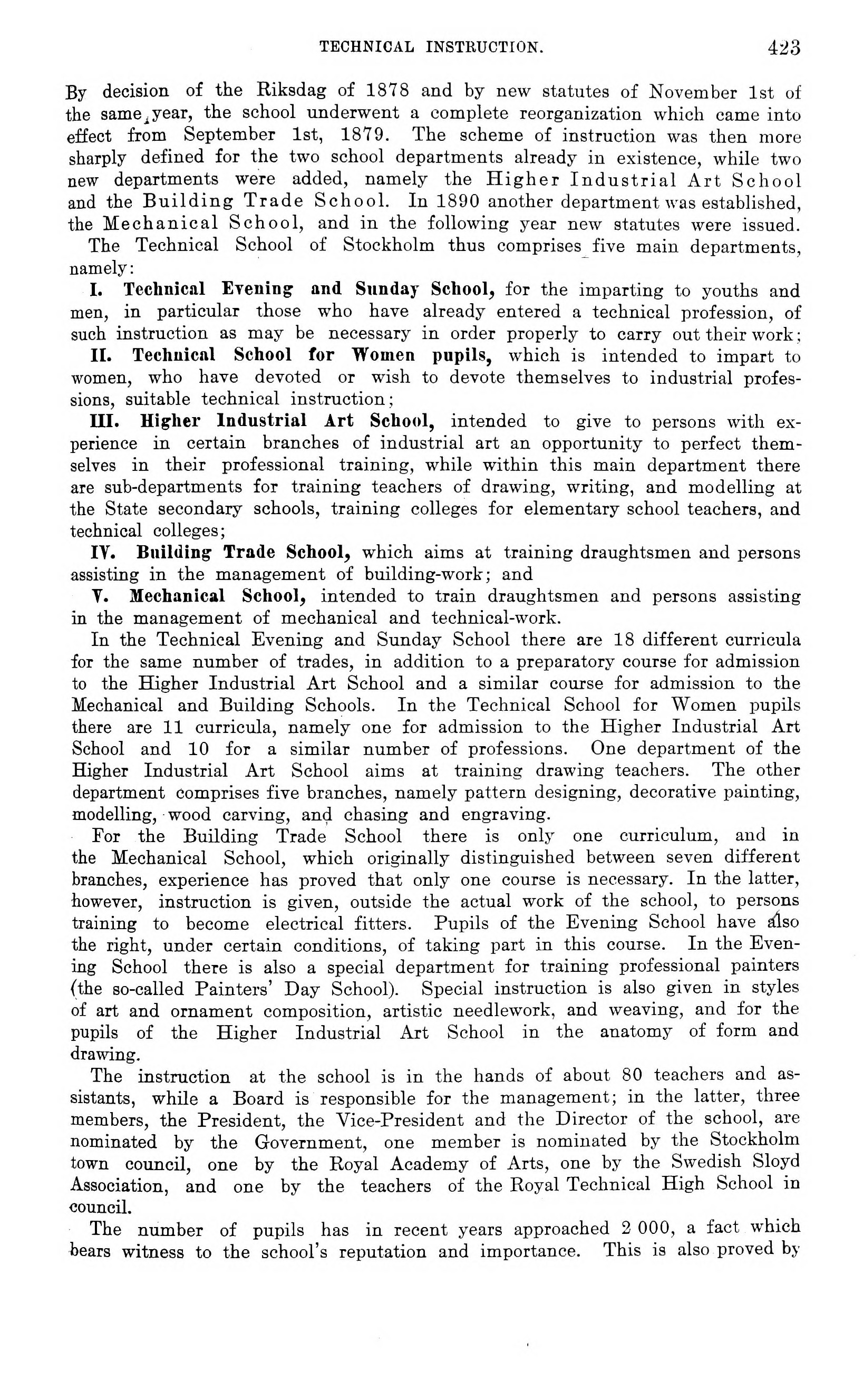
By decision of the Riksdag of 1878 and by new statutes of November 1st of
the same^year, the school underwent a complete reorganization which came into
effect from September 1st, 1879. The scheme of instruction was then more
sharply defined for the two school departments already in existence, while two
new departments were added, namely the Higher Industrial Art School
and the Building Trade School. In 1890 another department was established,
the Mechanical School, and in the following year new statutes were issued.
The Technical School of Stockholm thus comprises five main departments,
namely:
I. Technical Evening and Sunday School, for the imparting to youths and
men, in particular those who have already entered a technical profession, of
such instruction as may be necessary in order properly to carry out their work;
II. Technical School for Women pupils, which is intended to impart to
women, who have devoted or wish to devote themselves to industrial
professions, suitable technical instruction;
III. Higher Industrial Art School, intended to give to persons with
experience in certain branches of industrial art an opportunity to perfect
themselves in their professional training, while within this main department there
are sub-departments for training teachers of drawing, writing, and modelling at
the State secondary schools, training colleges for elementary school teachers, and
technical colleges;
IV. Building Trade School, which aims at training draughtsmen and persons
assisting in the management of building-work; and
Y. Mechanical School, intended to train draughtsmen and persons assisting
in the management of mechanical and technical-work.
In the Technical Evening and Sunday School there are 18 different curricula
for the same number of trades, in addition to a preparatory course for admission
to the Higher Industrial Art School and a similar course for admission to the
Mechanical and Building Schools. In the Technical School for Women pupils
there are 11 curricula, namely one for admission to the Higher Industrial Art
School and 10 for a similar number of professions. One department of the
Higher Industrial Art School aims at training drawing teachers. The other
department comprises five branches, namely pattern designing, decorative painting,
modelling, wood carving, and chasing and engraving.
For the Building Trade School there is only one curriculum, and in
the Mechanical School, which originally distinguished between seven different
branches, experience has proved that only one course is necessary. In the latter,
however, instruction is given, outside the actual work of the school, to persons
training to become electrical fitters. Pupils of the Evening School have älso
the right, under certain conditions, of taking part in this course. In the
Evening School there is also a special department for training professional painters
(the so-called Painters’ Day School). Special instruction is also given in styles
of art and ornament composition, artistic needlework, and weaving, and for the
pupils of the Higher Industrial Art School in the anatomy of form and
drawing.
The instruction at the school is in the hands of about 80 teachers and
assistants, while a Board is responsible for the management; in the latter, three
members, the President, the Vice-President and the Director of the school, are
nominated by the Government, one member is nominated by the Stockholm
town council, one by the Royal Academy of Arts, one by the Swedish Sloyd
Association, and one by the teachers of the Royal Technical High School in
council.
The number of pupils has in recent years approached 2 000, a fact which
bears witness to the school’s reputation and importance. This is also proved by
<< prev. page << föreg. sida << >> nästa sida >> next page >>