
Full resolution (JPEG) - On this page / på denna sida - IV. Education and Mental Culture. Introd. by P. E. Lindström - 8. Public Collections and Institutions for Science and Art. The Periodial Press - Academies and Learned Societies. By [B. Lundstedt] O. Wieselgren
<< prev. page << föreg. sida << >> nästa sida >> next page >>
Below is the raw OCR text
from the above scanned image.
Do you see an error? Proofread the page now!
Här nedan syns maskintolkade texten från faksimilbilden ovan.
Ser du något fel? Korrekturläs sidan nu!
This page has never been proofread. / Denna sida har aldrig korrekturlästs.
464
iv. education and mental cultulle.
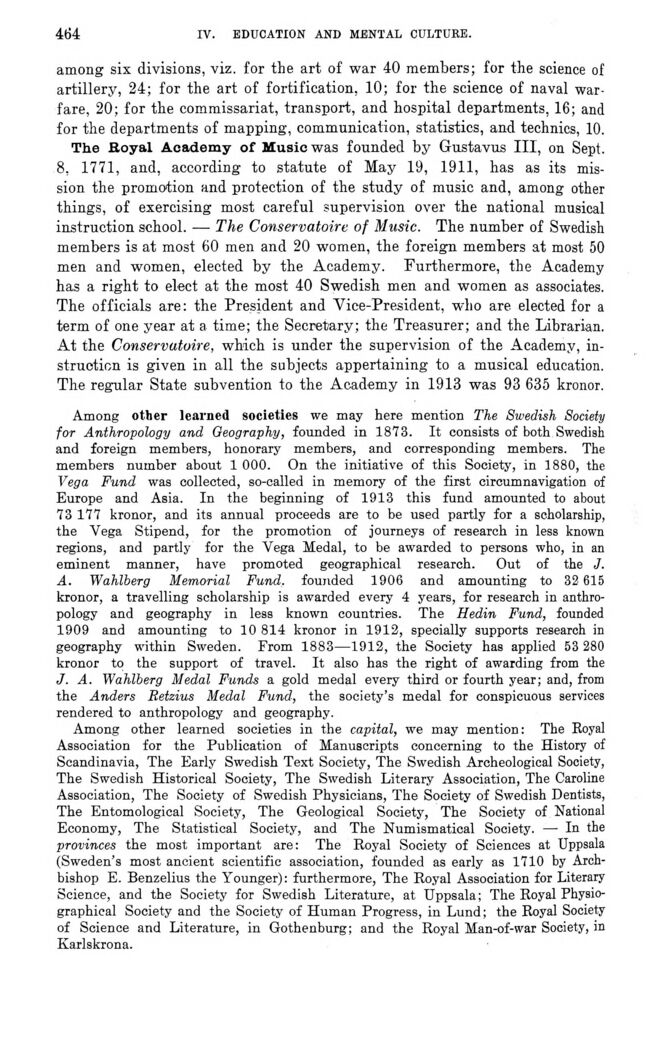
among six divisions, viz. for the art of war 40 members; for the science of
artillery, 24; for the art of fortification, 10; for the science of naval
warfare, 20; for the commissariat, transport, and hospital departments, 16; and
for the departments of mapping, communication, statistics, and technics, 10.
The Royal Academy of Music was founded by Gustavus III, on Sept.
8, 1771, and, according to statute of May 19, 1911, has as its
mission the promotion and protection of the study of music and, among other
things, of exercising most careful supervision over the national musical
instruction school. — The Conservatoire of Music. The number of Swedish
members is at most 60 men and 20 women, the foreign members at most 50
men and women, elected by the Academy. Furthermore, the Academy
has a right to elect at the most 40 Swedish men and women as associates.
The officials are: the President and Vice-President, who are elected for a
term of one year at a time; the Secretary; the Treasurer; and the Librarian.
At the Conservatoire, which is under the supervision of the Academy,
instruction is given in all the subjects appertaining to a musical education.
The regular State subvention to the Academy in 1913 was 93 635 kronor.
Among other learned societies we may here mention The Swedish Society
for Anthropology and Geography, founded in 1873. It consists of both Swedish
and foreign members, honorary members, and corresponding members. The
members number about 1 000. On the initiative of this Society, in 1880, the
Vega Fund was collected, so-called in memory of the first circumnavigation of
Europe and Asia. In the beginning of 1913 this fund amounted to about
73 177 kronor, and its annual proceeds are to be used partly for a scholarship,
the Vega Stipend, for the promotion of journeys of research in less known
regions, and partly for the Vega Medal, to be awarded to persons who, in an
eminent manner, have promoted geographical research. Out of the J.
A. Wahlberg Memorial Fund, founded 1906 and amounting to 32 615
kronor, a travelling scholarship is awarded every 4 years, for research in
anthropology and geography in less known countries. The Hedin Fund, founded
1909 and amounting to 10 814 kronor in 1912, specially supports research in
geography within Sweden. From 1883—1912, the Society has applied 53 280
kronor to the support of travel. It also has the right of awarding from the
J. A. Wahlberg Medal Funds a gold medal every third or fourth year; and, from
the Anders Retzius Medal Fund, the society’s medal for conspicuous services
rendered to anthropology and geography.
Among other learned societies in the capital, we may mention: The Royal
Association for the Publication of Manuscripts concerning to the History of
Scandinavia, The Early Swedish Text Society, The Swedish Archeological Society,
The Swedish Historical Society, The Swedish Literary Association, The Caroline
Association, The Society of Swedish Physicians, The Society of Swedish Dentists,
The Entomological Society, The Geological Society, The Society of National
Economy, The Statistical Society, and The Numismatical Society. — In the
provinces the most important are: The Royal Society of Sciences at Uppsala
(Sweden’s most ancient scientific association, founded as early as 1710 by
Archbishop E. Benzelius the Younger): furthermore, The Royal Association for Literary
Science, and the Society for Swedish Literature, at Uppsala; The Royal
Physio-graphical Society and the Society of Human Progress, in Lund; the Royal Society
of Science and Literature, in Gothenburg; and the Royal Man-of-war Society, in
Karlskrona.
<< prev. page << föreg. sida << >> nästa sida >> next page >>


