Full resolution (JPEG) - On this page / på denna sida - IV. Education and Mental Culture. Introd. by P. E. Lindström - 11. Science - Philosophy. By A. Lagerwall

<< prev. page << föreg. sida << >> nästa sida >> next page >>
Below is the raw OCR text
from the above scanned image.
Do you see an error? Proofread the page now!
Här nedan syns maskintolkade texten från faksimilbilden ovan.
Ser du något fel? Korrekturläs sidan nu!
This page has never been proofread. / Denna sida har aldrig korrekturlästs.
philosophy.
543
prof. T’. Norström (b. 1856) of Gothenburg; prof. P. E. Liljeqvist (b. 1865) of
Lund; and prof. A. Hägerström (b. 1868), of Uppsala.
The most resolute adherent of these to Bostrom’s principles is Liljequist, who
critically elaborates and developes them in his academic teaching and in numerous
works. Burman’s most important works deal with the great German
transcendental philosophies of Kant, Fichte and Schelling, whom he interprets with
penetrating insight. Geijers interest has been directed essentially to empirical
psychology and the history of philosophy. Hägerström has, with fruitful
productiveness, traversed a long range of philosophic propositions, greatly influenced,
as he has been, by critical transcendental philosophy, absolute logical idealism,
and sociological moral empiricism.
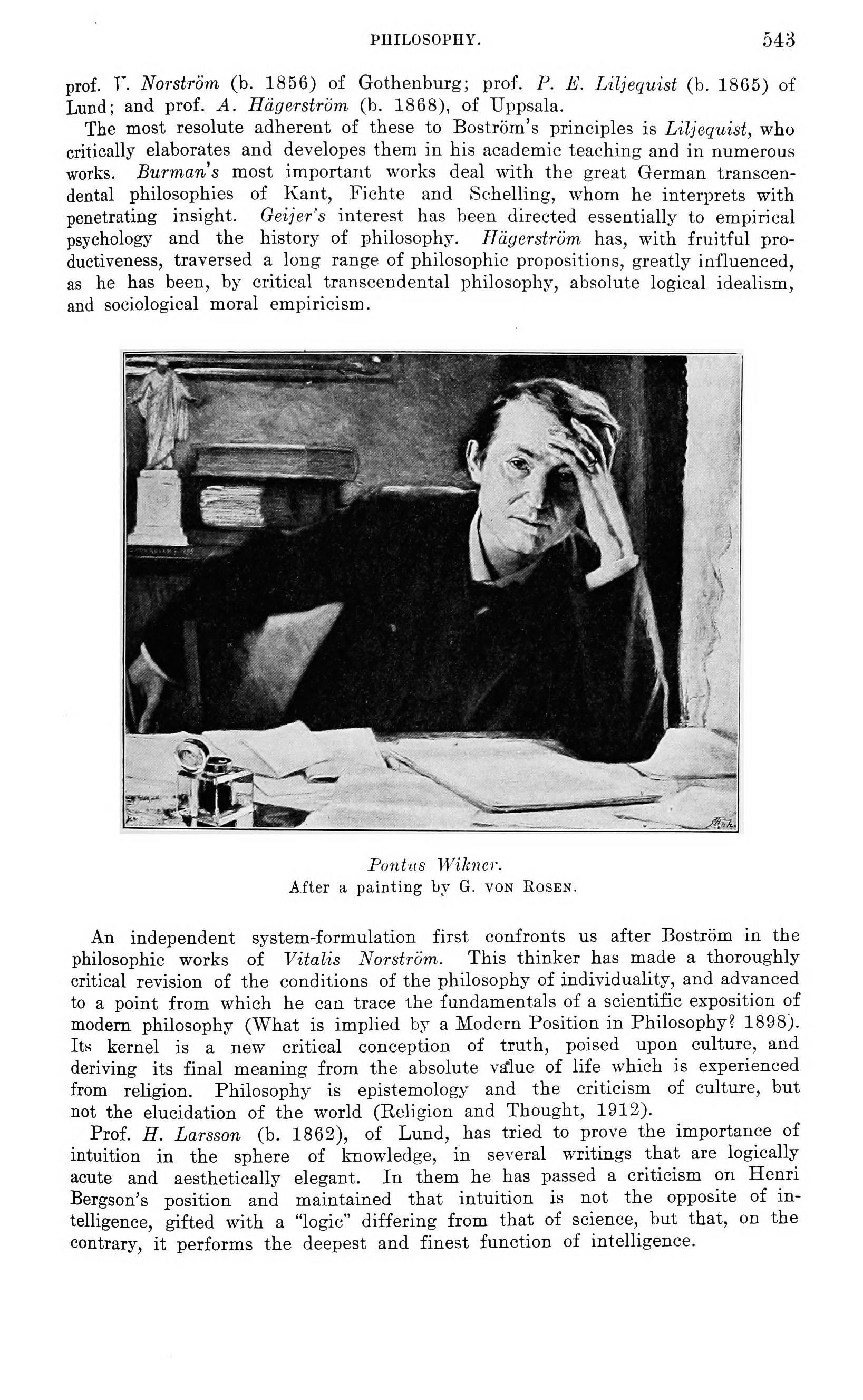
Pontus Wikner.
After a painting by G. von Rosen.
An independent system-formulation first confronts us after Boström in the
philosophic works of Vitalis Norström. This thinker has made a thoroughly
critical revision of the conditions of the philosophy of individuality, and advanced
to a point from which he can trace the fundamentals of a scientific exposition of
modern philosophy (What is implied by a Modern Position in Philosophy? 1898).
Its kernel is a new critical conception of truth, poised upon culture, and
deriving its final meaning from the absolute vsflue of life which is experienced
from religion. Philosophy is epistemology and the criticism of culture, but
not the elucidation of the world (Religion and Thought, 1912).
Prof. H. Larsson (b. 1862), of Lund, has tried to prove the importance of
intuition in the sphere of knowledge, in several writings that are logically
acute and aesthetically elegant. In them he has passed a criticism on Henri
Bergson’s position and maintained that intuition is not the opposite of
intelligence, gifted with a "logic" differing from that of science, but that, on the
contrary, it performs the deepest and finest function of intelligence.
<< prev. page << föreg. sida << >> nästa sida >> next page >>