Full resolution (JPEG) - On this page / på denna sida - V. Social Movements - 4. Other Social Movements - Preservation of Natural Scenery. According to information contributed by T. Högdahl, K. Starbäck, and A. Wigelius. By G. Adolf Larsson - Protection of Animals. According to information contributed by F. A. Wingborg and Hj. Dahlström
<< prev. page << föreg. sida << >> nästa sida >> next page >>
Below is the raw OCR text
from the above scanned image.
Do you see an error? Proofread the page now!
Här nedan syns maskintolkade texten från faksimilbilden ovan.
Ser du något fel? Korrekturläs sidan nu!
This page has never been proofread. / Denna sida har aldrig korrekturlästs.
protection of animals.
779
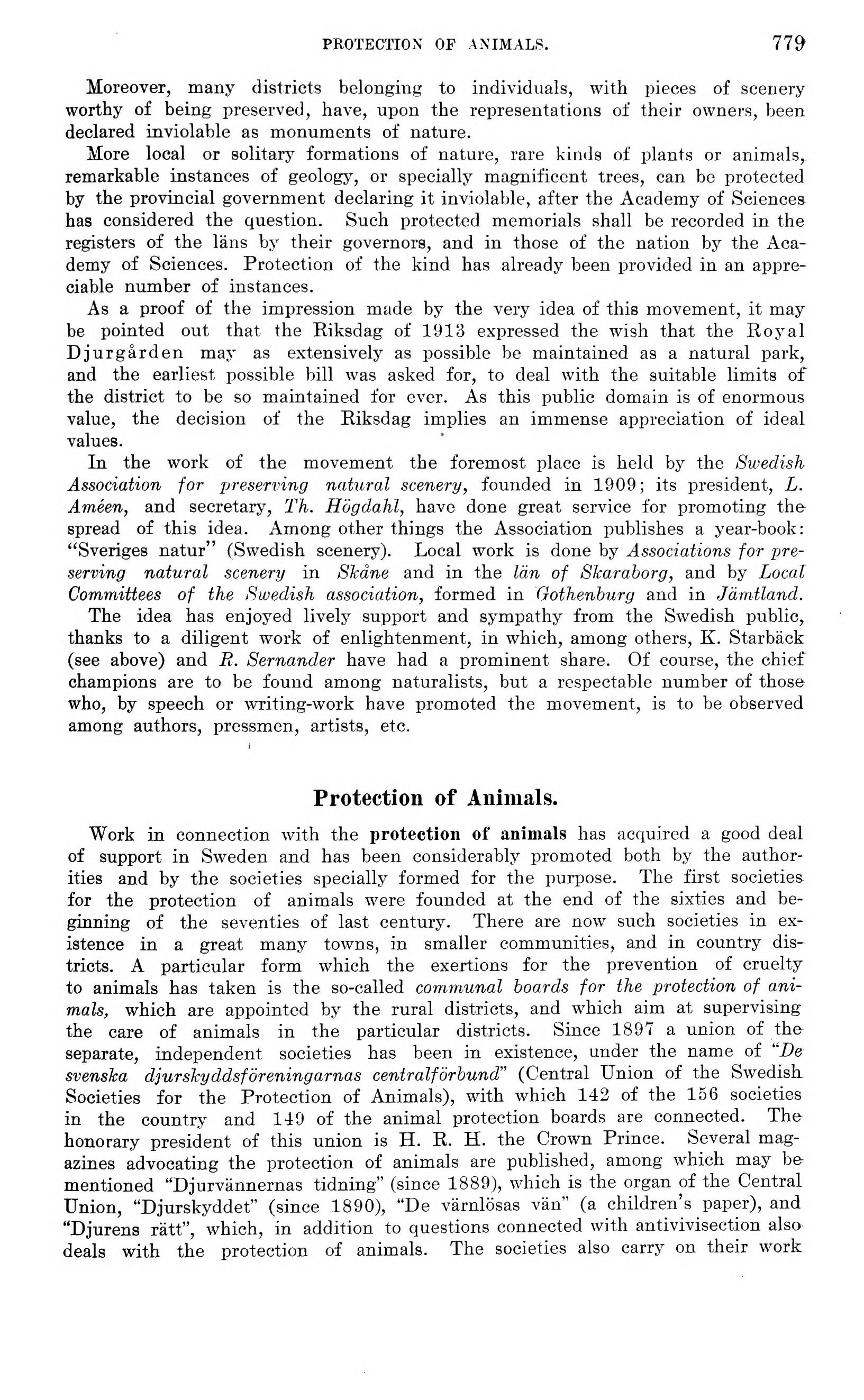
Moreover, many districts belonging to individuals, with pieces of scenery
worthy of being preserved, have, upon the representations of their owners, been
declared inviolable as monuments of nature.
More local or solitary formations of nature, rare kinds of plants or animals,
remarkable instances of geology, or specially magnificent trees, can be protected
by the provincial government declaring it inviolable, after the Academy of Sciences
has considered the question. Such protected memorials shall be recorded in the
registers of the läns by their governors, and in those of the nation by the
Academy of Sciences. Protection of the kind has already been provided in an
appreciable number of instances.
As a proof of the impression made by the very idea of this movement, it may
be pointed out that the Riksdag of 1913 expressed the wish that the Royal
Djurgården may as extensively as possible be maintained as a natural park,
and the earliest possible bill was asked for, to deal with the suitable limits of
the district to be so maintained for ever. As this public domain is of enormous
value, the decision of the Riksdag implies an immense appreciation of ideal
values.
In the work of the movement the foremost place is held by the Swedish
Association for preserving natural scenery, founded in 1909; its president, L.
Améen, and secretary, Th. Högdahl, have done great service for promoting the
spread of this idea. Among other things the Association publishes a year-book:
"Sveriges natur" (Swedish scenery). Local work is done by Associations for
preserving natural scenery in Skåne and in the län of Skaraborg, and by Local
Committees of the Swedish association, formed in Gothenburg and in Jämtland.
The idea has enjoyed lively support and sympathy from the Swedish public,
thanks to a diligent work of enlightenment, in which, among others, K. Starbäck
(see above) and R. Sernander have had a prominent share. Of course, the chief
champions are to be found among naturalists, but a respectable number of those
who, by speech or writing-work have promoted the movement, is to be observed
among authors, pressmen, artists, etc.
Protection of Animals.
Work in connection with the protection of animals has acquired a good deal
of support in Sweden and has been considerably promoted both by the
authorities and by the societies specially formed for the purpose. The first societies
for the protection of animals were founded at the end of the sixties and
beginning of the seventies of last century. There are now such societies in
existence in a great many towns, in smaller communities, and in country
districts. A particular form which the exertions for the prevention of cruelty
to animals has taken is the so-called communal boards for the protection of
animals, which are appointed by the rural districts, and which aim at supervising
the care of animals in the particular districts. Since 1897 a union of the
separate, independent societies has been in existence, under the name of "De
svenska djurskyddsföreningarnas centralförbund" (Central Union of the Swedish
Societies for the Protection of Animals), with which 142 of the 156 societies
in the country and 149 of the animal protection boards are connected. The
honorary president of this union is H. R. H. the Crown Prince. Several
magazines advocating the protection of animals are published, among which may be
mentioned "Djurvännernas tidning" (since 1889), which is the organ of the Central
Union, "Djurskyddet" (since 1890), "De värnlösas vän" (a children’s paper), and
"Djurens rätt", which, in addition to questions connected with antivivisection also
deals with the protection of animals. The societies also carry on their work
<< prev. page << föreg. sida << >> nästa sida >> next page >>