
Full resolution (JPEG) - On this page / på denna sida - III. Rural Husbandry. Introd. by H. Juhlin Dannfelt - 3. Dairies and Dairy-Industry. By L. G. Thomé
<< prev. page << föreg. sida << >> nästa sida >> next page >>
Below is the raw OCR text
from the above scanned image.
Do you see an error? Proofread the page now!
Här nedan syns maskintolkade texten från faksimilbilden ovan.
Ser du något fel? Korrekturläs sidan nu!
This page has never been proofread. / Denna sida har aldrig korrekturlästs.
the development of the dairy-industry.
107
especially by its adoption for dairy purposes of vessels and implements made of
tinned sheet-iron. Both the above methods of creaming were hampered by
their demand for space and many vessels, and great difficulty was experienced,
too, in keeping the milk sweet during the process of creaming.
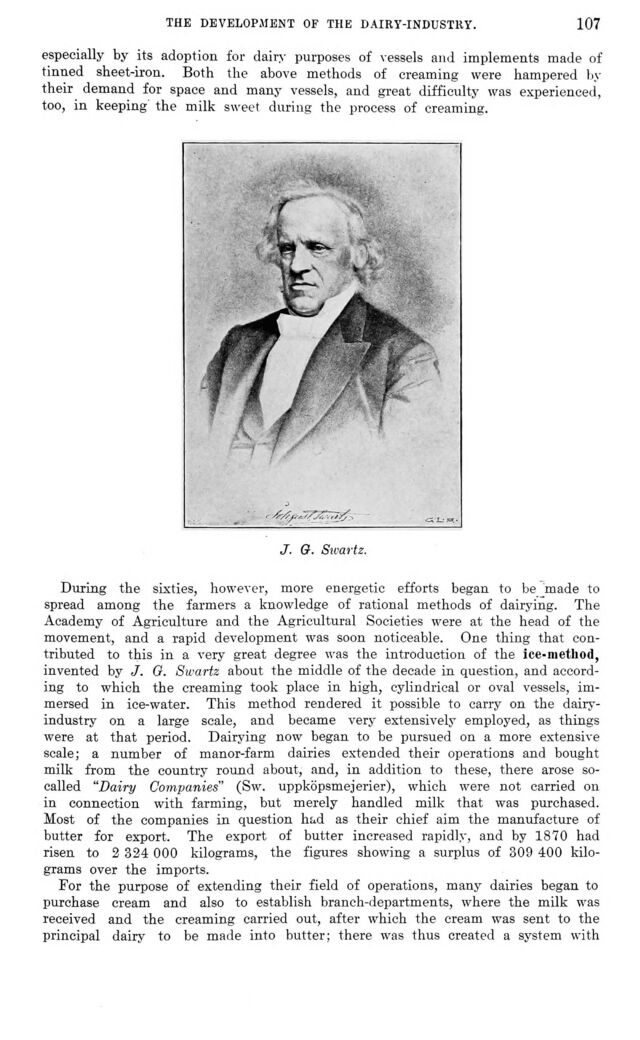
J. ff. Swartz.
During the sixties, however, more energetic efforts began to be made to
spread among the farmers a knowledge of rational methods of dairying. The
Academy of Agriculture and the Agricultural Societies were at the head of the
movement, and a rapid development was soon noticeable. One thing that
contributed to this in a very great degree was the introduction of the ice-method,
invented by J. O. Swartz about the middle of the decade in question, and
according to which the creaming took place in high, cylindrical or oval vessels,
immersed in ice-water. This method rendered it possible to carry on the
dairy-industry on a large scale, and became very extensively employed, as things
were at that period. Dairying now began to be pursued on a more extensive
scale; a number of manor-farm dairies extended their operations and bought
milk from the country round about, and, in addition to these, there arose
so-called "Dairy Companies" (Sw. uppköpsmejerier), which were not carried on
in connection with farming, but merely handled milk that was purchased.
Most of the companies in question had as their chief aim the manufacture of
butter for export. The export of butter increased rapidly, and by 1870 had
risen to 2 324 000 kilograms, the figures showing a surplus of 309 400
kilograms over the imports.
For the purpose of extending their field of operations, many dairies began to
purchase cream and also to establish branch-departments, where the milk was
received and the creaming carried out, after which the cream was sent to the
principal dairy to be made into butter; there was thus created a system with
<< prev. page << föreg. sida << >> nästa sida >> next page >>


