
Full resolution (JPEG) - On this page / på denna sida - VII. Manufacturing Industries. Introd. by [G. Sundbärg] K. Åmark - 10. Metal and Machine Industry. By Alf. Larson
<< prev. page << föreg. sida << >> nästa sida >> next page >>
Below is the raw OCR text
from the above scanned image.
Do you see an error? Proofread the page now!
Här nedan syns maskintolkade texten från faksimilbilden ovan.
Ser du något fel? Korrekturläs sidan nu!
This page has never been proofread. / Denna sida har aldrig korrekturlästs.
452
vii. manufacturing industries.
founded in 1898, and the share capital is now 2 million kronor. The number
of employees is about 500. The company manufactures exclusively Diesel motors
up to the largest sizes, for use as stationery engines and for propelling vessels.
The Swedish Diesel motor is protected by international patents and has won a
world-wide reputation. Of the output, about 4 million kronor, i. e. approximately
two-thirds, is exported. The firm executes large orders, particularly for ship
motors, which are built under the patents of the company’s head engineer, K. J. E.
Hesselman. The Swedish Marine Polar Motor was the first directly reversible
Diesel motor to be constructed and has been fitted in a great number of ships
— a greater number, indeed, than any other firm in the world has fitted.
Patent-rights for America have been transferred to Mc Imposh & Seymour,
Auburn, N. Y.
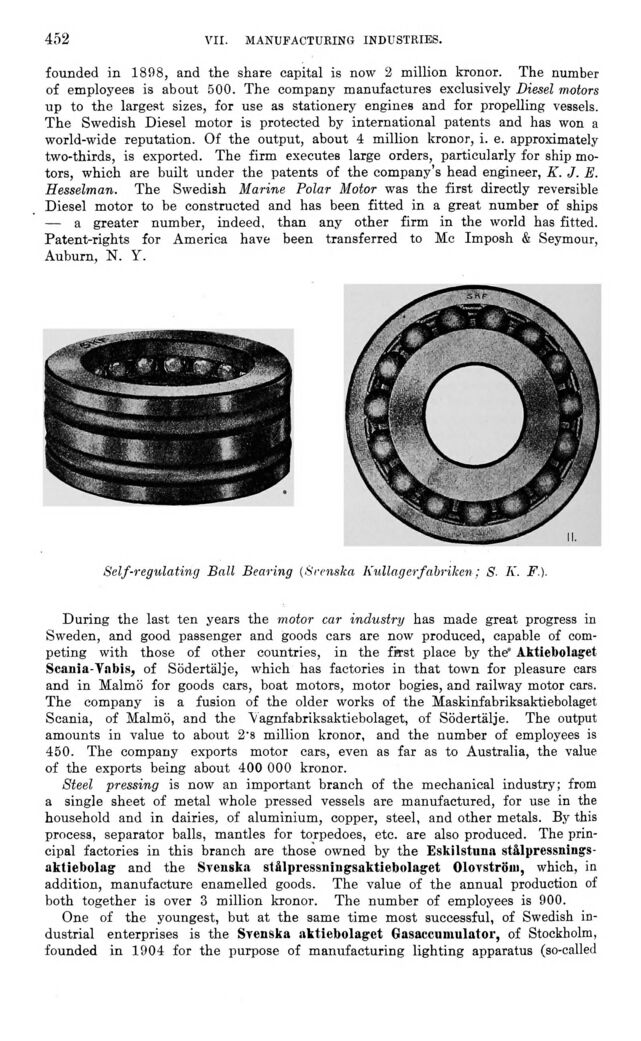
Self-regulating Ball Bearing (Srenska Kullager fabriken; S. K. F.).
During the last ten years the motor car industry has made great progress in
Sweden, and good passenger and goods cars are now produced, capable of
competing with those of other countries, in the first place by the* Aktiebolaget
Scania-Ynbis, of Södertälje, which has factories in that town for pleasure cars
and in Malmö for goods cars, boat motors, motor bogies, and railway motor cars.
The company is a fusion of the older works of the Maskinfabriksaktiebolaget
Scania, of Malmö, and the Vagnfabriksaktiebolaget, of Södertälje. The output
amounts in value to about 2’8 million kronor, and the number of employees is
450. The company exports motor cars, even as far as to Australia, the value
of the exports being about 400 000 kronor.
Steel pressing is now an important branch of the mechanical industry; from
a single sheet of metal whole pressed vessels are manufactured, for use in the
household and in dairies, of aluminium, copper, steel, and other metals. By this
process, separator balls, mantles for torpedoes, etc. are also produced. The
principal factories in this branch are those owned by the Eskilstuna
stålpressnings-aktiebolag and the Svenska stålpressningsaktiebolaget Olovströin, which, in
addition, manufacture enamelled goods. The value of the annual production of
both together is over 3 million kronor. The number of employees is 900.
One of the youngest, but at the same time most successful, of Swedish
industrial enterprises is the Svenska aktiebolaget Gasaccumulator, of Stockholm,
founded in 1904 for the purpose of manufacturing lighting apparatus (so-called
<< prev. page << föreg. sida << >> nästa sida >> next page >>


