Full resolution (JPEG) - On this page / på denna sida - VII. Manufacturing Industries. Introd. by [G. Sundbärg] K. Åmark - 12. Handicrafts and Domestic Industries. [By A. Raphael] - Handicrafts. By C. J. F. Ljunggren

<< prev. page << föreg. sida << >> nästa sida >> next page >>
Below is the raw OCR text
from the above scanned image.
Do you see an error? Proofread the page now!
Här nedan syns maskintolkade texten från faksimilbilden ovan.
Ser du något fel? Korrekturläs sidan nu!
This page has never been proofread. / Denna sida har aldrig korrekturlästs.
488
vii. manufacturing industries.
the only claim laid on those that wished to follow a trade or craft was
that they should be of good character, and that they themselves and
their property should not be under the control of any other person.
The second was the regulations in §§ 13 and 14, where, in contrast
with the requirements of the enactment of 1846 regarding those that
established factories or followed a craft, it was left to the workers
themselves to decide whether they should form unions or not.
The third objection was directed against the absence in the act of
regulations enabling the followers of a trade to train workmen to become
skilful artisans.
Ever since the beginning of the decade 1870—80, i. e., only a few
years after the grant of the formerly so much longed for freedom
of trade, the above-mentioned defects in the law have made themselves
felt with undiminished force, and this is the more remarkable as the
alterations made in the above-mentioned details may be considered as
the chief points in the act of 1846. As a matter of fact, they may
be regard as relics of the guild-system, whose constitution, among
other things, was distinguished by regulations concerning a) the
ability necessary for being allowed to follow a trade, b) the formation
of unions or associations, and, c) the training of apprentices and
journeymen. At the present time, there seems to exist a general desire to renew
in some modern form, among other things, the regulations determining the
skill that an artisan should possess before being allowed to carry on his
trade, just as in Germany, where such a rule has already been
established (Befähigungsnachweis). Of låte years, as a matter of fact,
propositions have been made to this end.
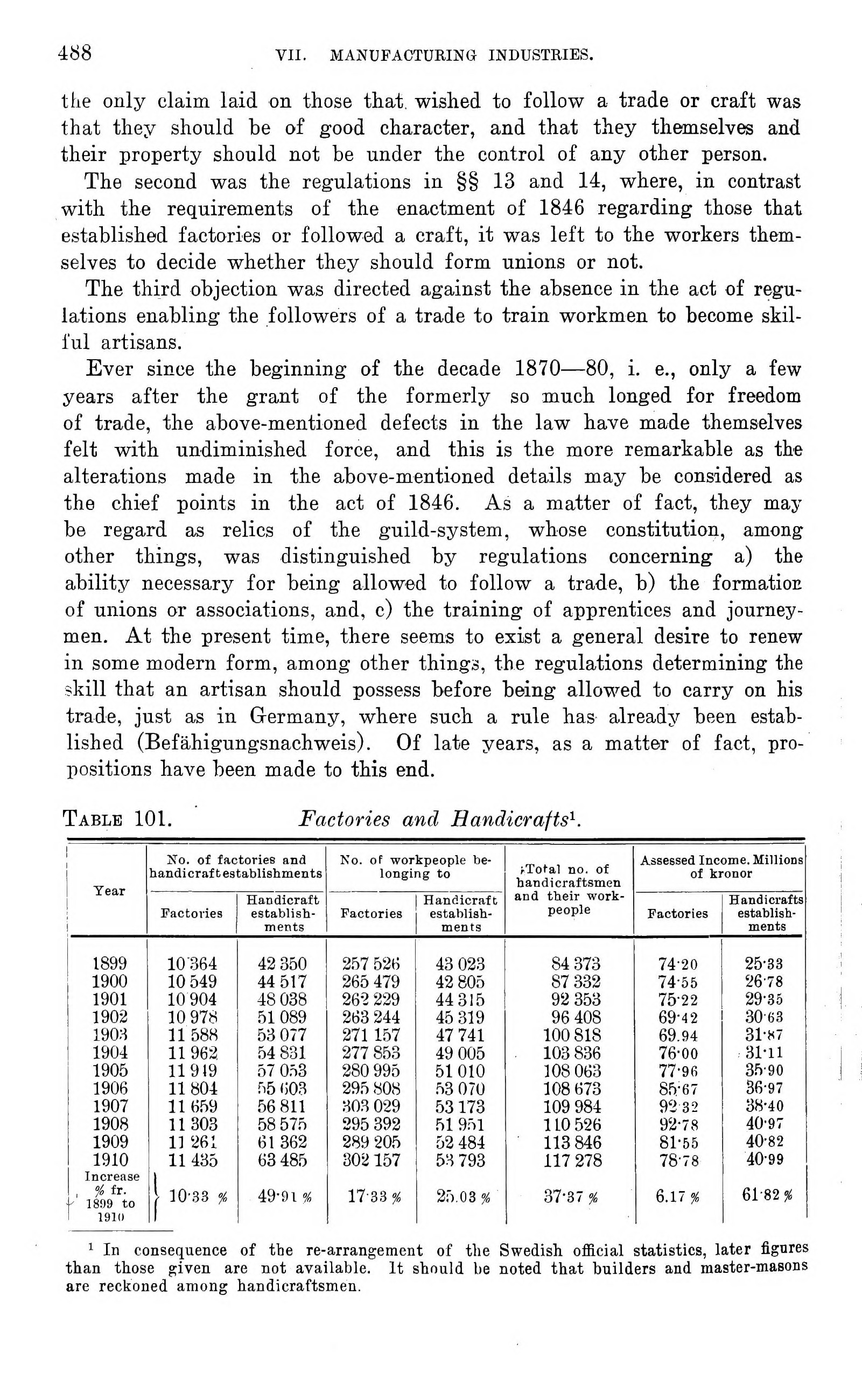
Table 101. Factories and Handicrafts1.
Year No. of factories and handicraft establishments No. of workpeople
belonging to fTotal no. of handicraftsmen and their
workpeople Assessed Income. Millions of kronor
Factories Handicraft
establishments Factories Handicraft
establishments Factories Handicrafts
establishments
1899 10’364 42 350 257 526 43 023 84 373 74-20 25-33
1900 10 549 44 517 265 479 42 805 87 332 74 55 26-78
1901 10 904 48 038 262 229 44 315 92 353 75-22 29-35
190-2 10 978 51089 263 244 45 319 96 408 69-4 2 30-63
1903 11 588 53 077 271 157 47 741 100 818 69.94 31-87
1904 11 963 54 831 277 853 49 005 103 836 76-00 31-11
1905 11919 57 053 280 995 51010 108 063 77-90 35-90
1906 11804 55 603 295 808 53 070 108 673 85-67 36-97
1907 11 659 56 811 303 029 53173 109 984 92 32 38-40
1908 11 303 58 575 295 392 51 951 110 526 92-78 40-97
1909 11 261 61 362 289 205 52 484 113 846 81-55 40-82
1910 11 435 63 485 302157 53 793 117 278 78-78 40-99
Increase I
, % fr. - 1899 to > 10-33 % 49-91 % 17 33 % 25.03 % 37-37 % 6.17 % 61 82 %
1910 1
1 In consequence of the re-arrangement of the Swedish official statistics, later figures
than those given are not available. It should be noted that builders and master-masons
are reckoned among handicraftsmen.
<< prev. page << föreg. sida << >> nästa sida >> next page >>