Full resolution (JPEG) - On this page / på denna sida - IX. Shipping and Navigation. By H. Rosman - Maritime Legislation. By E. Modig - Shipping Dues. By E. Modig
<< prev. page << föreg. sida << >> nästa sida >> next page >>
Below is the raw OCR text
from the above scanned image.
Do you see an error? Proofread the page now!
Här nedan syns maskintolkade texten från faksimilbilden ovan.
Ser du något fel? Korrekturläs sidan nu!
This page has never been proofread. / Denna sida har aldrig korrekturlästs.
■588
ix. shipping and navigation.
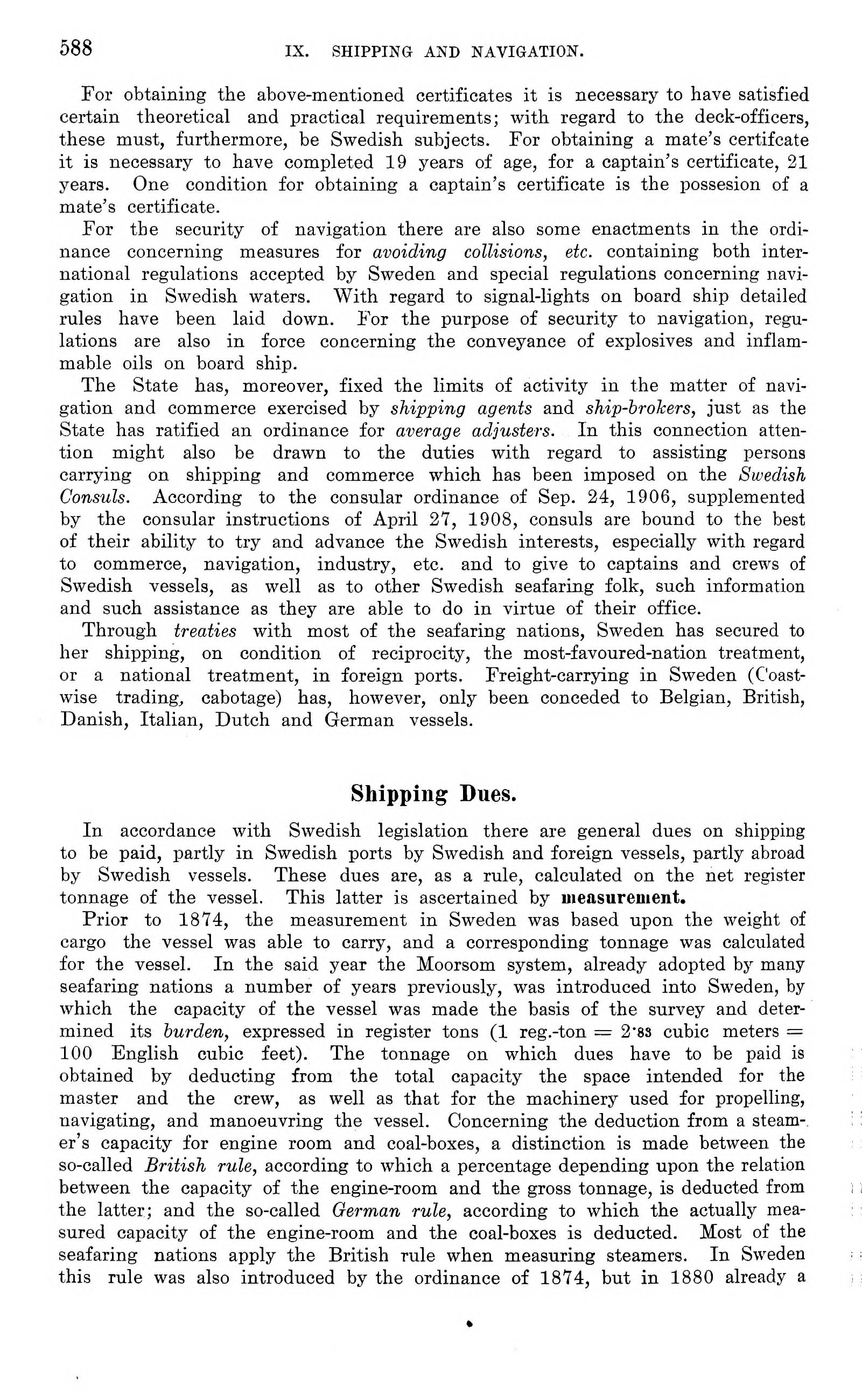
For obtaining the above-mentioned certificates it is necessary to have satisfied
certain theoretical and practical requirements; with regard to the deck-officers,
these must, furthermore, be Swedish subjects. For obtaining a mate’s certifcate
it is necessary to have completed 19 years of age, for a captain’s certificate, 21
years. One condition for obtaining a captain’s certificate is the possesion of a
mate’s certificate.
For the security of navigation there are also some enactments in the
ordinance concerning measures for avoiding collisions, etc. containing both
international regulations accepted by Sweden and special regulations concerning
navigation in Swedish waters. With regard to signal-lights on board ship detailed
rules have been laid down. For the purpose of security to navigation,
regulations are also in force concerning the conveyance of explosives and
inflammable oils on board ship.
The State has, moreover, fixed the limits of activity in the matter of
navigation and commerce exercised by shipping agents and ship-brokers, just as the
State has ratified an ordinance for average adjusters. In this connection
attention might also be drawn to the duties with regard to assisting persons
carrying on shipping and commerce which has been imposed on the Swedish
Consuls. According to the consular ordinance of Sep. 24, 1906, supplemented
by the consular instructions of April 27, 1908, consuls are bound to the best
of their ability to try and advance the Swedish interests, especially with regard
to commerce, navigation, industry, etc. and to give to captains and crews of
Swedish vessels, as well as to other Swedish seafaring folk, such information
and such assistance as they are able to do in virtue of their office.
Through treaties with most of the seafaring nations, Sweden has secured to
her shipping, on condition of reciprocity, the most-favoured-nation treatment,
or a national treatment, in foreign ports. Freight-carrying in Sweden
(Coastwise trading, cabotage) has, however, only been conceded to Belgian, British,
Danish, Italian, Dutch and German vessels.
Shipping Dues.
In accordance with Swedish legislation there are general dues on shipping
to be paid, partly in Swedish ports by Swedish and foreign vessels, partly abroad
by Swedish vessels. These dues are, as a rule, calculated on the net register
tonnage of the vessel. This latter is ascertained by measurement.
Prior to 1874, the measurement in Sweden was based upon the weight of
cargo the vessel was able to carry, and a corresponding tonnage was calculated
for the vessel. In the said year the Moorsom system, already adopted by many
seafaring nations a number of years previously, was introduced into Sweden, by
which the capacity of the vessel was made the basis of the survey and
determined its burden, expressed in register tons (1 reg.-ton = 2’83 cubic meters =
100 English cubic feet). The tonnage on which dues have to be paid is
obtained by deducting from the total capacity the space intended for the
master and the crew, as well as that for the machinery used for propelling,
navigating, and manoeuvring the vessel. Concerning the deduction from a
steamer’s capacity for engine room and coal-boxes, a distinction is made between the
so-called British rule, according to which a percentage depending upon the relation
between the capacity of the engine-room and the gross tonnage, is deducted from
the latter; and the so-called German rule, according to which the actually
measured capacity of the engine-room and the coal-boxes is deducted. Most of the
seafaring nations apply the British rule when measuring steamers. In Sweden
this rule was also introduced by the ordinance of 1874, but in 1880 already a
<< prev. page << föreg. sida << >> nästa sida >> next page >>