Full resolution (JPEG) - On this page / på denna sida - Sidor ...

<< prev. page << föreg. sida << >> nästa sida >> next page >>
Below is the raw OCR text
from the above scanned image.
Do you see an error? Proofread the page now!
Här nedan syns maskintolkade texten från faksimilbilden ovan.
Ser du något fel? Korrekturläs sidan nu!
This page has never been proofread. / Denna sida har aldrig korrekturlästs.
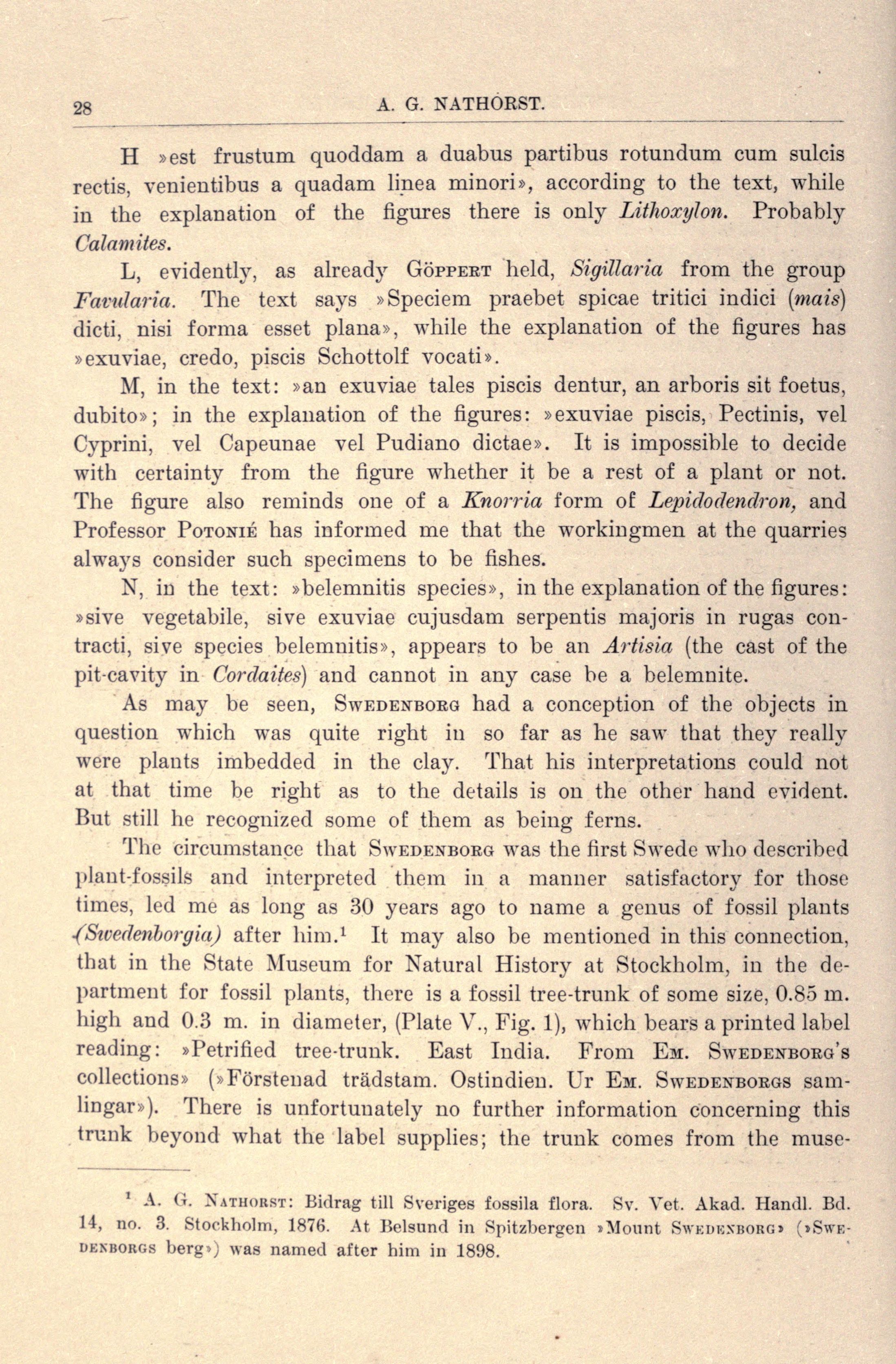
H »est frustum quoddam a duabus partibus rotundum cum sulcis
rectis, venientibus a quadam linea minori», aecording to the text, while
iu the explanation of the figures there is only Lithoxylon. Probably
Calamites.
L, evidently, as already Göppert held, Sigillaria from the group
Favularia. The text says »Speciem praebet spicae tritici indici (mais)
dicti, nisi forma esset plana», while the explanation of the figures has
»exuviae, credo, piscis Schottolf vocati».
M, in the text: »an exuviae tales piscis dentur, an arboris sit foetus,
dubito»; in the explanation of the figures: »exuviae piscis, Pectinis, vel
Cyprini, vel Capeunae vel Pudiano dictae». It is impossible to decide
with certainty from the figure whether it be a rest of a plant or not.
The figure also reminds one of a Knorria form of Lepidodendron, and
Professor Potonié has informed me that the wrorkingmen at the quarries
always consider such specimens to be fishes.
N, in the text: »belemnitis species», in the explanation of the figures:
»sive vegetabile, sive exuviae cujusdam serpentis majoris in rugas
con-tracti, sive species belemnitis», appears to be an Artisia (the cast of the
pit-cavity in Cordaites) and cannot in any case be a belemnite.
As may be seen, Swedexborg had a conception of the objects in
question which was quite right in so far as he saw that they really
were plants imbedded in the clay. That his interpretations could not
at that time be right as to the details is on the other hånd evident.
But still he recognized some of them as being ferns.
The circumstance that Swedexborg was the first Swede who described
plant-fossils and interpreted them in a manner satisfactory for those
times, led me as long as 30 years ago to name a genus of fossil plants
■(Sivederiborgia) after him.1 It may also be mentioned in this connection,
that in the State Museum for Natural History at Stockholm, in the
de-partment for fossil plants, there is a fossil tree-trunk of some size, 0.85 m.
high and 0.3 m. in diameter, (Plate V., Fig. 1), which bears a printed label
reading: »Petrified tree-trunk. East India. From Em. Swedexborg’s
collections» (»Förstenad trädstam. Ostindien. Ur Em. Swedexborgs
samlingar»). There is unfortunately no further information concerning this
trunk beyond what the label supplies; the trunk comes from the muse-
1 A. G. Nathorst: Bidrag till Sveriges fossila flora. Sv. Vet. Akad. Handl. Bd.
14, no. 3. Stockholm, 1876. At Belsund in Spitzbergen »Mount Swkijkxborg>
(»Swe-denborgs berg») was named after him in 1898.
<< prev. page << föreg. sida << >> nästa sida >> next page >>