Full resolution (JPEG) - On this page / på denna sida - Sidor ...

<< prev. page << föreg. sida << >> nästa sida >> next page >>
Below is the raw OCR text
from the above scanned image.
Do you see an error? Proofread the page now!
Här nedan syns maskintolkade texten från faksimilbilden ovan.
Ser du något fel? Korrekturläs sidan nu!
This page has never been proofread. / Denna sida har aldrig korrekturlästs.
20 W. E. Lidforss.
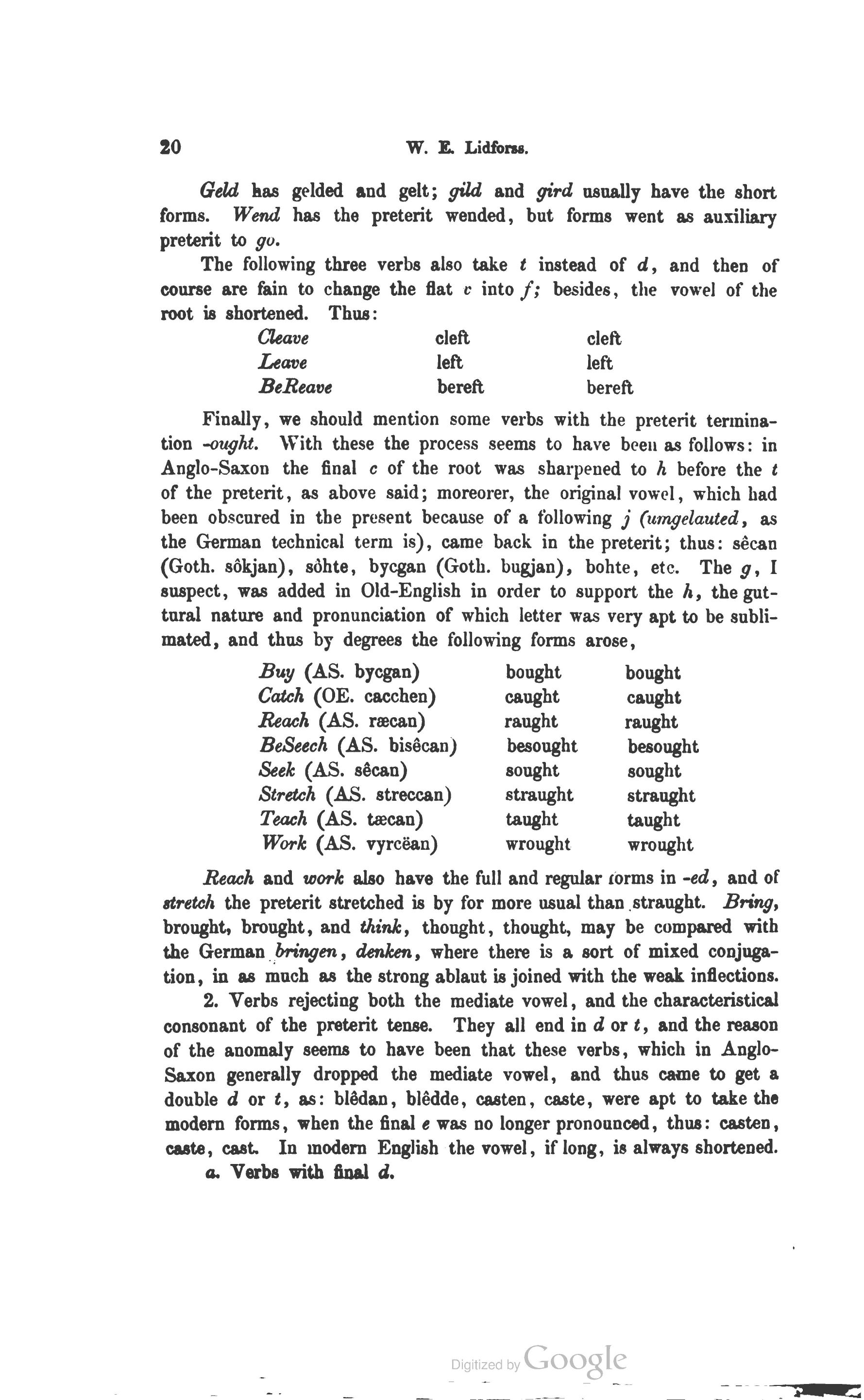
Geld has gelded and gelt; gild and gird usually have the short
forms. Wend has the preterit wended, but forms went as auxiliary
preterit to go.
The following three verbs also take t instead of d, and then of
course are fain to change the flat v into f; besides, the vowel of the
root is shortened. Thus:
Cleave cleft eleft
Leave left left
BeReave bereft bereft
Finally, we should mention some verbs with the preterit termina-
tion -ought. With these the process seems to have been as follows: in
Anglo-Saxon the final c of the root was sharpened to & before the t
of the preterit, as above said; moreorer, the original vowel, which had
been obscured in the present because of a following j (umgelauted, as
the German technical term is), came back in the preterit; thus: sécan
(Goth. sökjan), såhte, bycgan (Goth. bugjan), bohte, etc. The g, I
suspect, was added in Old-English in order to support the A, the gut-
tural nature and pronunciation of which letter was very apt to be subli-
mated, and thus by degrees the following forms arose,
Buy (AS. bycgan) bought bought
Catch (OE. cacchen) caught caught
Reach (AS. recan) raught raught
BeSeech (AS. bisécan) besought besought
Seek (AS. såécan) sought sought
Stretch (AS. streccan) straught straught
Teach (AS. tecan) taught taught
Work (AS. vyrcöan) wrought wrought
Reach and work also have the full and regular corms in -ed, and of
stretch the preterit stretched is by for more usual than straught. Bring,
brought, brought, and think, thought, thought, may be compared with
the German bringen , denken, where there is a sort of mixed conjuga-
tion, in as much as the strong ablaut is joined with the weak inflections.
2. Verbs rejecting both the mediate vowel, and the characteristical
consonant of the preterit tense. They all end in d ort, and the reason
of the anomaly seems to have been that these verbs, which in Anglo-
Saxon generally dropped the mediate vowel, and thus came to get a
double d or t, as: blådan, blåédde, casten, caste, were apt to take the
modern forms, when the final e was no longer pronounced, thus: casten,
caste, cast. In modern English the vowel, if long, is always shortened.
a. Verbs with final d.
<< prev. page << föreg. sida << >> nästa sida >> next page >>